
Why Your Biggest Asset (Inventory) Is Also Your Biggest Risk | Bellamy Grindl | Retailytics | Profits on Purpose
Jan 07, 2026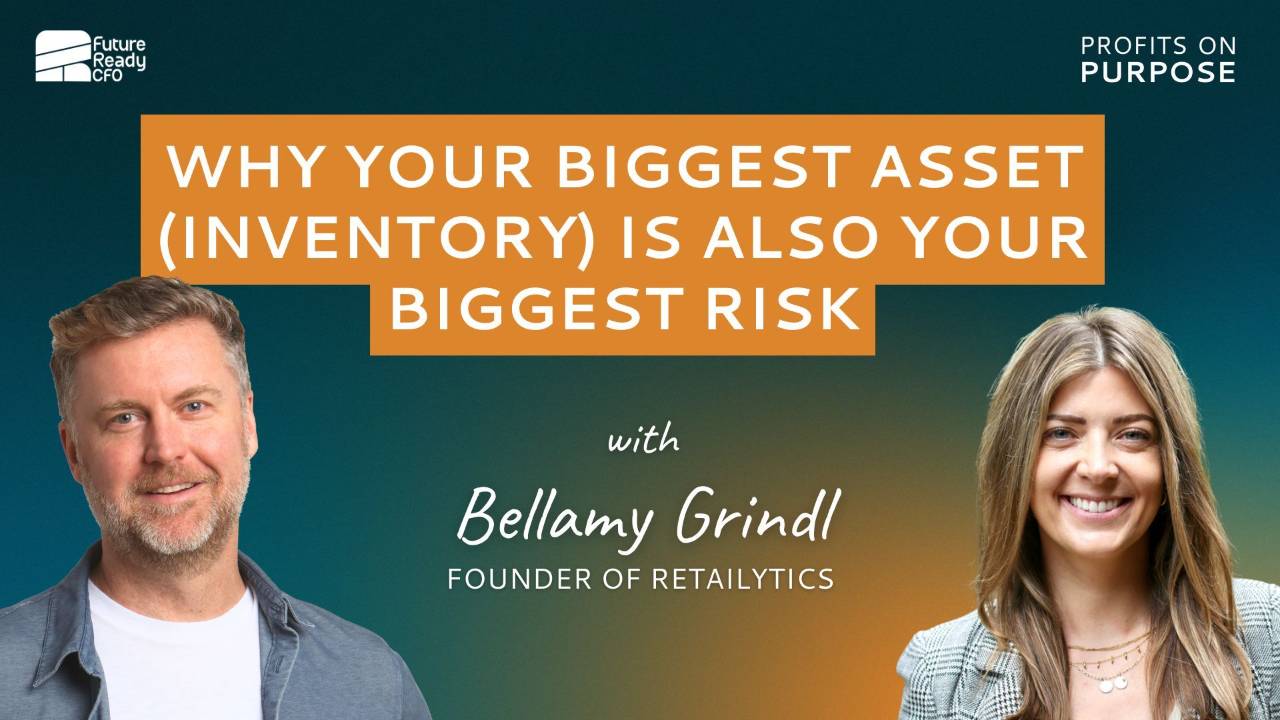
Episode Description
In this episode of Profits On Purpose, host Nate Littlewood speaks with Bellamy Grindl, founder of Retailytics, about the intricacies of inventory management and supply chain operations for e-commerce and CPG founders. They discuss the evolution of operations as businesses grow, common inventory challenges, the importance of breaking down silos between departments, and strategies for effective planning and communication. Bellamy shares insights on navigating post-holiday sales recovery, the impact of COVID on supply chain strategies, and the significance of financial literacy and technology in managing inventory effectively. The conversation concludes with key performance indicators and resources for further learning.
Key Takeaways
- Founders often struggle with inventory management as they scale.
- Understanding the root causes of inventory issues is crucial.
- Effective communication between finance, marketing, and operations is essential.
- Seasonality impacts inventory management decisions significantly.
- COVID has changed the way companies approach supply chain and inventory.
- Regular hindsight reviews can help identify areas for improvement.
- Pricing strategies should align with market conditions and product value.
- Technology should enhance visibility, not replace decision-making processes.
- Financial literacy is vital for all team members in a growing business.
- Building a cohesive operations team is key to managing complexity.
See More from Bellamy and Retailytics
Listen to the full episode to discover how Bellamy's experiences can inspire and guide you on your entrepreneurial journey. Don't forget to subscribe for more insightful conversations!
I hope you enjoy this episode!
Give it a like, share, and subscribe to not miss the content coming your way weekly.
– Nate and the Profits on Purpose podcast team




Transcript
-----
00:06 Introduction to Profits on Purpose
01:28 Bellamy Grindl's Background and Expertise
03:17 The Evolution of Operations in Growing Businesses
05:41 Addressing Inventory Challenges
09:03 Understanding Product Viability
10:27 Breaking Down Silos in Business Functions
14:12 Managing Seasonality and Minimums
16:49 Impact of COVID on Supply Chain Management
18:43 Strategies for Post-Holiday Sales Challenges
20:54 Analyzing Performance through Hindsight
22:40 Pricing Strategies and Profitability
24:18 Choosing the Right Technology Solutions
27:15 Common Mistakes in Technology Adoption
28:39 Identifying When to Seek Help
30:27 Building an Operations Team
32:50 Navigating Tariff Challenges
34:08 Key Performance Indicators for Success
-----
Nate Littlewood (00:06)
Welcome to Profits on Purpose, which is a podcast for e-comm and CPG founders who are looking to scale their businesses, both profitably and purposefully. I'm your host, Nate Littlewood from Future Ready CFO, which is the go-to fractional CFO solution for seven-figure founders who are looking to turn financial chaos and confusion into business clarity and confidence.
Anyway, today's guest is Bellamy Grindl, who's the founder of Retailytics and a top retail expert who spent more than 15 years mastering the art and science of inventory planning across Fortune 500 companies like Walmart and high growth startups like Gilt and Boxed.com. Bellamy has seen what works and what breaks.
when brands scale from scrappy to sophisticated. Today, she helps EECOM and CPG founders navigate the tension that exists between cashflow and growth by building integrated planning systems that connect the finance, marketing, and operations functions within your business. So if you have ever felt like inventory is either your biggest opportunity or perhaps your biggest nightmare, then this is the conversation for you.
Bellamy, welcome to the show. It's so great to have you here.
Bellamy Grindl (01:32)
Thank you so much for having me. I'm excited to chat today.
Nate Littlewood (01:36)
Likewise. Well, listen, I, I'd like to, I guess, get a bit of a sense for your background. Initially here, you've had a really impressive career journey going from, you know, huge, huge retailers like Walmart and box.com and obviously more recently launching your own fractional practice. Can you tell me how and when you kind of realized that founders needed more help than what they currently have in terms of inventory and supply chain plan?
Bellamy Grindl (02:06)
Definitely. So early in my career, I had the opportunity to work for guilt.com. Back in the day, that was a really fast growth startup and I had the opportunity to work for them from what I say startup to acquisition and then also to fire sales. So I really saw the evolution of the business and how the planning systems evolved to either meet those needs as the business changed or not. I think that really shaped who I was.
And after working for them, I did go to larger companies like Gap and Walmart, but I really liked the hustle of the smaller company. So I worked for a host of startups after that and realized I was doing the exact same thing for every company. How are you going from zero to one? Who are you hiring after marketing and finance? You're usually looking at someone in operations, data science, buying, planning, but for smaller companies, they don't didn't really know how to
write that strategy and how to bring people on to help them grow the business strategically. So after I did that for about three or four startups, realized that I could go out on my own and that's my specialty now.
Nate Littlewood (03:17)
Very cool. Very cool. So it sounds like there's a fairly common, you know, evolution of these businesses, as you just described, going through a marketing hire and then an operations type hire. could we maybe take that a couple of steps further? Right? I'd love to understand from your perspective, how you see the operations function kind of evolving as you go from say, you know, a sub million dollar a year business to, know,
ten million dollars and beyond.
Bellamy Grindl (03:49)
Right, so within larger companies, when I worked at Gap and Walmart, their entire team's dedicated to this called integrated business planning. So you're looking at really bridging inventory planning, marketing and finance to make sure you're investing in the right things. And then you're also marketing the things that you have. So within smaller companies, usually this is one person and then how are they growing the team beyond that? A lot of the companies I work with are founder led and they just
they don't know what they don't know. So being able to show them the path in which they need to take to grow these teams and it may be different, a slightly different path depending on what the business product is, what the nature of the business looks like. It's not always necessarily a copy and paste. It really depends on a lot of factors on what they want to focus on first.
Nate Littlewood (04:41)
Okay. Gotcha. So one of the most common problems that I encounter as a fractional CFO, obviously being a little bit more finance and numbers focused is, I would say 90 something percent of the time when I look into a new company's financials and they're, you know, a small team or maybe a solo founder, I can always guarantee that they're going to have a problem with too much inventory.
and incredibly high levels of stock coverage. And we can maybe talk a bit later about, you know, how and why that comes about. But for a founder who has found themselves in that situation, and they're now struggling with a lack of cashflow and, you know, drowning in this mountain of different skews and product. Can you help me understand like what are some of the
tangible ways that someone like you actually works with and supports these people and helps get them out of situations like that.
Bellamy Grindl (05:41)
So I'd say the first thing is definitely looking at what you own. It always surprises me how no matter the size of the company, there's so much focus on the new what's coming in. And this is especially true of fashion. They don't actually know what they already have. Comes down to a lack of attribution, a lack of data, a lack of visibility. But they're always focusing on marketing the new, pushing the new, pricing the new, that everything else sort of falls through the cracks.
So the most immediate, I guess the easiest impact is look at what you already have. How can you leverage that and move it and work with other teams? So especially I like to work really closely with marketing because let's say you have a hero product, but 80 % of your inventory is in your third tier product. How can you actually work with marketing to create a message that leverages that project product and changes the shopping behavior? Because if you
I mean, I always tell people inventory is just cash sitting in your warehouse. So if you're going to, if your cash conversion cycle is really slow, you're not going to be able to buy new inventory. it just, you have to fix the upstream effects in order to move more efficiently.
Nate Littlewood (06:56)
So in your experience, what are some of the most common underlying reasons that founders kind of get themselves into that situation? I mean, you just mentioned a couple of things, which is about, you know, a tendency to focus on the new. but is, is there more to that? And is there, is there commonly a tools or systems problem that's responsible for this as well?
Bellamy Grindl (07:25)
So I always say that too much inventory is a symptom. You need to fix the root cause, which is the actual planning process. But I do see, especially with growing companies, that it does come down to minimums. you're working with a vendor and they require you that you have 500 unit minimum, that adds up if you're launching, let's say, 100 new styles per quarter. So.
No one's really doing the math to say, okay, if you're actually only moving 10 units a week, how many weeks of coverage does that actually translate to? So I always tell people that you really need to think of your inventory as an investment portfolio. You need to make sure you're investing in everything that you love. Because I've definitely worked for a of fashion companies where they'll launch a product just because they want new product to talk about.
But no, 1 really loves it and then you'll do a post mortem or a hindsight and say, why did we launch that? We weren't 100 % behind it. So there's a lot of things that you can build into the process and checks and balances to make sure that. You're launching products that the company believes in and wants to invest really invest in. So I think the easiest way to look at it is consider it your portfolio. And where you're investing your dollars.
Nate Littlewood (08:41)
That's a really interesting perspective and a way to think about that. What are some of the practical ways that a founder or a startup business could actually determine and prove to themselves that this is legitimately a product that they love and that they're excited to be pushing?
Bellamy Grindl (09:03)
So sometimes I think the easiest way to look at newness is, you know, use hindsight and looking at historicals. So anytime you've done any sort of quarter or annual hindsight, you can see, you can look at your sales to stock ratio to see how things are out of whack, where your sales and your inventory percentages aligned. And if not, what can you do to fix it? And then also look at, so I'm speaking a lot to fashion because that's where I have the most experience, but
If you are looking at a CPG brand, for example, and you have a hero product that does 90 % of your sales, well, that should also align with how much marketing you're doing for that specific segment as well. So I like to look at it as a percentage based across all of those. So inventory, sales, marketing, and those percentages should be roughly aligned with how you're investing in each of those.
Nate Littlewood (09:58)
Okay. Interesting. Interesting. So one of the things that you talk a bit about is the breaking down of silos between finance, marketing and operations. Can you tell me, know, what that, how that kind of comes to life? Like, what does that look like in practice when you walk into or you find a situation where people are in these separate silos?
Bellamy Grindl (10:27)
Usually where I like to start is just making sure that everyone is speaking the same language that comes down to defining KPIs both mathematically and with the same verbiage because sometimes when marketing team when the marketing team says sales and maybe a planning team says sales, they may be speaking gross versus net. And even if you're talking to finance and they're saying that their net may be different than the merchandising net. So.
Think first and foremost level the playing field where everyone is literally speaking the same language. All of the numbers match. So therefore you can align and then implementing a cadence of. Looking at your historicals and also creating a path forward and being able to move levers and usually what that looks like is in larger companies. We did this. We basically had a weekly sales are you on Monday? How do we do the past week?
How did we look at compared to plan? What are the steps that we can take this week to action on if we're either behind plan or ahead of plan and how we switch it up? I'd say a lot of smaller companies are really hesitant to set a plan because it's always gonna change. And I always tell people in my coaching that the plan is always gonna change. It is really just your best educated guess at a certain point in time and what you're doing.
And I keep coming back to this portfolio management. How are you making yourself whole again based on what is changing? So speak the same language, have open lines of communication. And then one of the things I see is. Not checking in with other teams, so if you're speaking the same language, also having the same data and reports because you're ultimately all trying to achieve the same goals, just.
Different ways so larger organizations usually finance will have a tops down plan marketing will also have a marketing version of bottoms up and then buying and planning will come with the bottoms up. And those numbers more or less need to triangulate to the same place and if they're not then you need to see where where you can pull levers in the business to get there or at least negotiate between teams on on what you can change.
Nate Littlewood (12:49)
Okay. Interesting. So you mentioned a few things there, which was the, Monday sales meeting. You mentioned making sure that everyone is talking the same language in terms of definitions and terminology. And you also touched on the kind of finance top down and marketing and operation bottom up approach to forecasting. there are any other elements or.
aspects of what you would consider a cohesive and well-oiled machine when it comes to the collaboration of these three different departments and making decisions about supply chain planning.
Bellamy Grindl (13:28)
I'd also say just financial literacy, especially with smaller companies. Some teams don't understand the numbers or they don't understand the definitions of the numbers, but that's really a non-negotiable for me. When you're setting goals and especially financial goals, you can't move towards them if you don't know what they are and define them.
Understanding where the company is today, setting those benchmarks. So everyone understands, okay, this is what we do in an average week. This is the number of units we sell. This is our AUR. This is our average cost. Really setting that. So, and it's published, so everyone understands what those are. So then when you're performing above or below those expectations, it's very clear.
Nate Littlewood (14:12)
Okay. Okay. You mentioned the topic of minimums earlier and throughout an example of 500 units, which I get is a reorder point, if you will. Could you talk a little bit about how you recommend people handle situations where there's huge amounts of seasonality? So, you know, there could be times a year where 500 units represent several months, but
Maybe other times a year, 500 units only represents a week. So how do you make repurchase decisions and what are some of the mathematical approaches to doing that for businesses that have very high volatility or seasonality?
Bellamy Grindl (14:59)
So one thing I recommend is a lot of brands think that they don't have any negotiating powder. But if you're working with your vendor or suppliers, they want to grow with you. And so just making sure that that was also an open line of communication. If you know, if you have a key item that you're going to do 20,000 units in in the whole year, you know that. If you tell your vendor partner that, and then that way they can prepare on their side for it, they will be much more flexible.
in terms of holding receipts, pushing receipts, breaking receipts up. If you have a 500 unit minimum, they may let you pull only a hundred units now and ship the rest later. That if you're creating this forecast upfront, I've seen vendor partners be much more, much more, they want to partner with you. Again, it's, you both have the same goal to grow together. So if you're sharing those forecasts, they can work with you.
more easily.
Nate Littlewood (15:57)
Interesting, interesting. That's a really good approach. I want to talk a little bit about COVID. I know it's a few years back now, but COVID was a pretty traumatic time for a lot of us who are responsible for or exposed to the ordering and handling and shipping of physical goods. And I'm sure you probably have a very long list of war stories to share, but
I'm curious what sorts of changes you might've seen in the industry as you, cause you've been at this a few years now, like what sort of changes have you seen in the kind of pre COVID and post COVID era when it comes to the approaches that brands are taking with respect to, you know, procurement, supply chain and holding inventory.
Bellamy Grindl (16:49)
I think overall companies are understanding that in order to improve P &L and bottom line, they understand that inventory is a much more important part of the piece than it used to be. Quite frankly, when I first started in my career, planning was almost a novel career. now that there's so much volatility,
And people understand that if you cut your weeks of supply by say, two, how much more that can save you if you don't have like inventory liability left over at the end of the season, what does that do? And so I think there's just a greater. Respect for the industry, but people are trying or understanding it more. mean, when I was going to retail conferences a couple of years ago, people never talked about inventory, but sort of ever since COVID people are like.
Inventory is the main thing you should focus on, especially if you want to improve profitability because it is, mean, aside from marketing and people, that's your third biggest line item on your P&L.
Nate Littlewood (17:52)
Yeah. Yeah. It's curious. I wonder whether there's a relationship there with access to capital and interest rates as well.
Bellamy Grindl (18:04)
I mean, it was a different time then when, and so there was the money and you didn't need to be as careful, but now that the money has scaled back, people are being really strategic about whether placing their dollars.
Nate Littlewood (18:19)
Yeah. Yeah. I hear you. hear you. So listen, this episode is I think going to be airing in January. hopefully that's, that's the case when we go to publish it live. So, you know, a lot of people listening to this will have recently finished the holiday period and, hopefully things worked out for them, but I'm guessing that there could be a few people listening right now.
who maybe didn't have the holiday that they expected in terms of sales. Maybe their Q4 numbers were perhaps a bit weaker than what they had budgeted or expected. I'd love to hear your thoughts on some of the more successful strategies that you've seen or any advice that you could offer for folks who may be finding themselves in that situation in January, 2026.
Bellamy Grindl (19:09)
So think first of all, have a hindsight either on the past quarter or the whole year to find those areas of opportunity or that you know you can improve upon in the next year and make sure it is published somewhere where other people can access it, especially if there is turnover. And then creating a plan. Like I alluded to earlier, a lot of smaller companies are hesitant to put numbers to a plan because it's always gonna change.
Setting those goals and creating those Weekly touch points where you're tracking to those goals. I really think is imperative And then lastly if you are having an inventory problem, don't wait till Q4 to address it I've seen so many people push off inventory or looking at returns Because those either of those things are a problem until they are a major problem. So making sure that that is sort of always in the back of your head.
Are returns creeping up? Is my inventory level creeping up? Because quite frankly, if you look at the off price market right now, it is so saturated. maybe you could have moved those goods three quarters ago, but now you can't. So again, that cash was just tied up and you can't use it.
Nate Littlewood (20:22)
Okay. Okay. Gotcha. You mentioned a couple of things that I just want to circle back to, to, the sake of clarification, you mentioned the off price market. assume that's like discounting liquidation platforms for selling. Okay. And you also mentioned a hindsight, which I gather is a meeting or review to basically, you know, break down the decision that you made and kind of analyze what happened. Is there a specific kind of format or template?
that those meetings should take.
Bellamy Grindl (20:54)
They can be really simple. sort of look at those as depending on the maturity of the business. So one of the things I mentioned earlier was just looking at your percent of sales to your percent of stock and maybe your percent of marketing efforts over a quarter or over a year to see if those percentages are aligned. That's sort of the most basic. You can get very complex with every KPI under the sun, but that's usually where I like to start.
Nate Littlewood (21:15)
Yeah.
Bellamy Grindl (21:23)
And then off price, just want to add another note on that is everyone thinks they can always sell it off price. If you're especially if you're in fashion and apparel and not CPG, you will get pennies on the dollar. So being able to offload something on your own website will almost always be more profitable, even if you're selling it at cost breaking even then trying to go to some of these jobbers or TJ Maxx, because usually if it's a dog.
Bad product, no one wants it. I mean, you can sometimes barely give it away.
Nate Littlewood (21:57)
Yeah. Interesting. You mentioned, you know, selling stuff at the loss and the possibility that folks may be forced to thinking like that. Just for the sake of clarity, could you talk a little bit about the difference between pricing and, should we say retailing and selling on a P&L perspective, i.e. with the goal of being profitable?
versus what it might look like for a business to be managing from the perspective of cashflow, which I presume could include selling at a P &L loss. Tell me a little bit about those two different environments, I guess.
Bellamy Grindl (22:40)
So pricing is a whole other ball game, but making sure that you are pricing your product so you can be profitable. I've seen a lot of companies who are scared to price above potentially where the market is, but if you can prove value and communicate that to the customer, there's definitely opportunity to be higher than the market, but then also markdown cadence. So if you're moving through products,
If you're not achieving the sell through you want, or if it's a seasonal good and you've already passed that season, how are you marking it down in a timely fashion? So you're moving through the products. And then also at the end of season, when I'm saying at a loss, I'm usually speaking to just the product cost. You can definitely look at it from a contribution margin, which will include all the logistics, how many times it's been handled, warehousing costs, which
Contribution margin is very hard to look at. I tell people that is an advanced metric of the business of when you're starting to optimize. But for most of the companies that I'm working with, that they're not quite there looking at the contribution margin yet.
Nate Littlewood (23:51)
Okay. Okay. Gotcha. I'd love to hear your perspective on kind of software and tools. mean, it's obviously possible to do a lot of this stuff in spreadsheets, Google Sheets, Excel, or whatever, but there are of course far more sophisticated platforms. People might have heard of ERP or enterprise resource planning tools, IMS or inventory management systems.
But there's a whole world of these products and they come with, as you would know better than me, very wide range of price tags as well. For a brand that's scaling, say, sub $1 million up to 10, are there any kind of common points in that journey where you would recommend certain types of tools or systems or softwares? And if so, what does that evolution look like?
Bellamy Grindl (24:45)
So usually the most basic, I'm recommending Airtable as an upgrade to Google Sheets to you can automate a lot of systems in there and just for data visibility. That way one person isn't a gatekeeper for it, especially for companies that aren't yet on a PIM, a product information management tool. Where are you housing all that information like product name, price, cost.
average cost and then anything from an attribution perspective on how you want to track it. So specifically for if it's at what type of category it's in, what type of tags are you want to use reporting against. I recommend that for Airtable. then also parabola is a really great data cleaning tool that I use a lot personally with clients. Okay. And then beyond that, there are tons of
inventory adjacent, pricing adjacent tools, but they're so vast in terms of what they focus on that I haven't really found one that I recommend across the board just because they vary so much in cost, what other systems they work well with. And usually it will come down to budget and playing nice with other systems, which there are, I mean, there's probably like 30 that I usually look at when I'm making a recommendation for a client.
Nate Littlewood (26:12)
Interesting. Interesting. That is a long list. I went through this process myself a couple of, well, actually a couple of, on a couple of different occasions. And I think we had maybe 12 or 15 in the mix. one thing that I really took away from that process was that there's really
No right answer to the question that I just asked you in that the right tool depends on your specific situation and what the rest of your ecosystem looks like and what features and functionalities important to you and your business. But I'm curious if there are any common mistakes that you see people making when they're going through the process of trying to figure out their technology solutions. I put another way.
Bellamy Grindl (27:00)
date.
Go ahead.
Nate Littlewood (27:02)
might just backtrack a little bit there.
In fact, no, that doesn't matter. Sorry, go on.
Bellamy Grindl (27:14)
I think the biggest mistake is thinking that technology is going to solve your problem. So for example, I'm working with a client right now. They know that spreadsheets are not working for us. The teams are doing the best we can in terms to provide the data that the teams need to make effective decisions. But the teams aren't making those decisions properly, and so even if we implement a system, we'll have better visibility.
But unless the team is actually taking that feedback and acting on it, technology is not going to fix it. It's just going to fix the visibility. But I do think visibility is a key one because especially with growing companies, no one person can be a gatekeeper to a function or a data, a dataset. That's where you get hiccups. If it's living on someone's computer in their Dropbox, in their personal file, you need to have visibility and speak the same language across all of your teams. And that's...
where I see technologies being the biggest help.
Nate Littlewood (28:15)
Hmm. Interesting. Interesting. So you mentioned earlier that one of the things you look for is symptoms, but what you're really trying to understand and get to is the underlying cure. I'm curious as a fractional specialist that works with a number of different brands, how is it that founders
tend to be looking for someone like you. Or put another way, like what are the most common problems that you see your clients or prospective clients encountering that kind of lead them to thinking, I need someone like Bellamy.
Bellamy Grindl (28:55)
Yes, so the most common symptom is too much inventory. And then I've also leaned a little bit more into the education component right now. Hiring junior talent that doesn't necessarily have the strategy or understand the framework to set the companies up for growth. So leaning a little bit more into that. But it almost comes down to a little bit of project management to have someone be able to zoom out, look at every function, make sure they're
operating in the process as efficiently as possible to move the strategy forward. And if they're not, how are you fixing those process communication and all of that upfront and streamlining it? So there's no duplicate, duplicate of effort and then making it as efficient as possible.
Nate Littlewood (29:43)
Got it. Got it. Do you ever say no to clients? know, do people come to you with these sorts of symptoms and you go, sorry, I can't help you. and if so, like, why, why is that?
Bellamy Grindl (29:58)
The most common reason I say no to a client is because they're not ready. Sometimes either the client isn't ready or the team isn't ready to be able to hand it off. So that's where I leaned a little bit more into the education to understand the process a little bit better and do a little bit more advising rather than doing the actual work. So sometimes it comes down to being ready, being able to delegate and then also just size.
business. So while people hire me most of the time when there's too much inventory, it's also a function of if something is happening in the business, like they are going into wholesale, they're going on Amazon, or that maybe they're opening their own retail stores, where the inventory just gets a little bit more complex and understanding that they need it can't be someone's part time job anymore. It needs to be someone's full time job to understand because
You're not even if you're marketing all day, you have inventory to be able to support the business.
Nate Littlewood (31:01)
Got it. Got it. And if we're at a point where we're growing our brand and we're looking to build out our operations team, could you tell me what a typical, I guess, operations and supply chain department kind of an org chart might look like, or, you know, put another way, what are the, the kind of job titles that you might have within this team? Um, as you go from say one person to maybe four or five.
Bellamy Grindl (31:28)
So, within a larger organization, I'd say there's definitely someone that focuses on operations and more logistics. And that will that team will be bigger, smaller, depending on if you have your owned operations, or if you're working with a 3PL third party logistics provider. And then if you have a large assortment. As opposed to, you know, if you have hundreds of thousands of variants versus maybe 4, if you're in CPG.
You'll definitely have more of a merchandising team that is focused on growing the assortment and where you want to invest those dollars going forward and then a planning team, which is more. A little bit more focused on the inventory side of things. Those teams often overlap a lot, so it really depends on the type of business you have and if you're more. If you have a large assortment or not.
Nate Littlewood (32:23)
Okay. Okay. One, one topic I wanted to circle back on where you haven't covered this yet is, tariffs, which are obviously a huge, issue or challenge for a lot of brands at the moment. What are you recommending people do around the, I guess, tariff threats slash uncertainty that is plaguing a lot of people in this industry at the moment?
Bellamy Grindl (32:50)
So one of the first things I did with a lot of my clients was just looking at your general pricing architecture. Usually when people and company are pricing products, they're doing it at a point in time and understanding where they set in the market at that point. Everyone I worked with, we went and looked at the market again to say, have our competitors increased prices? Does this make sense? Did we launch new categories? Does this make sense compared to the other categories? So that was number one. And then I think
Number two is make sure they are only paying for tariffs on the actual cost of the goods. I had a lot of companies that were working with smaller vendors and actually research and development and some other line items was actually baked into the cost of the product. And so we worked with the suppliers to take those line items out so we could pay for that separately. And then we're only paying tariffs on the actual cost of the goods.
Nate Littlewood (33:44)
Okay, that's a very good tip. So you're not paying tariffs on freight and for the handling fees around it, I guess. Cool. Okay. Well, this has been a very, very comprehensive overview of supply chain ops and how to manage all this stuff and some great wisdom that you've shared here. I'm curious, I asked
Bellamy Grindl (33:51)
Great.
Nate Littlewood (34:08)
all my guests on the show this question, and most of them in fairness are founders and you're a little bit different and special as a guest on this show. But I'm wondering as a supply chain person and someone who works across a lot of different brands with many different founders, what are some of your favorite business KPIs and metrics? How often do you like to track them and why?
Bellamy Grindl (34:33)
So, 1 thing I really like to look at is GMROI. So understanding, I mean, this comes down to how much inventory you're holding per margin dollar that you're making. And I sort of call this an advanced KPI because usually with smaller businesses, this is this is a little bit painful to look at. And then another thing for larger businesses or let me back up businesses that have larger assortment is 0 selling. So. If you have.
it, for example, 100 items on your website and 20 % of them aren't they didn't sell last week. Why? So that's a little bit of a harder one to look at because usually you're looking at your sales data and if there's zero sales, it won't necessarily show up. But if you merge your inventory and your sales data, you'll say you have inventory in this, but there were no sales against it.
And that can be a really big indicator of how website operations are you surfacing the product in a certain way. There's a whole decision tree that you can go through to say what's wrong with this product. Is it the title. Is it the image and assets. Is it the copy. Is it the price. And those are all things you can adjust to say if it will move the product but even moving it up on the website. If a brand has a large
A lot of choice on their website. What happens if you move it from position number 10 on the collection page to position number 1 and so with with brands that are so focused on new making sure that you're looking at those things that could potentially be falling through the cracks to make sure you're more efficient. Can go along.
Nate Littlewood (36:15)
Okay. I really like that second metric. It's essentially looking at your dead inventory, the stuff that's sitting on the balance sheet, but not moving. You have to forgive me though. I didn't hear the first one. Can you just elaborate or clarify that first metric?
Bellamy Grindl (36:28)
G-M-R-O-I.
Nate Littlewood (36:30)
GMROI which is gross to
Bellamy Grindl (36:33)
at your gross margin return on investment. So you're taking your average inventory divided by the margin dollars you make. And so for every dollar that you're holding, how much money are you making?
Nate Littlewood (36:48)
Okay. Okay. So it's a little bit like a return on assets where asset is the inventory, basically. Cool. Okay. Yeah, that makes sense. Which, would be a very interesting number to compare to your financing cost, I guess, especially if your inventory is mostly or entirely debt financed. If you're paying hypothetically, you know,
20, 30 % interest on the debt that's used to finance inventory, then obviously we need to be making at least 20 or 30 % GMROI, as you put it, in order to pay for that, pay that interest. And if you're not doing that, then I would have to presume that you're losing money on holding that inventory. Am I thinking about that the right way? Yeah. Okay, cool. That's really good. I like that metric.
Well, where should people go if they would like to learn a little bit more about you? Maybe even they, they have some questions on, you know, wanting to learn a bit more about what it would be like to work with you or just wanting to learn what you're up to.
Bellamy Grindl (38:03)
Yes, so most of my information is on my website at retailytics.co and I also do a lot of thought leadership on LinkedIn where I post tips and tricks. So those are the 2 best places to get in touch with me.
Nate Littlewood (38:19)
Awesome. So Bellamy, you've shared a whole lot of really interesting advice and knowledge and wisdom with us today about operations, supply chain, and how to think a little bit more constructively about the inventory decisions that we make. Where should people go if they would like to learn more about you?
Bellamy Grindl (38:38)
Definitely. So you can find out most about me at my website at retailytics.co and then also LinkedIn where I post a lot of thought leadership and you can get in touch with me directly.
Nate Littlewood (38:51)
Perfect. Well, thank you again for joining us today on Profits on Purpose. Been a pleasure chatting with you and thank you for bringing me up to speed on all things inventory and supply chain related. I hope folks have got a lot of value out of this and by all means reach out to Bellamy if you have any more questions. Thanks guys. Bye.
Bellamy Grindl (39:11)
Thank you.
Want more like this?
Join our newsletter list and every Thursday morning you can look forward to actionable insights and free tools for scaling your brand.
We hate SPAM. We will never sell your information, for any reason.
