
The ROI of Better Materials: Where Purpose Meets Profit | Holly Garrard | Fundae | Profits on Purpose
Apr 29, 2026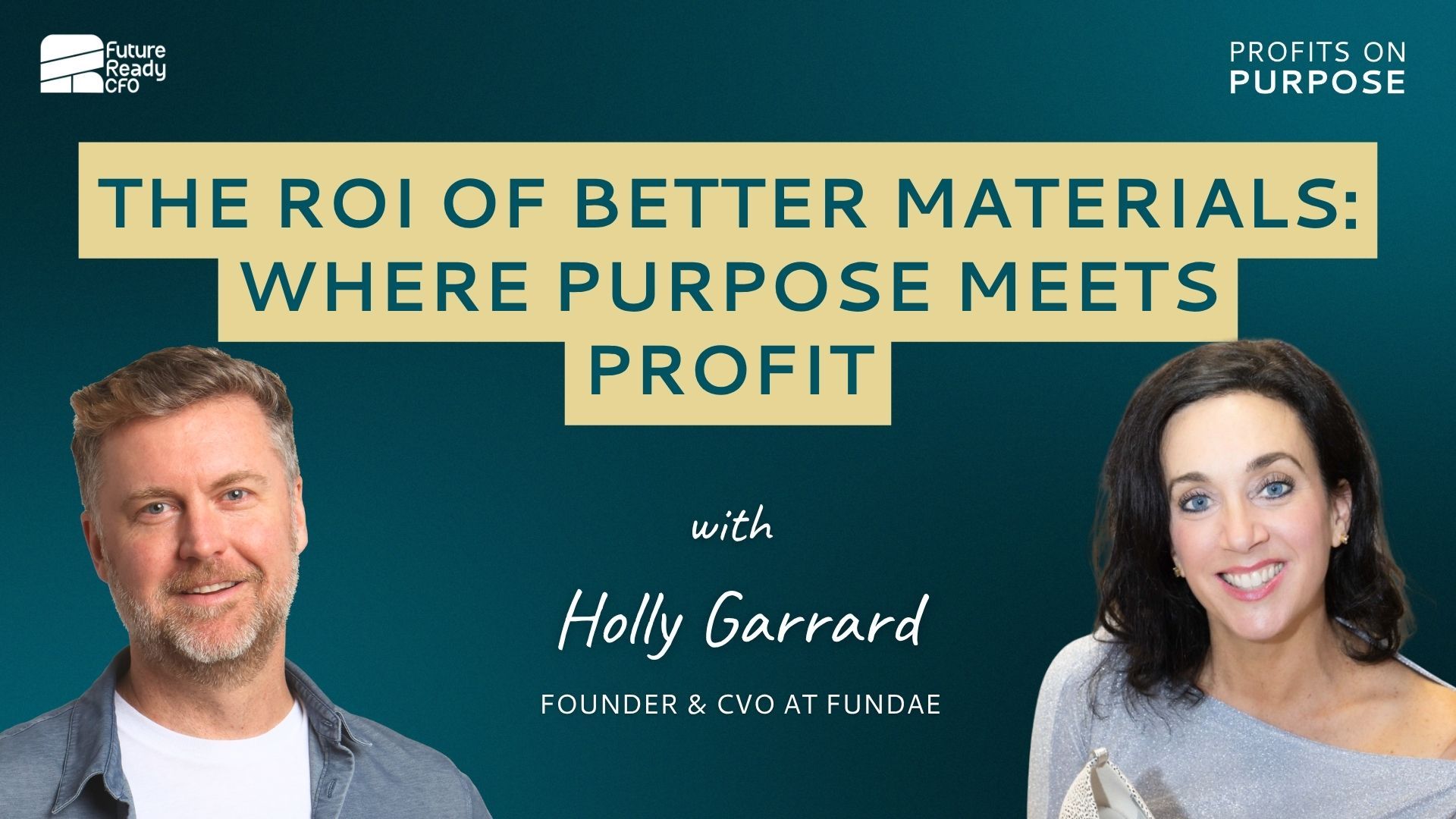
Episode Description
Holly Garrard spent nearly 25 years in media and podcasting before deciding to stop telling other brands' stories and build one of her own. The result is Fundae - a purpose-driven footwear brand built on plant-based materials, manufactured in Italy, and designed to prove that sustainable fashion and high style can coexist.
In this episode, Holly gets into the financial realities of building with conviction: absorbing a 20–30% cost premium on materials, navigating unethical vendors, funding the business while supplementing income from consulting, and holding the line on values that every Italian supplier tried to talk her out of. It's an honest conversation about the cost of doing things the right way - and why she believes it's worth it.
Key Takeaways
- Building a purpose-led brand requires unwavering conviction, as authenticity creates a lasting impact.
- Purpose and profit are deeply intertwined when the mission guides every decision, reinforcing brand integrity.
- The impact of purpose-based branding can be amplified through storytelling and technology, creating emotional connections.
- Purpose-driven entrepreneurs must balance financial viability with their mission to prevent burnout.
- Purpose extends beyond product to broader impact and community engagement, diversifying efforts for deeper loyalty.
- Purpose-driven pricing requires strategic evolution to protect margins while expanding access.
See More from Holly and Fundae
Listen to the full episode to discover how Holly's experiences can inspire and guide you on your entrepreneurial journey. Don't forget to subscribe for more insightful conversations!
I hope you enjoy this episode!
Give it a like, share, and subscribe to not miss the content coming your way weekly.
– Nate and the Profits on Purpose podcast team




Transcript
-----
00:00 Introduction to Purpose-Driven Entrepreneurship
01:49 Holly's Journey from Media to Footwear
04:08 Identifying Gaps in the Footwear Industry
06:00 Sourcing Sustainable Materials in Italy
09:57 Financial Implications of Sustainable Choices
11:51 Marketing a Purpose-Driven Brand
15:06 The Reality of Financial Sacrifices
17:56 Navigating Optimism and Business Challenges
18:55 Balancing Cost and Impact
22:05 Future Goals and Scaling the Business
26:00 Advice for Aspiring Purpose-Driven Founders
28:46 Communicating the Brand Story
-----
Nate Littlewood (00:06)
Have you ever wondered whether building a truly sustainable business, one that refuses to cut corners on its values, can actually be profitable? Or does doing the right thing always come at a financial cost? Welcome to Profits On Purpose, the podcast for seven figure e-commerce and CPG founders who are navigating the intersection of purpose-led entrepreneurship and the realities of needing to generate a financial profit.
I'm your host, Nate Littlewood from Future Ready CFO, where I help e-commerce and CPG founders turn financial chaos and confusion into strategic clarity and decision making confidence. Today's guest is Holly Garrard, who's the founder of Fundae, which is a purpose-driven footwear brand built on plant-based sustainable materials and made in Italy.
Holly spent nearly 25 years in media and podcasting, helping brands tell their stories before deciding to build one of her own from scratch. Fundae is her answer to a question that she couldn't stop asking herself, which is what would a fashion brand actually look like if it really lived up to its values from the soul up?
Every material, every component, every supplier decision has been made with both the planet and the profit and loss in mind. And the tension between those two things is going to be one of the topics that we're exploring in today's conversation. Holly, welcome to the show. It's great to have you here.
Holly Garrard (01:46)
Thank you, Nate. It's wonderful to be here. I'm excited to chat.
Nate Littlewood (01:49)
Likewise. So Holly, you spent quite a few years in the media and podcasting space. And I, I, I'm hoping at some point, maybe you'll have some tips and feedback for me, but, you know, at some point during your journey, you decided that you'd had enough telling other people stories and wanted to go and build a brand of your own. I'd love to get started here. Just talking about the backstory, you know, what made you want to make that leap or change?
Holly Garrard (02:16)
Absolutely. You know, think I always had or I know I always had that entrepreneurial spirit and was the entrepreneur, as they say in the major media companies. I thrived on helping brands tell their story. always I loved it, storytelling by nature. I put a lot of research into the storytelling. And so there was always that lingering question of “What would you do? What would I do if I were to start my own company?”
And I loved fashion, I loved shoes, I was known for my shoes, I was known for color. And once in a while that idea would creep in and it's like, that's ridiculous, that's audacious. You're not gonna start a shoe company, right? And so I think I parked that idea for a while or even starting anything. I was a single mom raising my girls, so I stayed the corporate line and helped other brands.
there came a point when after a lot of research and a lot of brands were like, I need help being sustainable. I need help giving back. And I knew that those trends were on the rise from the research. Yet I was seeing a lot of brands really not embracing it authentically.
And it was like a slap on and afterthought. It's like, what to your question, what would it really look like if we started a fashion brand from the very, very beginning built upon preservation and planet positive and purpose driven?
And so I think it was the combination of years of experience, years of that hunger of what would I build coupled with the research that gave me the courage to take the leap.
Nate Littlewood (03:49)
I love that. Love that. Well, for those of us who are perhaps less familiar with ladies footwear, and I might include myself in this population. me up to speed here. Like what some of the problems that you saw with the way the footwear industry is kind of operating or working today.
Holly Garrard (04:08)
Sure. So in general, most shoes are made by men. So I love wearing high heels and they may not always be comfortable. just, you know, coming from wearing them, just in general, forgetting that the sustainable material part, that's part one. Like how do we make sexy and comfortable the same, right? We don't need an orthopedic shoe, but like, how can we make it better and still be stylish? The next question was, I loved all these sustainable brands that were coming out.
Maybe like an Allbirds or even a Rothy's and people that were really leaning in and thinking about let's do things better for the, for the, most of the brands that were doing sustainable things were casual, utilitarian, quite frankly, as someone who loves high heels, not my style. And as marketer, I knew, like, you have to meet people where they are. So in order to get people who love high fashion and high style to embrace sustainability, you've got to design that same way. And that was the gap. No one was serving that market.
Nate Littlewood (05:07)
Gotcha. Gotcha. Okay. That makes sense. And I understand you've gone to Italy to source some or all of these products. And you mentioned the other day when we spoke that during those initial conversations, a lot of these suppliers or vendors were trying to push you towards, I don't know, I guess, cheaper or more conventional sorts of materials.
You were describing to me when we spoke last time that you kind of pushed back on that and, you know, held your ground and said, no, I need to do it this way. I'd love to hear you explain, you know, what were some of those decisions and choices. And since where, you know, you're on a podcast talking to a CFO. I want to hear like, what did that actually cost you? You know, in terms of cost of goods sold, what sort of premium are you paying here because of the values based decisions that you made?
around building the product.
Holly Garrard (06:00)
Yes, a lot, a lot to unpack there. And that really is the foundation of the brand. So when I decided to go for it and make shoes, I chose Italy because Italians are known for their artistry and their craftsmanship. And that was something that I couldn't bring to the table. Right. So if I was going to outsource and have people making the shoes, I wanted to start at the top with the quality. So I chose Italy from that standpoint.
I also was very intentional in choosing the materials. And a lot of the materials that I was researching, found are truly vegan. So really on a mission to explain like vegetable based, not vegan as in petroleum based.
I'm using plant-based materials that are actually, they're great sources in Italy, so it's a lower carbon footprint. So I use a wine grape leather from Northern Italy. I line all my shoes with corn, which is also from Northern Italy. I have some corks from Portugal, so regionally sourced. So it made sense to go there and put it all together. It also was very particular about my outsole. So something just as a user wearing, you know, high fashion shoes.
So Italy, let me take a step back. Italy is known for leather, right? So here I am going into Italy without leathers. Now I do have some recycled leather that we can come back to because recycled leathers are better for the planet than fake vegan as in petroleum based. But I knew going in, I'm primarily plant based. I'm not using leathers. So I called a bazillion people who wouldn't even work with me. No, we only work with leather.
No, we only work with leather leather and some I would and I have some recycled water bottles. don't do knit. That's only in sports. That's only for sneakers. We don't do it in high heels. So I got a lot of notes out of the gate. And then when I wasn't using leather on the, on the upper, the main part of the shoe, the color, I was also not using leather on the soles.The thing I noticed as wearing other brands high heels for years, these thin leather soles are actually super slippery. You're constantly having to resole it.
And the second it gets wet, like you're kind of ruined, right? And so I'm like, well, I don't want to do that. So I want recycled plastic, recycled rubber on the bottom. So I came up with a custom sole that is a hundred percent recycled. I can even recycle it and melt it back down into shoes when I get the infrastructure in place. was one of the coolest things I ever did. I was in bins sorting. I wanted a silver spoon, so I'm picking Maserati parts and metals and things. So I come to the
Nate Littlewood (08:30)
Did car parts?
Holly Garrard (08:30)
here.
These car parts. This is where the guys come in and love my shoes. Yeah. But the guys still like to buy it for their ladies. I've never had more fun or more creativity in my life. Like literally picking all the different materials. And that alone was a roadblock within Italy. So even if I could get a factory to do it me, they were like, we pick everything. We will buy whatever materials we think.
And that's to your original part of the question was when they started to push back, we can get you this leather, we can get you this, we can get that. And I wanted to work with people only who would work with every material I brought to the table. And so that was part of my biggest hurdle. Outside of the cost, it is a premium to your point. It was familiar with the materials and so their comfort level, it took us extra time to prototype once I finally got people willing to work with me, but they resisted on every single component I chose.
Nate Littlewood (09:27)
Yeah, I bet. mean, I guess they wanted to use materials they were familiar with because they knew how it would work on their machines and it would be predictable. You came in and said, all right, I don't want predictable and easy. Like I have these values and I need you to be using these materials for these reasons. Circling back to the finance piece though, I'm curious, what has been the financial implication for it? And you can answer it any way you want.
You might not want to give it a dollar number, but you know, just an order of magnitude or percentage or something like if, if you'd accepted their recommendations and materials, would have cost X, you know, how different is your cost.
Holly Garrard (10:07)
20 to 30 % less, especially at the beginning to be upwards of 30%. As I scale, can I get that margin down lower for sure? But to me, that was worth it. It's a premium item. I'm standing behind my vision, my pillars and the foundation that I wasn't willing to veer from.
I have a research told me and I believe that the future generations will make decisions based on that. And it's a brand's responsibility for us to educate them and tell them why, why is this important and what is it made of? that's actually something that the fashion industry is not known for transparency at all. that came about in why I named it Fundae. So it has an analogy of a food connotation to an ice cream sundae. Pick your cone, pick your flavor, put your cherry on top.
People thinking of the ingredients and the trends were showing that as people embraced organic food and it's like, what's my body consuming? And that was very popular. The next industry was the beauty industry because people started thinking, well, what my body is absorbing, the lotions and the different things. It's like, wait a second, what actually goes into that? And I have two teenage daughters and they pay attention to this stuff. And I started noticing that and I'm like, well, fashion's next.
That's always the way it goes. And so I knew it was important. So I'm not going to veer from that. I want to make a difference. There's a massive climate change issues with fashion. Fashion is the second largest contributor to polluting the environment. And so as an industry, it needs to change. And so I knew I needed to stand my ground.
Nate Littlewood (11:51)
Interesting. I'd love to hear how you have thought about incorporating this mission into your marketing messages. I'll tell you a little story before we come back to your answer, but in a past life, I was running my own e-commerce business. So we were a B Corp. got, you know, carbon neutrality certified at one point. And we went into it, you know, very environmentally oriented. And when we...
first launched the business, we took this very like mission driven environmental, you know, angle to it. And, you know, like the food system sucks, blah, blah, blah, terrible. Like we're a better option. What I eventually came to realize is that consumers don't particularly like to be made to feel guilty or like terrible person, people for making the decisions that they are.
And we, you know, eventually realized that that was a not a compelling way for us to market those products and, you know, became a little bit more subtle in terms of how we incorporated the environmental into our marketing and communications. Given, know, your background and expertise in marketing, I'd love to hear your perspective on how you're thinking about the value proposition, how you get people into the business and when and how is the right time to start talking to them about this environmental angle that you have.
Holly Garrard (13:09)
Such a great question and you're absolutely right. People don't want to be made to feel bad of the things that we've done. So can be a tricky, sensitive walk. And I think there's a few different approaches here for the people that maybe are, I mean, like all of us, know, the products that are out, of course I've bought things that are bad for the environment, right? Like we've all done it, right? So if we can approach it from a relatable and more of a, you know this even exists?
Like, hey, it's almost like back in the day, it's like people smoked when they were pregnant until they knew that that was really bad. So how do we bridge that gap without making people feel bad? Because you're absolutely right. And so the way I approach the conversation depends on who I'm marketing to. So if I'm going to market to vegan eaters, they already love vegan. A lot of them do love it because of the animal's perspective, you know, not only the health benefits. So I may have a different spin.
They already adopt this. This is important. Did you know you can get a shoe like that as well? From people just fashion, people who love shoes and style, and they may not care as much yet or don't know enough about the sustainable, I knew my product had to win from style and look anyway, right? Like I had to get them in. And so I kind of take the environmental approach. And that's why I try to have some fun with it with the ingredients. Like we're cute, we're sexy. And did you know this is made of wine grapes, right?
And to have some fun with it and try to give them the vibe of that ice cream shop. And so it's like a kid in the candy store, right? It's like you get a shoe, you can get unlimited toppings, you can get a bento box of toppings. so I try, the whole brand is built on whimsy and a fun element. So hopefully I'm not as condescending in that way and that it's more of a, not only is this fun and cute, it's really good. You know, you can feel good about what you're buying. You can look good and feel good. So I try to keep it positive.
Nate Littlewood (15:06)
Okay. I love that. love that. You described when we chatted the other day, taking some pretty significant financial hits on this business, particularly in the early years. And from what I understand, there've been, you know, periods where you're not, you know, paying yourself what you should perhaps. And I'm not saying this to make you feel bad. I see this all the time with founders. mean, I was guilty of it myself for a number of years.
with, with my own business. That's a situation that, you know, a lot of founders are not often willing to talk about incredibly openly. So I appreciate you. Appreciate you bringing it up the other day, but I'd love to hear your perspective on, know, what it kind of feels like to be running this mission led brand and business, but knowing in the back of your head that like, I'm not actually getting paid here what I'm worth. And I should be getting more out of this than I am.
How do you kind of reckon all that and what does the outlook look like for you on this topic?
Holly Garrard (16:08)
It's a deep question, right? And I believe that founders, no matter what business it is, whether it's purpose-driven or not purpose-driven, you must have a risk appetite, right? That's larger than most people. You know you're going into it. And so I really had to go in with that mind frame of you could lose it all, right? And so one, I had to really want it. And I looked at my life.
Like, what do I want in retirement? Let's pretend I don't do this and I stay the corporate path. Like, what are the goals? I love traveling. Okay, fun. Now I travel to Italy for work. So, you know, so are there benefits within it that I can justify the cost and if I lose everything and look back, did I have fun? Can I say I went? Am I showing my daughters to believe in your dreams? So for me, there are a lot of other personal, moral things that I take value out of. It's not a financial currency.
But maybe I've outdo it even more. And so I was able to reconcile that with myself. Other things like, okay, lot of people have lake houses or second houses, right? I'm not, I'm going to go for a business. Like you could lose all your money in the real estate. So what's the difference, right? So maybe I'm having these conversations with myself and I definitely did, but...
I looked at it from that perspective, like not going to buy a second home right now. What if I went back to grad school? How many hundreds of thousands would that cost me? So I viewed the early years as an investment in an education of a new industry that I was going into, which is very cool. I was willing to take what I saved. I believe in it. I run very optimistic sometimes to a fault, but I believe in the goodness of... giving back and that other people want to participate and support brands that do. And so I just, knew I was all, I'm all in no matter what it takes.
Nate Littlewood (17:56)
I appreciate that. I want to circle back on something you said just now about optimism, which is a big problem for a lot of founders. I mean, kind of by definition, you have to have a bit of an optimistic skew to be crazy enough to get into this game. Very true. Tell me about some of the problems that that has created for you in managing the business and are there any particular tricks or strategies that you've come up with? To manage or temper your own optimism.
Holly Garrard (18:29)
Ooh, yeah. Okay. So yeah, being optimistic and maybe can equate to also trusting people. Like I believe in the goodness of people. believe in, you know, we're going to make it work. And so I think where I got hurt the most was working with some unethical vendors, some bad partners. I believe in doing, you know, the good things and then realize that they weren't. And so I got burned a few times, lost some money that
you know, without loss from a regular business loss. And that hurt, me sad for sure. And so what I learned was I had to cut the ties faster. It's almost like dating, bad dating, right? I had to learn to get a little bit quicker. if I start in something or trusting your intuition a little bit more about maybe someone's not doing what they said they were going to do, I got better, I guess, at protecting myself where my open, bleeding, optimistic heart got burned a few times at the beginning. So I had to learn to cut vendors off earlier that weren't doing what they said.
Nate Littlewood (19:29)
So Holly, I want to circle back to this topic of cost pricing. So I have this kind of equation for thinking about impact and simply put, it's basically breadth times depth. So you can think of impact as a rectangle. It could be a skinny rectangle. In other words, it's very narrow, but you could have very deep, but you could have exactly the same volume of impact with a shallow depth, but have a much broader breadth. In other words, you know, touch much more customers or people.
When it comes to your business and thinking about the impact that you're having, where I'm going with this is that you have built a business where the costs, you know, as you mentioned earlier, 20 to 30 % higher than what they would otherwise be if you accepted, you know, conventional alternatives. I assume that that means that we need to recover that in price somehow in order to protect your, your margin, right?
There's a price implication to that. And by having a higher price, there's you know, some portion of the market that is you're kind of pressing out of being able to afford this product. Now you could be less strict on your quality and material requirements, mainly only have a 10 % premium, which would mean you could have a lower price, but sell to more people.
Holly Garrard (20:44)
It's a very good question and I think it's one that's going to evolve as the business grows. And in retail, there are two main factors in your profit margins. So direct to consumer and the wholesale side if I go into retail.
So when traditional fashion brands, they run really high profits. Like the goal of luxury fashion is a 60, 70 % is very high. you know, do we need that? Could we cut it back a little bit? Right? You know, I can survive on that. we need to do people really need to be making so much at the top in the leadership? And that's an issue I think across all industries that has really, really changed. That's just something personally, I may be willing to run my company a little bit differently. But you mentioned a really good point, like at what point is it completely sandwiched out, right? Where were some of the other factors come into play?
Well, I know I helped a lot of brands doing, you know, right at the dot-com boom in like 2010 where there was a ton of brands coming into the direct-to-consumer space. And now you see those brands, like an Away suitcase that has a retail shop where they did the reverse instead of retail going online. They were online only and now retail. And so I think the world exists in a more hybrid spot right now.
So I'd be curious to see, cause the dot-com, like the way a lot of those companies skyrocketed was because they didn't have the wholesale cut for profit, right? So they were able to fully manage their margins a lot better. And so I did start with direct to consumer. So I'm able to come in at a lower price or make deals, especially at the very beginning, I've been doing a ton of trunk shows and it's like a mini focus groups, like friends and family.
So you're able to move on the price a little bit just to getmore feet, right? I need feet in my shoes, like get them on the streets, have people seeing them. And so I think I'm able to get it out more that way without completely changing the price on a scalable level. But I'm intrigued by your question in depth from when you first started asking, I was actually thinking of when you said impact, I was thinking of the impact from the contributions I'm making with preservation or purpose. So if you
Nate Littlewood (22:46)
Mm-hmm.
Holly Garrard (23:04)
If you don't mind, I'll answer it a little bit differently. So I give back, so I'm two feet in, I'm preservation and purpose are my two main pillars. And then personalize is the other one where we get to play and have fun with the toppings. But I'm committed to 1 % of the planet. There's an organization that does that. And I'm building on sustainable materials. I would view that one as it's narrow. It's exactly what I'm going to do. I'm not going to build.
But we could go deep on that, right? I can continue with the materials. Where the other one with purpose, I feel like maybe it's going to be a smaller percentage, but I have more room to make more impact. we give a percentage back to charities that are doing great work for getting women back on their feet. maybe homelessness or domestic violence or human trafficking, like other charities that are doing wonderful things, help women get back on their feet.
In addition to that,I have a program called Soles Uplifting Souls where I'm featuring a phenomenal female once a quarter and we're giving a percentage to their charity of choice. And so I feel like I can make a broader breadth of impact to multiple charities by honoring what other people want where I'm going deep. So it's an interesting, I like your analogy of that.
Nate Littlewood (24:24)
Well, it's a question that I see a lot of impact or purpose led entrepreneurs kind of dealing with. Likewise, also, you know, layering in these give back one percent for the planet and the other charitable causes that you mentioned. Listen, I commend you for doing all that stuff, but I do think it's really, really important to make sure that you as a founder are being taken care of.
And this is financially viable for you in terms of your salary and what you need to be getting out of it. Because if that's not happening, you're going to stop showing up. You know, these, all these other charities will stop getting, getting their donations from you.
Holly Garrard (25:04)
And it's like the airline example, you got to put your mask on first before you can help others. And I think as mothers and women, we don't do that enough. I've definitely been guilty of that where it's like you forget your self care, you forget whatever it is. And so it's a good point. It's a great point as a reminder from the founder perspective. Yeah, I have to survive as well, right? And in the growth year, when you're...
So I'm building a product base, right? Like there are a lot of businesses in your service base. In fact, sometimes I wonder like, okay, I sold air for a living. I worked in podcasting. Wow, was that a hell of a lot easier than an actual tangible product? Naivety was bliss. So here I am paying the price for that, right? But I think I knew going into it, there was a significant investment level, like I wasn't going to get a product for free, right? So I knew it was going to cost.
So then my income was supplemented by I've still been consulting and working in podcasting. so I think it's a point, like at what point are you, am I full time into it? And I am now, but at that phase, was, I was investing in a business and then earning income somewhere else because until I had the product, how could I have made money?
Nate Littlewood (26:17)
Okay, that makes sense. is the kind of North Star outcome or metric goal that you're aiming for here? And I'm curious if that has changed or evolved at all since you began the business.
Holly Garrard (26:33)
Very good question. My North Star is to get into some big stores. And that would not maybe necessarily been my answer before. think ultimately, yeah, I'd love to be a household name. want people to know who Fundae is. I want to be known as the brand that's sprinkling joy and it's fun and comfortable and it's contagious in a good way. Everyone wants it. I would love to be that type of brand. At the beginning, I thought the DTC route would be faster.
Nate Littlewood (27:03)
Mm-hmm
Holly Garrard (27:05)
more maybe more viable and I didn't want to do wholesale right away and for a lot of different reasons. One, the cost and you know there's a lot of stores that are monopolies right now and a lot of vendors are saying they're not even getting paid so it's like how do I you know go into something like that and to your point of the profit margins. That said and if I may add I wouldn't even entertain wholesale until I was solidly comfortable with my supply chain so.
like my vendors, my partners. And so now I'm in a good spot with a good team of people where I'm ready for wholesale. And so I'm entertaining those conversations. So that's my current North Star is to get into some really big stores, because that'll help me scale much faster.
Nate Littlewood (27:43)
Okay. That makes sense. We've clearly navigated some very interesting and very difficult decisions here around, you know, balancing the profit and the purpose. know, 20 to 30 % on your cost structure is a big number. I have no idea what these shoes cost, but like it's a big number, at least in terms of percentage. there's a number of other give back causes that you're supporting here.
With the benefit of hindsight and looking back at how you've made some of these decisions, are there any that you would question or where you maybe have some regrets and would do them differently if you were presented with the same decision again?
Holly Garrard (28:24)
I'm sure. Yeah, there are definitely some, however, they're not in the foundational element. So I hope to only get more sustainable as the market offers more sustainable ingredients that I can make into my components. think if I made, mean, of course I've made mistakes, but again, it was maybe...
trusting particular partners or maybe going all in on like the website and the marketing at the very beginning. But I didn't, the product took a lot longer where it's like, could have tabled that, know, so do you lose a little money here and there? So I definitely depends on how I would do it differently. And I'm proud of what I'm doing with the purpose driven and the preservation. So I don't want to change that. The time will only tell how well that works holistically for the brand, for myself.
But I'm all in and I want to make it work and my optimism will never be dimmed sometimes, but I'm still a believer.
Nate Littlewood (29:21)
Hahaha.
I love the spirit. love the spirit. So if a founder came to you and said, I want to build a purpose driven brand and I absolutely refuse to compromise on my values, but I also need to, I need for this business to actually make money. What would you tell them? What advice would you give them?
Holly Garrard (29:46)
I would say if you have this purpose-driven business in your mind, in your heart, in your soul, you got to go for it. It's calling. And I believe it's more of a legacy play than a quick financial win. if it's really, if you're only in it for the profit and I want to make it work, I also think that's not going to work. It's not successful. It's not sustainable. It's not authentic enough to last.
So on the flip side of that, I would say then you do it and you go all in and you're to have to make sacrifices that you never thought you're going to have to make. And you're going to have to continue to make them. And maybe that is having two jobs and maybe it's finding other financial means. And I think a lot of people have multiple sources of income, right? It's, it's a more common thing now. And so I say, go for it. And if you have to manage it to survive and do that as well, but don't give up on the dream.
Nate Littlewood (30:44)
Okay. Makes sense. We're circling back to something you mentioned earlier, Holly, about channels. You mentioned initially that you'd started with DTC or e-commerce, but wanting to grow in wholesale. Just curious, is a brand that has, you you have a lot to say in terms of mission and purpose and product. There's a very, very complicated and, you know, rich story here. How do you think about telling that story?
Or communicating that story in a wholesale or retail environment when you do not have the direct connection to the customer that you do through e-commerce.
Holly Garrard (31:23)
Exactly. I have ingredient cards, so my packaging looks like food. So if I can have that cheeky fun way that's, you know, that's different. You know, will they read the ingredient card and look at it is one way as far as being transparent and sharing that story. I'm working with some technology partners that are helping us hopefully like either QR code or you can scan, but there is a whole supply and transparency.
I believe with digital technology, we'll be able to tell the story a lot more. Shoes are a little bit different because I don't have the tag in the product. So I've looked at little things that I can put on the sole or even on the inside, but like clothing or putting it in the tags. There's, you know, from years to come, we'd be able to know where that goes. So I think technology will play, make a play.
And then from a packaging standpoint, in addition to the ingredient card, I have, we haven't touched on it too much, but my piece de resistance, my cherry on top is literally my patented hardware. So sustainable inherently in that you can mix and match the styles. You buy one shoe, get four looks in once. Let's say you walk into a department store and it looks like a bento box. Like here's your shoe, here are your three toppings. It's a different look and feel than other products. So I think maybe they'll read more of the materials or the sales people will educate it.
Or maybe that will prompt them to go online and look for more information as to learning more. But that is also why at the end of the day, you've got to look good, right? Am I eye catching? Is someone going to pick me up off this? Like, I can't just be sustainable. And that was exactly the gap that I was talking about. It's like, I grew up in California. I love the ocean. I would love to save the ocean. You couldn't pay me to wear the options that existed, right? It's like, save the planet in a bright red stiletto. That's what I built.
Nate Littlewood (33:15)
Your ingredients or materials cards must be fascinating. I've heard grape leather, corn, used Maserati parts. I'm not sure if you mentioned Maserati, but wow. Yeah, certainly an interesting combination of components here.
Holly Garrard (33:34)
That's true. Yeah, I'll send you an ingredient card so we can share it with your audience. Okay.
Nate Littlewood (33:39)
Cool. I'll maybe link that in the show notes for folks who are interested in checking it out. Well, Holly, this has been really interesting. I appreciate you coming on and sharing this story. It's a fascinating business that you're building here. And I am so intrigued by the way that you're putting together this product and the materials and I guess, I don't know, is ingredients the right word to use? Well, that's I- Ingredients? That's you want me to think by calling it Fundae, right? Yeah. Exactly.
Holly Garrard (34:08)
Yes.
Nate Littlewood (34:10)
Okay. Well, anyway, very intriguing story and I appreciate you sharing it with us. Before I let you go, where should people head to if they would like to learn more about you or the business?
Holly Garrard (34:21)
Yes. Thank you for having me, Nate. I appreciate it. You can find me at Fundae.com and on social our handles are, it's Fundae soles.
Nate Littlewood (34:30)
Okay.
So really, yes. Okay, cool. I'll include again, all those links below, but Holly, thank you again. Been a pleasure and best of luck with everything. Take care.
Holly Garrard (34:39)
Thank you Nate.
Want more like this?
Join our newsletter list and every Thursday morning you can look forward to actionable insights and free tools for scaling your brand.
We hate SPAM. We will never sell your information, for any reason.
