
The 3 Things I Knew (And 7 I Didn't) Building a Multi-Million Dollar Tree Business | Teddy Oitzman | Simply Trees | Profits on Purpose
Dec 17, 2025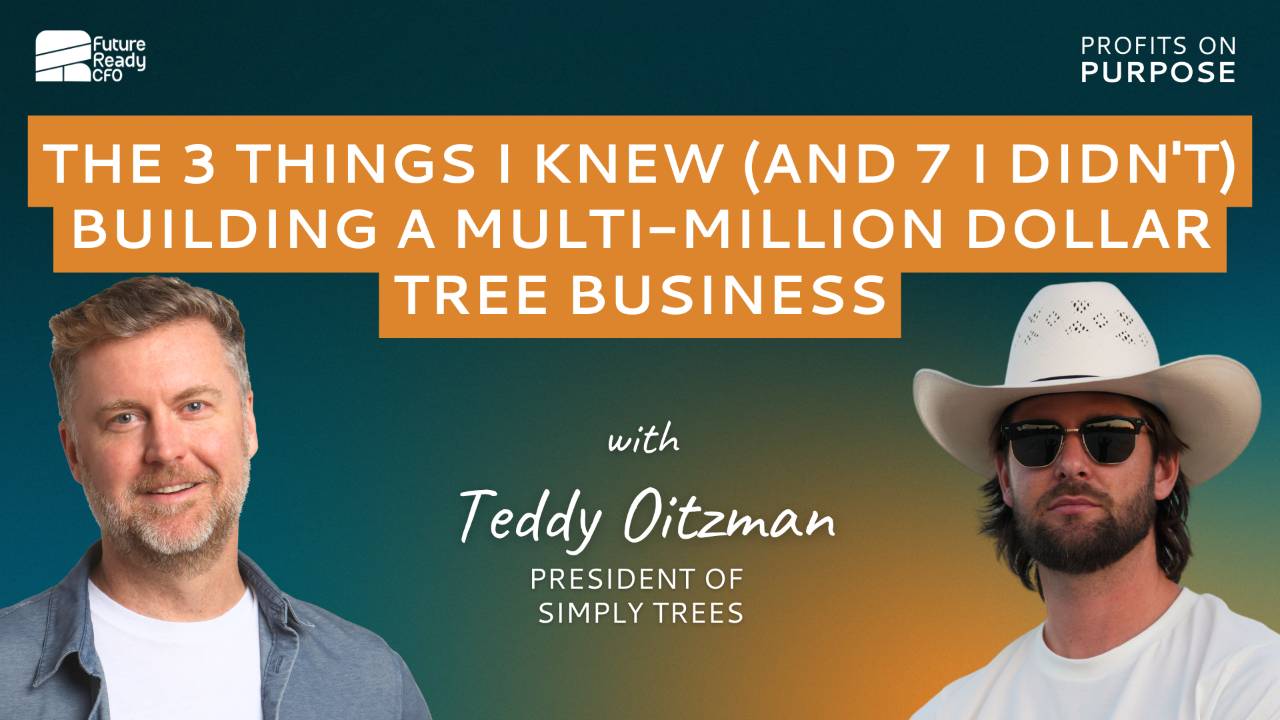
Episode Description
In this episode of Profits on Purpose, host Nate Littlewood interviews Teddy Oitzman, founder of Simply Trees, who shares his journey from having no experience in the plant industry to generating millions in revenue. Teddy discusses the importance of sales, understanding financials, and the challenges of running a seasonal business. He emphasizes the need for effective cash flow management and the lessons learned from overcoming significant setbacks, including a major inventory loss. The conversation highlights the hustle required in entrepreneurship and the eventual transition to hiring help to scale the business.
Key Takeaways
- Teddy Oitzman started Simply Trees with no prior experience in the plant industry.
- Sales and customer acquisition are critical skills for founders.
- Understanding financials is essential for business success.
- Seasonality poses unique challenges for businesses like Simply Trees.
- Managing living inventory requires careful attention and logistics.
- Early entrepreneurship often involves a significant grind and long hours.
- Hiring skilled help can lead to business growth and efficiency.
- Overcoming inventory loss requires quick pivots and strategic thinking.
- Balancing retail and wholesale can provide additional revenue streams.
- Cash flow management is crucial for the survival of a business.
See More from Teddy and Simply Trees
Listen to the full episode to discover how Teddy's experiences can inspire and guide you on your entrepreneurial journey. Don't forget to subscribe for more insightful conversations!
I hope you enjoy this episode!
Give it a like, share, and subscribe to not miss the content coming your way weekly.
– Nate and the Profits on Purpose podcast team




Transcript
-----
00:00 Introduction to Profits on Purpose
00:46 The Hustle Behind Simply Trees
02:41 Confidence in the Face of Uncertainty
04:56 Self-Taught Marketing Skills
06:52 The Importance of Financial Understanding
09:07 Unique Challenges of the Plant Business
10:05 Logistical Challenges in Shipping Plants
13:43 Managing Living Inventory
15:34 The Grind of Early Days
19:32 Transitioning to Hiring Help
23:05 Overcoming Setbacks and Financial Challenges
26:27 Navigating Business Challenges and Pivots
28:29 Supply Chain Management and Cash Flow Planning
32:24 The Importance of Cash Flow Over Profitability
39:37 Key Performance Indicators for Business Success
-----
Nate Littlewood (00:06)
Welcome to Profits on Purpose, which is a podcast for e-comm and CPG founders who are looking to scale their businesses, both profitably and purposefully. I'm your host, Nate Littlewood from Future Ready CFO, which is the go-to fractional CFO solution for seven figure founders who are looking to turn financial chaos and confusion into clarity and confidence.
Today's guest is Teddy Oitzman, who is a founder of Simply Trees. And today's conversation, I have a suspicion is going to be a masterclass in how to hustle as a founder. At just 25 years old with basically zero nursing, nursery experience.
Teddy watched Plants Express burn through about $15 million. And at some point along the way, thought to himself, you know what, I think I can do this better. He had no idea how to keep plants alive, no idea how to ship them, and was doing an accounting on a cash basis because at that point, he didn't yet understand accrual. But he figured it out and generated an amazing $3.5 million in his first year of operation.
that involved driving around trucks to pick up plants. He was hand watering plants in his 2000 square foot warehouse, cold calling landscapers at midnight just so he could cover the bills. And at one point lost over $50,000 when the irrigation system on his friend's farm stopped working. Today, Simply Trees operates on 25 acres with sophisticated systems and multimillion dollar revenue.
The gap between I don't know anything and building a real business, as you're to hear about today, it is pure hustle. Teddy, welcome to the show. It's great to have you here.
Teddy Oitzman (02:04)
Thanks for having me, I appreciate it.
Nate Littlewood (02:06)
Absolutely. Well, Teddy, I don't know if you realize this, but the other day when we chatted, it was only a brief conversation, but I think you said the phrase, I didn't know anything at least a dozen times. During that conversation, you said to me, I don't know how to keep plants alive, or I didn't know logistics, I didn't know how to manage people and you didn't understand or accrual accounting. Most people would see that as a reason not to start
a business, especially one in the plant space, what made you think that you could figure it out? And what gave you the confidence to give it a go anyway?
Teddy Oitzman (02:47)
It's a great point you make. A lot of people might think I'm a little crazy for that, but I believe in my ability to market and generate revenue. And I think generally speaking, that's the hardest part at the very beginning. Like, can you get sales in the door efficiently? Can you market efficiently? Can you advertise efficiently? And if you can do that, you can figure out the other pieces if you're willing to put the effort and the hours into doing so.
And I knew I could teach myself or learn or call a friend who might know the answers to some of these questions that I didn't at the time. And I believe in my ability to get sales. you need, think, know, early stage startups require revenue to keep them going. And if you can, the founder specifically can achieve that or
I was sourced it for very cheap. They were going to meet a better position. The other stuff is certainly learnable. I knew I'd either learn it or hire someone once we got going. And I was able to do that, but definitely felt out of like a bit of imposter syndrome, I would say. Like, I just didn't know the answer to a lot of questions, but I felt like if we could get sales, which we did, I could figure the rest of these things out. It's not rocket science or not building, not shooting satellites
Teddy Oitzman (04:18)
into space, right? We're putting plants in the box. We're keeping them alive. And so I might have been crazy, but I felt like we could make it happen.
Nate Littlewood (04:25)
Yeah, that's an interesting perspective and you're so true.
Sales and the ability to acquire customers is a critical skill. And a whole lot of revenue is going to cover up a lot of other mistakes that we might make along the way. But maybe we'll come back to that. actually want to go backwards a step though. And I'm realizing there's maybe a part in your story that we should have or that I've missed here. You said that you knew how to acquire customers and you understood digital marketing. How did you acquire those skills? In the first place?
Teddy Oitzman (04:56)
That's a good question. Mostly taught myself, I would say. I didn't work at an ad agency or anything. I played golf in college and I dropped out of college and I moved to Los Angeles and I was like, I need to acquire skills to earn a living and I was caddying at LA Country Club and using YouTube and I buy courses online to teach me how to market and teach me how to run meta ads and Google ads and I would...
Nate Littlewood (05:01)
Mm-hmm.
Teddy Oitzman (05:26)
Pitch myself to companies and eventually some hired me and that grew to two, three, four, five companies, six companies sometimes at a time. through trial and error, like when you're managing five ad accounts, like you know what's working, you know it's not. And I'm a pretty fast learner and especially in application, it's easy to learn on the job. There's definitely, I would go as far to say there were times where I would take.
positions or consulting roles where like I definitely wasn't qualified, but I figured it out on the spot and did a good job. and, it's not, it's not overly complicated, right? If you have a basic understanding of finance, which is crucial in marketing, like you have to know what you can acquire customers for. And you have me, I'm somewhat interested in psychology and, and consumer behavior. And so that interest mixed with my basic understanding of finance blended itself
Teddy Oitzman (06:25)
into I think a pretty good skill set.
Nate Littlewood (06:29)
Mm-hmm.
Got it. Yeah, makes sense. Well, you touched on a topic very close to my heart there, which is obviously finance. You mentioned that understanding finances is kind of critical to being able to run an ad account effectively. Tell me a little bit more about that. What do we need to know about finances to get that right?
Teddy Oitzman (06:52)
I mean, in terms of business, think a lot, it's fairly basic, right? Like I mentioned to you on our first call, I didn't have a vast understanding of accrual accounting. I knew the basics of an income statement, a balance sheet, and a cash flow statement. had interned at an investment bank and studied finance and econ in college, which was, I don't know, I don't know if I learned a lot, but I learned a little.
And I think having good financial controls on a business is the most important behind generating revenue, right? You need to generate revenue, but then to stay alive. But once you're alive, right, if you're breathing, you need to be able to have good financial controls in your business and know where you're making money and where you're bleeding. And I think it's critical to have a understanding on
Nate Littlewood (07:21)
Yeah.
Teddy Oitzman (07:49)
especially for a young business that doesn't have a ton of cash in the bank on a weekly basis like where's your cash going and In what lumps is it coming in? What time frame and if you can get those things under control? You should be in good shape And do some sort of cash flow forecasting just so you know, okay, I have this much runway I can take risk in these certain areas Without dying I say dying. I mean we're going out of business, right? So
Nate Littlewood (08:08)
Mm-hmm. Yeah.
Teddy Oitzman (08:20)
You know, it's very important and the larger the business gets, the more important it becomes. You're dealing with bigger numbers and risk looks different when you have 15 employees who rely on you for food, right, and for their families. And so it's quite, it feels like quite a responsibility. And so I've since hired some great people and learned a lot through the people I've hired as well in terms of finance.
Nate Littlewood (08:25)
Mm.
Yeah. Yeah.
Mm-hmm.
Teddy Oitzman (08:50)
the implications of certain KPIs and you know, we can get into that a bit later, but it's very important.
Nate Littlewood (08:58)
Okay, cool. Sounds good. Well, I would love to talk a little bit more about the business that you have found yourself running because it's
really, really interesting in a number of ways. And for context here, most of the founders that I work with as a fractional CFO are basically purchasing their finished goods from suppliers. they might have a bit of a bump through the holiday season, but usually things are somewhat constant throughout the year. I think it's really, really important that the listers kind of understand just how different your business is
to that, right? Like you have got seasonality to worry about. You have, I presume some pretty significant challenges around, you know, supply chain, procurement, maybe inventory shrinkage as well, I'm not sure. Could you just expand on that a little bit and tell us about the you know, some of the logistical and backhand challenges that you deal with as a guy who is shipping plants?
Teddy Oitzman (10:05)
Sure, it's a great question. Plants like you mentioned are not mecha-manufactured good. You can't just send a purchase order to a vendor and have it show up in two weeks or three weeks or whatever. They take a while to grow. Sometimes smaller plants, seven to 10 months, and the trees we sell that are six feet, seven feet tall, those are years. And there's only so many of them in the US at one time.
Nate Littlewood (10:32)
Mm-hmm.
Teddy Oitzman (10:34)
Home Depot and those has their arm around a large portion of those trees. And it's logistically daunting, quite frankly. The seasonality aspect is also challenging, right? 50 % of our revenue is in the spring, March, April, May. And June's not crazy slow, but the remaining nine months make up the rest of the revenue for the year. And you have to carry fixed costs.
Nate Littlewood (10:41)
Okay.
Mm-hmm.
Mm-hmm.
Teddy Oitzman (11:05)
through the rest of the year. mean, direct labor is a small percentage of our costs, which would be like labor to pack and ship, outside of office stuff. But you're carrying that labor for far longer than nine months, right? Whether it be visa guys you bring in or whatever. And these are things I didn't know before I got into this. I mean, I an idea at Seasonal. I worked at Plains Express. I had some concept of the seasonality. I had some concept of it being living good.
Nate Littlewood (11:11)
Mm-hmm.
Yeah.
Mm-hmm.
Teddy Oitzman (11:33)
There's a prone con to our inventory being a living good, being a tree, right? The pro is something we don't experience because our inventory turnover rate is fairly high. We turn inventory in like 30 days. But like, it grows. So it appreciates in value, but it also dies if you don't take care of it well. Or it'll get, maybe it won't die, right? But it'll get ugly. It's not like, we grade our inventory on like,
Nate Littlewood (11:48)
Mm-hmm.
Hmm, interesting.
Yeah.
Teddy Oitzman (12:03)
structure and foliage and these different criteria that make it, you know, grade AA, grade A, grade B. Grade B is not sellable. And we have inventory even right now. It's not sellable because something happened. It got missed by irrigation. It fell over in a windstorm. We have a big farm and it fell down for four days and it didn't get hit by sprinklers or whatever. you know, it goes into its own like area that's basically unsellable grade. And we try to rehab and bring it back. And sometimes you just throw it away
Teddy Oitzman (12:32)
shrinkage isn't like crazy in terms of the units we bring in annually. We've thrown away less than $10,000 this year, so it's very marginal. But that being said, there's about $20,000 on any given time of our inventory that's not sellable, $15,000 to $20,000, probably that's not sellable, which is fairly significant.
Nate Littlewood (12:41)
Mm hmm. wow. Okay.
Mm-hmm. Okay.
Yeah. So just to wrap all that up and paraphrase you a little bit, you've got inventory that's growing and literally changing in size. You have inventory that might be dependent on whether it gets watered, temperature, you know, you know, the time of year you've got inventory that
might not be very healthy and it might shrink or wither away, but then you can resurrect it and bring it back again. Like how on earth do you actually manage all that from a, know, ERP logistics perspective? Like what are some of the tools and systems that actually enable you to do that?
Teddy Oitzman (13:43)
It's a good question. The short answer is trial and error, right? Things don't work at some point and you figure out how to make them work. it's a few things, right? Managing that is like, you have like 10,000, I don't wanna say, I don't wanna quit a plant to a child, but it's like you have 10,000 living things right there.
Nate Littlewood (13:54)
Mm-hmm. Mm-hmm.
Teddy Oitzman (14:12)
right outside. And a lot of them are pretty easy to care for.
Nate Littlewood (14:13)
Mm-hmm. Yeah.
The more I think about this, the more my brain hurts from an accounting and infantry management perspective, all the things that could possibly go wrong. It's quite daunting. It's quite daunting. I think I mentioned to you that Eliza Blank, who's the founder of The Sill, is coming on this podcast too. I'm not sure if her episode will be just before yours or just after, but I'm recording with her on Friday. Anyway, I really...
Teddy Oitzman (14:24)
Yeah.
Nate Littlewood (14:46)
respect and appreciate what you were saying earlier about, you know, learning how to acquire customers and the fact that every business has a revenue problem to solve from the outset. And you clearly figured that out pretty well, pretty early. You were doing multiple million dollars of, you know, revenue out of the gate, but
You it sounds like you kind of took a bit of a hey, I'll figure it out when I get their type approach in terms of the logistics, you know, the trucks, the packing, you know, procurement and so forth. Tell me a little bit about what was going on behind the scenes. And what were some of the things that you were doing in order to keep up with this revenue that you were evidently quite successful at growing in the early days?
Teddy Oitzman (15:34)
Yeah. So to preface on this, like you mentioned before, and we touched on, it's a very seasonal business. And as a result of the seasonality of our business, was initially at the very beginning, like so scared of going into winter. I'm like, we'll run out of money. if we have, like if demand goes down, people aren't buying plants in December, January, half November, you know, when the, when most of us starts freezing, like we're going to, it's going to be, it's hard, right? And so.
I was so hesitant to hire anyone. I mean, I had some people that worked here, but not many because of the seasonality, the nature of the seasonality of this business and this industry. And so I took it to myself to pretty much do everything, a piece of everything. I had people helping me and working here full-time, but I was 100 % doing everything. I was driving a truck with a 30-foot trailer attached to it to go pick up plants from nearby because we weren't doing...
Nate Littlewood (16:12)
Mm-hmm.
Teddy Oitzman (16:30)
We're doing a lot of volume, millions of dollars in some volumes, like a real number, right? like that's significant volume, but we also don't have a ton of space at beginning to store all this inventory. So I like drive like two hours away, pick up plants at a vendor, at a grower, freight it back, driving myself because if we, freight's expensive and we bring everything in on refrigerated trailers, on semi-trailers. And when you have a semi-trailer that's refrigerated, you know, thousands of dollars to move these trucks around. And if we're not-
Teddy Oitzman (17:00)
in a full trailer with stuff, the freight's not worth it. So I would have to go pick it up myself. And I would pack boxes. And our first spring, I picked up inventory. I helped pack boxes. I had helpers, but I was in the warehouse the whole time. And my helpers spoke minimal-ish English, right? They're 100 % documented residents of the US, but they didn't have literacy skills like reading, know, ship stations, fulfillment software, et cetera. And so...
Nate Littlewood (17:03)
Mm-hmm. Right.
Mm-hmm.
Right, right.
Teddy Oitzman (17:29)
I was in there doing fulfillment, packing boxes, setting plans out. And then I would go, that'd be from 7 a.m. to 6 p.m. ish, whatever FedEx would come pick up the boxes. And then I would go sit at my desk, work on marketing, work on the accounting. At this time, and even now, we have so many transactions that occur on daily basis. So obviously the transactions, the customers who are buying product from us, but also all the transactions to our vendors. And when you're not buying...
you know, as many plants as we do now at a time, right? There's more transactions, multiple transactions, multiple vendors a day. So just categorizing these things in QuickBooks in the evening and, you know, writing ad copy and writing emails and all these different things took up the evenings. And I was, you know, working, would say six or seven days a week from six a.m., seven a.m. to two a.m. ish. And that was for the better part of a year.
Nate Littlewood (18:05)
Mm-hmm.
My God. Wow.
Teddy Oitzman (18:30)
and, yeah, and, it was something I wouldn't recommend, but it taught me a lot. Like I was able to learn a lot and learn about our business and how our business works better because of this. was doing double time. And so I probably sucked up two years worth of experience in one year. And, it was, it was like looking back, it's, it was like so hard and it was fairly stressful, but like,
Nate Littlewood (18:44)
Yeah.
Hmm.
Teddy Oitzman (18:58)
It was fun at the same time, right? Like I'm a 25 to 26 year old dude, just doing it. And they, you know, wasn't at this time, I wasn't getting paid a salary either. So was like, okay, this has to work, right? And so I'm super grateful for that period of my life and that time, but it was hard.
Nate Littlewood (19:00)
Hmm.
Yeah.
Mm-hmm.
Yeah, yeah. Wow, that's certainly a grind. Did your investment banking days prepare you for that?
Teddy Oitzman (19:33)
But the work ethic aspect of it, I had learned then and just the nature of practicing to play college golf, the work ethic thing has been ingrained in me since I was a little kid. And so it didn't seem like everything that I couldn't do.
Nate Littlewood (19:50)
Right, right. Okay. Well, I respect the hustle, but you eventually got to the point where you were comfortable in hiring some more kind of, you know, C-suite or, you know, corporate level people to help you. Tell me a little bit more about that transition. Like, how did you get comfortable with the reality that you weren't going to be able to do all of this yourself anymore and that you did indeed need to hire help despite the seasonality concerns that were you know, still present and never going away.
Teddy Oitzman (20:22)
Yeah, it was based on a conversation really I had with a few mentors or friends of mine that were older in their 50s, maybe early 60s that were from various industries that had been very successful. Specifically a friend of mine who's a venture investor and serial entrepreneur and he basically just said like, you're fired from driving trucks and packing boxes like.
Nate Littlewood (20:32)
Mm-hmm.
Mm-hmm.
Teddy Oitzman (20:50)
and you need to hire someone who has not only operational skills, like better financial skills as well. And your business won't grow past what it is now if you don't do that. Like there's no way for you to possibly do more than what you just did the past year without expanding your team. And I thought that was a very true statement because like I couldn't do more. It was like impossible. Like I couldn't shave.
Nate Littlewood (20:50)
Mm-hmm.
Mm-hmm.
Yeah. I mean, you just told me you had only four hours to sleep a day or something. You're virtually a vampire at this point.
Teddy Oitzman (21:19)
more time out of the day.
Yeah, absolutely. that's that those conversations is what changed my mind. And I'm like, okay, like these guys are saying so, and they've done super well. Like they must be right. And, know, okay, let's, let's try this out. And so we onboarded and a lot more labor. I hired a guy who's incredibly intelligent. He has multiple degrees from Notre Dame. He worked at Bain. He
Nate Littlewood (21:36)
Yeah.
Teddy Oitzman (21:54)
have extensive experience in operations and has a finance and accounting background. so those things, we hired an agency. So I wasn't doing all the Google ads and meta ads and everything myself. And that made the world of difference. Our business has grown tremendously since then. And we've become a lot more efficient in that as well. So I...
Nate Littlewood (22:08)
Yeah.
Teddy Oitzman (22:23)
I think that that was a decision, like thinking back, could have I done that earlier for sure, but I don't know if I would have just because like I learned so much along the way, you know, and I think there's something to be said for doing everything for a little while.
Nate Littlewood (22:32)
Mm. Mm-hmm.
Yeah.
I'm sure it gave you a very valuable perspective on what was required in all these tasks, but you've clearly evolved since then and have come a long way. One of the things that I wanted to just circle back on though, is you told me the other day that somewhat early on you had an experience where.
You had a whole lot of inventory and plants at your friend's farm, I think it was. And there was a time when the irrigation broke from what I understand. And you lost at what was at the time, like over half of your inventory or something. I mean, something like that, like losing half of that, that stock and inventory would would break a lot of founders. How did you recover from that both financially and mentally?
Teddy Oitzman (23:21)
Yeah, that was a grim part of a summer we had at the beginning. We lost about, I think just over $50,000 worth of inventory. I was using, you at this point we didn't have our new facility, new HQ, and I didn't have all the space to store these plants at my facility. so my friend had a big farm and I'm like, can I irrigate some of this area and use a couple acres and use a churno problem? like you mentioned, the inventory basically just broke.
Nate Littlewood (23:39)
I bet.
Teddy Oitzman (24:04)
Their well pump broke. So the pump that pumps water out of the well to the irrigation broke. And it happened, it was summer, it happened over a weekend and I wasn't out there and it just, everything pretty much died. And so it was, I was sad. was like, it was just, I didn't really have time to be sad. was just like, damn, like this, thanks. But now I'm getting orders for products that I don't own that I already paid for, which is a problem, right? Like in terms of cash.
Teddy Oitzman (24:34)
I don't really have right now that I've already paid for this problem and so I was like we have to and I had you know, papals coming up that I would no longer have to cash for because I have to now buy this inventory for orders that are coming in and So I started I'm like, okay, we need to make a lot of money like now like yesterday We have to make a lot of money that tens of thousands dollars. So it's very calling landscape
Nate Littlewood (24:39)
Mm-hmm. Yep.
Right. Right.
Teddy Oitzman (25:04)
and landscapers that were doing bigger commercial jobs, et cetera. And fortunately, I got like three or four customers quickly. And in the period from like late July through the beginning of October, we did like roughly 500, maybe $550,000 with the revenue from just landscapers. And I think 200 of that was in the first three weeks. And so...
Nate Littlewood (25:29)
Wow.
Teddy Oitzman (25:30)
That like saved us, right? Like at some capacity. Like I don't know if it, I don't know what the outcome would have been if that didn't happen, but it would have been grim. Like we did not have a ton of cash. And I personally didn't have a ton of money to like, I personally couldn't like foot this, right? Like these are bills that, and I'm a fairly risk averse person financially. I'm not going to go throw something on the credit card that I don't have to cash pay for it. Like that's just not me.
And so my options were taking a really terrible Shopify. Shopify gives out loans, I'm sure you're aware. It's like a shop, whatever. Shopify will give you a loan, terrible rates, like 9%, 10 % over a six month period, right? So this is like 20 % APR. This is not good. I could do that or I could just like hustle and figure it out. We'll do that. It's really expensive debt. And so we ended up like figuring it out and generating these wholesale, like this wholesale revenue and it like saved us.
Nate Littlewood (26:03)
Mm-hmm.
Mm-hmm.
Teddy Oitzman (26:27)
And it's not the set of our business that we have any intent on scaling by any means. It's not like a very scalable business model in terms of like the direct consumer shipping it. Your total trust from market is much smaller. It requires labor, trucks, trailers. You're selling big trees, right? Like, you know, trees that weigh a thousand pounds a piece. So not as scalable, but it saved us an interim. And I think the reason we went that direction was a pivot, I just had like, I'm like...
my mentality was this isn't gonna fail. Like I'll do whatever I have to do to make it happen. If I have to call 10,000 people, I'll call 10,000 people. And so we were very fortunate to make that work and make that happen, but it was grim and it was stressful, but I didn't have time to like freak out. I just had to get pivot and go, you know?
Nate Littlewood (27:00)
Mm-hmm. Yeah.
Mm-hmm.
Wow, guess, yeah, did what was required to, to keep the business alive. But it sounds like a pretty important pivot. Are you continuing to service that sort of market? you continue? Are you still selling to landscaping businesses today? Is there more retail focused?
Teddy Oitzman (27:41)
It's, it's more retail focus for sure. Um, we've kept like you wholesale customers, um, out of the maybe 10 that we acquired in total and they've become friends and they're easy to work with. and it's a one delivery a week per customer and they're large orders like in the AOV of 75 to $10,000 a piece. Um, so
Nate Littlewood (27:44)
Okay.
Right.
Hmm.
Right.
Mm-hmm.
Teddy Oitzman (28:10)
Even at the scale right now, like I'm not going to say no to that cash flow. And it's pretty easy to accommodate at this point, Scaling that would be a logistical nightmare. But for now with the current state of our business, it works great and it's fun.
Nate Littlewood (28:15)
Yeah.
Yeah.
Yep. Yep. Interesting. Listen, we touched on it a little bit earlier, but I wanted to circle back and talk a little bit more about this supply chain topic specifically from a planning cash flow and projections perspective. So you're selling trees, obviously.
And we have a very, short window of time every year to sell them. You mentioned three months or so represents about 50 % of your full year revenue. And you can't just pick up a phone to a supplier and say, hey, I need more Maya lemon trees. Can you deliver some next week? Like those trees had to get planted and started growing possibly years ago. And then you've got Home Depot and Lowe's who I gather are wanting a big chunk of that market.
Tell me a little bit more about how you actually manage this from a planning and cashflow perspective.
Teddy Oitzman (29:29)
Mm hmm. That's a question. So a few things, right? Like at the beginning, it's very challenging because you don't have historical or much historical data, especially when you're growing 100 % a year. And so it's like what skews are going to like is that and they don't the skews don't what we've learned, they don't grow at the same individual skews don't always go at the same rate as your revenue growth or our revenue growth. And so
Nate Littlewood (29:43)
Mm-hmm.
Mm-hmm.
Teddy Oitzman (29:59)
and that's The unfortunate aspect of this business is like I mentioned many times already you just can't manufacture a plant in in three weeks
Nate Littlewood (29:59)
Yeah.
Yeah.
Yeah. Yeah. I'm not sure if you've come across a term, but I understand in the supermarket and grocery industry, they have the concept of loss leaders and commonly, you know, barbecue chickens, for example, might be a loss leader. They don't make money on it, but they sell it to get you in there in hopes that you buy other higher price or higher margin stuff. Does that same concept exist here and is something like a Maya lemon, you know, potentially a candidate for being a loss.
need it to bring the customer into your ecosystem and while they're there they happen to boost the cart size and you make money on the rest of the skews.
Teddy Oitzman (30:49)
Good question. We certainly have those. lemon is not one of them. My lemon has extremely high conversion rate and we have good margin, but they're absolutely products that are lost leaders and specifically the perennial category, small one gallon plants that are a flowering shrub that goes dormant in the winter. We don't sell them for that much money because if we did it'd be
you know, a ripoff to the customer and it would be good value. And when you're selling an item for 20 something dollars and our margin as a percentage is still pretty strong, but dollar margins are low, right? Like we have, you know, labor costs, packing, packing each box and fulfilling each order and these sorts of things. so they drive a ton of traffic. And it's
Teddy Oitzman (31:44)
they know you exist and they know that you can provide them what they ordered and it shows up what they how they expected it to.
Nate Littlewood (31:45)
Yeah.
Mm-hmm.
Got it, got it. Just as a heads up, I'm having a bit of a few connection issues this end. You're pausing for like three, four, five seconds at a time. So if you see me giving you a kind of blank look, it's because I can't actually hear what you're saying. And you've paused. You actually paused for me at the beginning of that answer. So apologies in advance if you're getting some funny looks from me. Okay.
Teddy Oitzman (31:53)
But to answer your question,
Thank you.
Nate Littlewood (32:24)
So Teddy, we've spoken a little bit already about some of the cashflow, the seasonality issues that you have with this business. But one thing I wanted to just touch on is your relationship with the financial statements. You mentioned to me the other day that the cashflow statement for you is more important than anything else, which is a little bit unusual for a founder. Like most founders that I work with,
you know, tend to spend a bit more of their time looking at the profit and loss statement by contrast. Tell me why is cash your North Star and what have you learned over the years about the difference between, I guess, looking profitable on paper versus actually having money in the bank?
Teddy Oitzman (33:08)
Yeah, that's good question. In a business, and I would say this isn't true to all businesses, especially service-based businesses, where you don't have a ton of your balance sheet tied up in inventory or whatever, but the P&L is very helpful in getting directionally, getting information that's directionally helpful toward, in terms of like your margin, right? What's your cost of shipping in relation to...
to revenue, what's your cost of direct labor, or plants, or any of these different things. And that's helpful. your business will die if you don't have cash flow, unless you have private equity investors or whatever. Even at that point, you'll run out eventually. And I've seen it happen to other businesses where, we're scanning, let's buy tons of inventory or whatever the case is, and then you have all this inventory type on your balance sheet.
Payables that become due and then you have payroll and you have all these other fixed costs and you can run out of cash easily at the beginning, right? If you're an established business that's been around for 10 years, I'd hope you'd have it figured out. But at the beginning, I see a lot of founders get overly excited and purchase a ton of inventory they may or may not need and it really can set them back and honestly can kill a business. so knowing what you have due in terms of
Nate Littlewood (34:13)
Mm. Mm-hmm.
Mm-hmm. Yep.
Hmm.
Teddy Oitzman (34:37)
Payables and knowing Where all your cash is sitting because if it's not your bank account, it's gotta be somewhere might be inventory who knows where it is, right and And at the beginning it's so I mean it's like the most important thing right if you need cash to stay alive and Without that like you're cooked and The the PNL is gonna give you a ton of helpful information that's gonna get you
Teddy Oitzman (35:07)
get any founder, included, to make strategic decisions in terms of we need to cut a few points off, name a category, a chart of accounts or whatever, name anything, right? Anything in line with this. We can cut, can shift one or two points here or one point here or even 15 cents per bag on this by going from four mill bags to two mill bags and those will work fine. Those are all directionally helpful things you can get from the P &L, but.
If without a healthy understanding of where your cash position is, like you're in bad shape, unless you're printing money. If you're printing money right off the gate for 10 months, which is, would be impressive. Like you need it at your cash position. Otherwise, I mean, there's just the negative implications of not knowing that are so high, right?
Nate Littlewood (35:44)
Yeah, yeah.
Mm-hmm.
Yeah, yeah.
Absolutely spot on.
Teddy Oitzman (36:07)
And I would love to know what you think too, because you're a finance guy, like you're a fractional CFO. What's your perspective on the financial statements?
Nate Littlewood (36:12)
Yeah. So I like to use the analogy of a performance athlete and a coach. And each of the financial statements kind of serves like a slightly different purpose. So the, the, the idea behind a profit and loss is to kind of track your project over your progress over time. Clearly, I wouldn't be able to coach you on,
running the hundred meters at the Olympics, if you know, we didn't have some way to know what your time was doing and that you're actually getting better. And is there actually a correlation between, you know, the initiatives that we're rolling out the new projects, products, things that we're doing, and your performance. So what we want to be able to see is some kind of track record that the profitability and the profit and loss statement is improving over time. Cash is like,
the kind of calorie or the calories that you're consuming through, you know, food and nutrition versus the energy that you're spending. Now there can be periods of time where you can expel more energy than what you're consuming and you know, you'll have a net deficit, but that cannot go on for a prolonged period of time. Eventually you will wither and die if you're not, you know, replenishing yourself with that, that energy from cash.
And then the balance sheet is a little bit like your, you know, your body mass index is your composition, like how you made up like what is the constitution of this entity? And, you know, how is it all put together? But I think you made a really, really interesting point just now about kind of the importance of cash and cash flow management, and its relationship to how healthy your profit and loss statement is.
And I don't want to put words in your mouth, but just let me know if I heard you correctly. I think what you're explaining is that if you've got a phenomenally good profit and loss and really, really strong margins, then maybe you don't need to spend quite as much time on your cash flow statement. But a lot of people aren't that lucky. And if you've got modest margins, and especially when you've got a seasonal business like yours, there are going to be times of the year where
you know, cash is flowing, you know, in and out. And if you don't have the luxury of huge amounts of, you know, invest or money, then it is probably the thing that is going to kill the business if you happen to run out of it. So I get that right.
Teddy Oitzman (38:53)
Yeah, I think that that's spot on. Especially for us, right? When you have, when my experience is losing $50,000 of inventory right after our busy season, right? So my perspective is, is partially shaped from my experience early on. And I think it's a bit different now, but at the beginning it was, it's so important.
Nate Littlewood (39:04)
Yeah. Yeah.
Hmm. Yeah.
Yeah, yeah, I hear you. Well, Teddy, we're going to need to wrap things up pretty soon. I have one question for you that I like to ask all my guests, which is what is your favorite business KPI or metric? How often do you track it? And why?
Teddy Oitzman (39:37)
That's a good question.
My, it's...
I would say my favorite KPI is like our, I mean there's two because it's so, so meaningful to our business at this stage, but it's like our lifetime value to our, the ratio of our lifetime value to our customer acquisition costs or just, or just customer acquisition costs. Because I have an idea, like lifetime value is not going to change daily or weekly or anything, but our, CAC will change and, and fluctuate in it, the rate and the efficiency at which we're acquiring customers.
Nate Littlewood (39:59)
Mm-hmm. Mm-hmm. Yeah.
Teddy Oitzman (40:13)
directly impacts our bottom line. For example, if we're spending $300,000 a month on advertising and we're generating, we're doing, we're acquiring X number of customers or we're generating X dollars in revenue, the difference between a 3.3 and a 3.1 at a couple million bucks a month is like, know, like drastic, right? And,
Teddy Oitzman (40:40)
you know, like I can just look at our triple well report and tell you like, was it a profitable day or was it
Nate Littlewood (40:40)
Yeah.
Teddy Oitzman (40:46)
And, you know.
Nate Littlewood (40:46)
Yeah, yeah.
Interesting. Well, I appreciate this perspective and Teddy, this has been such an interesting conversation. You've got a fascinating journey that you've been on here and I really, really respect the, I guess, sales and customer acquisition first perspective that you've taken here and...
the hustle and the grind that you've put in here, man, to just figure everything else out on the back end. I see, unfortunately, a lot of founders, you know, tackle things the other way around and build the systems and build the product and get the inventory before they've actually figured it out to how to sell it and move it in significant quantities, which is often a bit of a recipe for disaster. So yeah, congrats on everything you've achieved here.
Before I let you go, can you just share with the listeners, where should people go if they would like to learn a little bit more about you, the business, what you're up to, any favorite social platforms or websites you want me to include in the show notes.
Teddy Oitzman (41:54)
Sure, you can find our business at simplytrees.com. Our business is Instagram and TikTok is at shop simplytrees. My personal Instagram is thedoreoitzman, which might be in the title of the video. I don't post a lot of stories. I don't post feed posts, but you can keep up. I post business feed stories all the time on my Instagram. And hopefully the viewers got something out of this and...
Nate Littlewood (42:17)
Okay, cool.
Teddy Oitzman (42:23)
If anyone has any personal questions, they can reach me on LinkedIn at my name or in my Instagram DM box, whatever. Happy to help or encourage or answer any questions anyone has in the future.
Nate Littlewood (42:37)
That's so kind of you. Really appreciate it, man. Well, thanks again for joining me on the show today. It's been an absolute pleasure chatting with you and I guess we'll catch up soon. Take care. Bye.
Teddy Oitzman (42:49)
Thank you.
Want more like this?
Join our newsletter list and every Thursday morning you can look forward to actionable insights and free tools for scaling your brand.
We hate SPAM. We will never sell your information, for any reason.
