The $2,500 Rebrand, Two Years Without Pay, and What Investors Actually Want to See | Scott Turner & Nick Lagonia | Dawnbreaker Oats | Profits on Purpose
Feb 11, 2026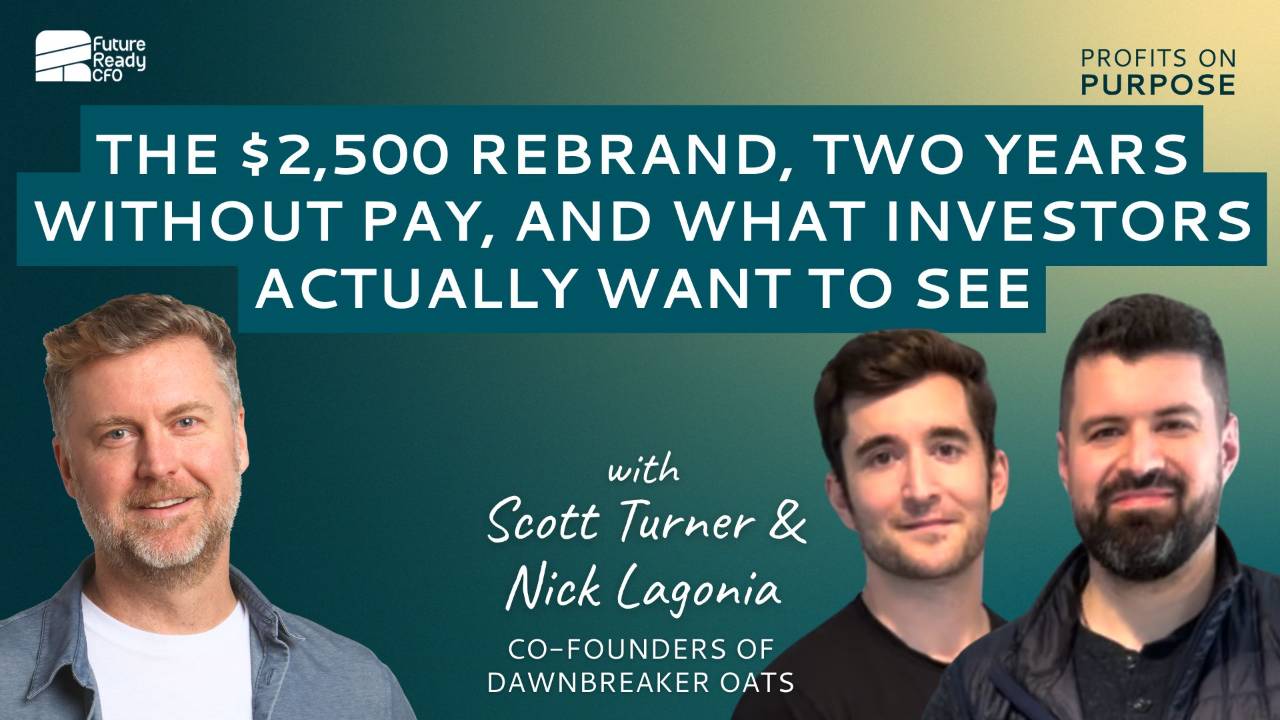
Episode Description
In this episode of the Profits on Purpose podcast, host Nate Littlewood engages with Scott Turner and Nick Lagonia, co-founders of Dawnbreaker Oats, to discuss their journey in building a consumer packaged goods (CPG) brand. The conversation delves into their initial struggles, including the challenges of branding and the costly mistakes they made in influencer marketing and agency partnerships. Scott and Nick share their candid experiences of rebranding from 'Misery and Mayhem' to 'Dawnbreaker Oats' in just seven weeks, emphasizing the importance of aligning their brand identity with their product's purpose and consumer expectations.
The duo reflects on the operational hurdles they faced, such as minimum order quantities and the need for a more effective marketing strategy. They highlight the significance of being hands-on in every aspect of their business, especially in the early stages, and the lessons learned about patience and calculated risks. As they navigate the complexities of e-commerce and fundraising, Scott and Nick provide valuable insights into the metrics that matter for startup success, including customer acquisition costs and retention rates, while stressing the importance of building relationships with investors and understanding consumer behavior.
Key Topics:
-
Why their original brand name (Misery & Mayhem) became a distraction instead of an advantage
-
The 7-week, $2,500 rebrand process that tested 50+ concepts
-
User testing results: from 10% to 65% brand preference
-
Real talk on not paying yourself for 2.5 years while raising young families
-
What investors actually want to see now vs. the "golden age of CPG"
-
D2C unit economics: $7 trials, $25-30 CAC, 50%+ retention on subscriptions
-
The discipline of proving small bets before scaling
-
Why they chose e-commerce over retail (and the cash flow reasons behind it
See More from Scott & Nick and Dawnbreaker Oats
Listen to the full episode to discover how Scott and Nick's experiences can inspire and guide you on your entrepreneurial journey. Don't forget to subscribe for more insightful conversations!
I hope you enjoy this episode!
Give it a like, share, and subscribe to not miss the content coming your way weekly.
– Nate and the Profits on Purpose podcast team




Transcript
-----
00:00 Introduction to Profits on Purpose Podcast
02:04 The Origin Story of Dawnbreaker Oats
08:02 The Branding Challenge: Misery and Mayhem
14:31 The Decision to Rebrand
19:00 Lessons Learned from Mistakes
25:10 The Importance of Patience in Entrepreneurship
27:46 The Importance of Patience in Business Growth
29:23 Strategic Focus on E-Commerce
33:59 Understanding Unit Economics
37:51 Fundraising Insights and Investor Expectations
44:36 Navigating Challenges and Prioritization
-----
Nate Littlewood (00:05)
Welcome back to the Profits on Purpose podcast, which is the podcast for e-comm and CPG founders who are looking to scale their businesses, both profitably and purposefully. I'm your host, Nate Littlewood from Future Ready CFO, where I help seven figure e-comm and CPG founders make confident data-backed decisions that drive profitable growth and at the same time, help them sleep better at night.
Anyway, today's guests are Scott Turner and Nick Lagonia, who are the co-founders of Dawnbreaker Oats. What I find really compelling and interesting about this story is the raw honesty that these guys are willing to share about what it actually takes to build a CPG brand from scratch. After raising over $300,000 and spending a couple of years in the trenches, these guys made the bold decision a little while back to completely
rebrand the entire company. They completed this transition in just seven weeks, rebuilding everything from the ground up on hard-won lessons about product market fit, consumer testing, and what actually drives purchase decisions. In this conversation, we're going to be talking about some of the expensive mistakes that they made with things like influencer marketing and agencies early on. We're going to be talking about some of the operational
nightmares of minimum order quantities and why sometimes the thing that you think is your brand strength is actually what's getting in the way of your success. Scott, Nick, welcome to the show. It's great to have you guys here.
Scott Turner (01:43)
Thanks, Nate. Happy to be here.
Nick Lagonia (01:45)
Yeah, thank you.
Nate Littlewood (01:47)
Of course. Well guys, I usually like to get these conversations started with talking a little bit about the origin story and the background of how you guys got started. Quickly and high level, how did you guys get into the oats business and how did the two of you come to be working together on this project?
Scott Turner (02:07)
Yeah, so Nick and I met in 2016 working at Peloton and Nick worked on the content side. I worked on the IT and tech side of the business and just became friends in the office and then started going to the gym together and getting dialed in at the gym. know, obviously nutrition is a really important part of training. It's something that you're focused on all the time.
And kind of a go-to meal before or after a workout is protein oatmeal because you're getting a good energy source through the oats and the carbs that come with that. And then layering that in with protein. It's filling, it's something that you need, it helps you reach your macro goals. And if you're trying to build muscle, it's just kind of a no-brainer. And so Nick and I had been making our own concoctions for a long time.
And they're passable, right? They're good enough, but not really something that you'd be super excited to eat every single morning unless you want to take 10, 15 minutes to make it and add everything that you want. And so when we'd go to the grocery store to look for something that was already made, the options just weren't really jumping out at us from a nutritional standpoint. You had a lot of sugar.
different products would have protein oatmeal on the front and then they'd only have like 10 grams of protein, which felt kind of lackluster. You know, I might as well go just choose another food to consume that inherently has more protein. you know, after a few years of kind of sitting on this idea, we really looked around and said, hey, there's not a lot of innovation in this space. Why don't we just make this the way that we've been making it, but try to improve it?
drastically so that other people actually want to eat it. and it's convenient and easy and it has, you know, the macros and the nutritional quality that consumers today are actually looking for. So. that's kind of the, the, the summary of how we met and how we got started.
Nate Littlewood (04:18)
When you transition from this being, Hey, an interesting idea and thing that we can chat about in the gym to getting to the point where you're like, okay, no, this needs to be a real company and we need to work on it. How did that transition happen?
Scott Turner (04:35)
Yeah, so I had been sitting on this idea personally for about five years. Nick and I, when we work together and we're working out together, we had thrown around this idea of starting a company together. We threw around a couple of ideas, but the protein oatmeal specifically is something that...
starting in like 2019, I actually began to look into. And then 2020, actually, I don't want to say I took a stab at it, but I like called a recipe developer and kind of, you it's one of those things where I just did a little discovery work and then tabled it again. And then 2021 comes around, I kind of do the same thing, but this time I buy a domain for, it had a completely different name and all this stuff. And then,
Nate Littlewood (05:22)
Yeah.
Scott Turner (05:32)
2023 comes around and I've been working in tech for about eight years at this time. I just got married, Nick had just got married. We've stayed in touch through the years and kind of came to a point where I said, if I don't do this now and I don't actually take it seriously, I'm probably never gonna do this. I'm content with where I'm at in my career. I'm not.
super pumped about the work that I'm doing all the time. I want to do something that's a little bit more involved that I'm a little bit more passionate about. And this protein oatmeal had always been in the background. And I knew that if there was one person that I could do this with, it was Nick. I didn't really consider anyone else to be honest, because we know each other as coworkers first and then friends. And we've kind of...
maintained our relationship around fitness and all this stuff. And again, we've worked together. So I basically called Nick and I had this slide deck and it was like, there's a white space in this market. There's a gap here. Oatmeal has no innovation. It's the same brands for the last 20, 30 plus years, or at least 90 % of the market is.
said like, hey man, are you down to like really give this a try with me? I don't know what I'm doing. We both don't know what we're doing. We've never run a CPG company. Like, let's just make an Excel spreadsheet with tasks and dates. you know, this is like kind of right. This is pre-chat GVT. So it was kind of like, all right, man, like let's figure out a name and start working on the brand. And then let's just Google like, how do you get
Oatmeal protein oatmeal made commercially and anyway, could I could tell you the entire story from there But that's that's really how it started I mean I've wanted to start this company for a really long time and it's just like push came to shove and it was like hey We're married. We're probably gonna have some kids soon. Like let's start working on this now because all of a sudden Yeah, 10 15 years is gonna go by and I'm gonna wish that I at least tried so
Nate Littlewood (07:42)
Yeah, yeah, I hear you. Once you get the itch, it's hard not to scratch it, I guess.
Scott Turner (07:48)
Yeah.
Nick Lagonia (07:48)
And we moved quick too, it's funny, he nailed that. He literally showed me the deck and he was like, let me just give this a second. He caught me at the perfect time, literally, I think it was like one hour later, he like, all right, I'm all in. So it really, it was supposed to be like a two week, I don't know, it was like, nah, let's do it.
Nate Littlewood (08:06)
Okay. Well, you, Scott, you touched on this just a moment ago. And in fact, when I first met you guys, you were operating under a very different brand and brand name to what you are now. So today you're Dawnbreaker Oats. Back then it was Misery and Mayhem. Um, and the, you know, vibe and look of the whole company was completely different. Uh, we spoke, uh, a little while back about the pivot and what triggered that. And, you know, from my perspective, the.
incredibly quick timeline through which you kind of executed all that. Let's talk about what happened. How did you know there was a branding problem here and how the heck did you go through this transformation so quickly?
Scott Turner (08:52)
Yeah, you know, Misery and Mayhem was, you know, we came up with the name like two weeks after that initial phone call or maybe even less. And, you know, it was built to be an homage to Nick and I's workouts that kind of forged our friendship and, you know, working out in this basement gym in Manhattan and were
doing these super strenuous workouts and Nick went through like an incredible transformation during that time and all of this stuff. And so, you know, we launched the company in February of 2025 under Misery and Mayhem. And, you know, we're getting some interest, we're getting some traction, all these different things, but, you know, and I'll let Nick talk about a lot of this, but we spent a lot of time talking to people directly and kind of pitching the brand directly.
Very, very quickly what we realized because when you're in this built phase, you're in kind of a silo or at least we were right? Not everyone is. Some people are doing the things that we learn to do from the jump. like Nick and I kind of have to like touch the stove to see if it's hot with some of this stuff like to learn like we got to we got to feel feel what people are saying. So talking to people, it would be like cool protein oatmeal.
this name is so out there, why is your company named this? And we always thought, it's perfect that this name is gonna turn heads because it's then gonna lead us into telling our story, which is then gonna help us acquire the customer. But the story was too many hops removed from the product itself. And it's not an energy drink, it's not beef jerky. The name essentially has
nothing to do with the product in a lot of ways and so instead of drawing people into this conversation and creating a venue for the storytelling moment it actually became a distraction where We would go off on the tangent about our story and being in this basement gym in Manhattan and the workouts are so hard Misery and Mayhem is you know the The feelings that you have at the pinnacle the workout when you want to give up I mean me even doing it right now feels kind of laborious, right?
How do I like that connection to then a protein oatmeal that is actually better for you? Differentiated from a nutritional standpoint and all of these things like it just they became two very different compartments and and Nick I'll pass it over to you, but basically like that's Kind of what we started to see that friction point is what we started to see
pretty quickly and again, we had all these ideas of how it would actually do the opposite and then in practice after hundreds of repetitions of telling people about this brand and product, the reaction and kind of the difficulty in connecting those dots became very clear.
Nick Lagonia (12:02)
Yeah, and I think too, you know, Scott, as mentioned, we are first time founders, right? So we are building a lot of these things in a vacuum and we used to have some sayings that we have now, right? Which is, know, your favorite band name is doesn't need to be your brand name, right? So it's like, are you attaching your visuals and all these things? Cause we're creative and we wanted to build this world, but it also, at the end of the day, what matters is sales, right? What matters is that somebody can look at the product and go, I understand what this is. And also
to do service by your product, right? Like we put so much time into developing a really great recipe and a formulation that we're proud of. And a lot of the times people would look and almost think of it as a junk food. And that was the feedback we're getting. And we're like, wait, no, no, no, that's not what we made. We tried to make it better for you oatmeal. And we did, but if someone's just looking at one picture on a website and they go, wait, this looks like pre-workout oatmeal. We weren't really telling the narrative through our own design.
And the other thing too, as we continue to get more feedback too, is like, you know, we had this other, you know, adage, which was, know, if you build it, they'll come and that's just not true. Right. Like, know, you know, like, you know, so we're like, oh man, you build this. It looks so cool. And look at how it's so funny to on a side note, actually, we had a lot of people say to us, like, you know, it was, it was liquid death, like a, you know, an inspiration for you guys. And honestly, it wasn't, you we were really built this brand just because we thought it was like, you know, we like it. And so.
I think what really was the turning point for us is obviously huge sales spike. And when you open this, we built up some, you know, some momentum there, but as it starts to go down, you're like, wait, what's going on here? Right. And so if I'm explaining, like Scott just did, you know, the brand to you, a consumer, I'm not going to be able to explain this to them for five minutes every single time. Right. So we actually, the, the finding turn up a turning point.
was we actually brought on two amazing new advisors and they were great. And hopefully they fit our personality. were like, we basically thought we made Misery and Mayhem for them. We're like, these guys are going to love it. We can build this. They're going to get our story. And we had told them the full story a couple of times. And then on our first real meeting, they go, guys, you got to be honest. I have no idea what you, what you're, I don't get it. I don't get it. I don't get.
Nate Littlewood (14:19)
That must have been a tough thing to hear.
Nick Lagonia (14:22)
You know, can I be honest? It was a relief. It was freeing because we had to, like Scott had mentioned earlier, we had been feeling this because we've been investor pitches feeling the weight of explanation, the weight of like, this is not linking. And I think the one thing maybe we move really fast, but Scott and I also were very good at like saying, Hey, this has to work. You know, this can't, you can't ride this into the dirt dirt for our own egos.
Scott Turner (14:25)
It's free.
Nick Lagonia (14:50)
And so we were on, let's step back and then they said, hey guys, your brand is actually really, excuse me, your product is actually really good, but this brand is just, it's just not going to work. And then that's what made us change.
Nate Littlewood (15:01)
Got it. So product good. We had a problem with the brand. Yes. Talk to me about the pivot because from what I understand, you did this in a really short timeframe and on a pretty tight budget as well. How do you re yeah. Tell me, tell me how that played out.
Scott Turner (15:19)
Yeah, so the rebrand. Nick and I at this point had, I can't state an exact figure, but we had definitely less than $20,000 in our checking account for the business. We had very, very little money.
And we did this entire rebrand in terms of the visual design and everything like that. Obviously packaging in the new production run is a different set of funds. we did the entire thing for about $2,500. And we...
Again, it was this freeing moment. It cemented that we were working with the right people to that. They were straight up with us We had a lot of people who were kind of like, okay, like who am I to say? This isn't gonna work, which is right, but they were kind of like what are these guys doing? and You know Nick and I like we We started over completely we came up with I want to say at least 50 new concepts at least and
You know what we were doing was is we were coming up with these ideas and then we have a graphic designer that would have that has done both brands and we basically talked to her about the idea and say can you make a mock-up of this can you make a mock-up of this so on and so forth and initially we were completely lost right because you're you know.
you're kind of undoing everything you did with the last brand. It's a really interesting creative space to be. It's incredibly difficult because we're like, we have to rebuild this entire thing. And we don't know what the new direction is. We just know that the old direction is not what we're doing now. So we actually moved to this kind of overly neutral place for a while during the rebrand where we were saying, okay, this just needs to be like enough fun. Stop having fun. Stop trying to be different.
just let the product tell the story of it being better for you and leave it there and have some nice aesthetic touches, but don't. And so we came up with all these concepts and we're showing one of our advisors all these concepts and they're kind of like these minimalist premium, we're like, we're gonna go this minimalist premium route because our product is a little more expensive than what's currently on shelf, so on and so forth. And then we bring up this mock-up of
like a muscle beach guy with these bright colors and it says muscle up oatmeal and all this stuff and it's like it's basically a joke that we had kind of like gone along with and I wasn't even going to show one of our advisors and we show him he goes okay this is cool we're showing him the minimalist stuff he's like all right this is cool whatever and Nick and I love the muscle up thing but we in between the two of us we said we already did this and it didn't work we can't we can't be different anymore
Like we gotta just play the game as it's meant to be played. And we showed him and we showed like our spouses and other stuff and they were like, this is like incredibly attractive. And we're like, yeah, but we just did this whole kind of like out of the box thing. We can't do that again. And they go, no, well, this doesn't confuse me. If you put the bowl of oatmeal and everything in there and like this guy and it's fun and it's like.
bright sunshine and it's drawing me in, I'm no longer confused. We also didn't have a name at this point nailed down. But anyway, so it was kind of like, and then Nick and I sat there and we said like, okay, maybe we over-corrected and we're also working furiously with absolutely like basically no money. And so we started to go into user testing and we tested like thousands of people and we took this concept.
And we said up against the existing brands, which one would you pick? Which one looks most interesting to you? And then we start editing and we do more and more testing. And then all of a sudden by the end, Misery and Mayhem had like 10 % of people picking the brand over the big Quaker Kodiak competitors. And then by the end, we have Dawnbreaker with the new packaging and everything. And over 65 % of people are picking it over the existing brands.
And that's off no notch. then we're layering in price and macros and all this other stuff. And that data is sticking. so anyway, I could go on forever about that, but it really was this like Nick and I having to accept other people's insight for sure, because we were so in our own world and kind of over-correcting that our...
The people that we trust kind of brought us back into the middle and was like no you guys can still have fun and build a world and have a character and do all this stuff. It's just like draw me in so that I know what this is in five seconds, but I'm also still curious as opposed to drawing me in and I don't really know what this is and I'm like WTF like why like what is this thing? So anyway?
Nate Littlewood (20:24)
What are some of the other difficult decisions or big mistakes that you guys have made? mean, one of the things I, for transparency, one of the things I really enjoy about chatting with you guys is that you're willing to open up and chat about the good, bad, and the ugly. This is obviously a big one, but have there been any other significant surprises or lessons learned through your first couple of years?
Nick Lagonia (20:52)
Yeah, so there's been so many. So it's interesting.
Scott Turner (20:57)
Watch.
Nate Littlewood (20:57)
I've got my notebook here, let's go.
Nick Lagonia (21:00)
And it's really hard, Because you don't want to be also, I think it's important to not let it ruin your confidence as a founder. Right? Like as you go on this journey, it's so easy with hindsight 2020 to go, oh my God, man, what were we thinking? What were we doing? Well, the truth is, is at the time they were good decisions. It wasn't like, you know, we wanted to waste money. You know, it wasn't like we tried to build things, right? But it's, you're going a million miles an hour. You're trying to build this thing. You know, there's a sense of urgency
on a personal level, right? With your family, you know, and like, how am I building this thing? This is becoming my full-time job. So like, how am I going to really turn this thing and grow it? And so I think one of the first lessons that we learned is that I, and then I'm going to let Scott take over the deck. go, we'll go back and forth. One of the first ones that we learned is that in the beginning, I really do believe you need to be scrappy. And I think that we kind of, where we had come from tech and Peloton, which again, was an amazing experience. It's nothing there.
We kind of were insulated with kind of having the money to do objects and things that you want, right? So you're like, let's just hire this person. They'll help it and ask, you know, uh, you know, make this faster for us. Or they're an expert here. Let's just pay them. And the truth is, is that nobody truly can build your business the way that you can. And, and as much as you want it, you think, and listen, there's amazing agencies, but in the true beginning, you need to really be the ones that get your hands dirty in every single department or what you're doing. And I think that that was really where.
It wasn't like we wanted, know, we were lazy by any means, but it's like, oh man, like we don't really understand how this works. Like there's gotta be an expert. Well, maybe take the couple of weeks and research it. Maybe you start to do this stuff and kind of like learn how this stuff goes. So I think in an effort to do this as quick as possible, you make mistakes because you're not learning things that you really need to learn and taking that extra little bit of time. So I would think that that's definitely
our first things and I, and it's funny even now to how many years later, Scott, like doing it after years later, we've scaled a lot. We do. We're bringing most things now in house. Yeah. Yep. Because we've learned now that again, only we can really sell this brand the right way. We live in it every day. It's pretty unrealistic to expect somebody that's a part time and to really understand what you're thinking and to be with us every day.
Nate Littlewood (23:05)
really? Wow.
Nick Lagonia (23:22)
And also from a sales perspective, your consumer today wants to see the founder. They want to hear what they're doing. They want to be a part of it with you. mean, you can look at amazing brands that have founders that are talking. Like we was talking about like midday squares, for example. They're an amazing example of like that whole journey. And so that's why that works. If we're just sitting behind like the curtain, it's as impactful. So that's the other thing too. It's like we are trying to take a lot more
Nate Littlewood (23:37)
Great example, yeah.
Nick Lagonia (23:51)
ownership of our own business.
Nate Littlewood (23:54)
Yeah, yeah, okay.
Scott Turner (23:56)
Yeah, mean, there's all... Sorry, go ahead, Nate.
Nate Littlewood (24:00)
I was gonna say anything to add, you go for it.
Scott Turner (24:03)
No, just, yeah, mean, there's an immense amount of patience that this requires. And a lot of people, and I included, are not exactly patient all the time. So like, know, whatever you think is gonna happen, basically, you gotta double or triple that timeline. And nobody, your business does not care about
all the environmental factors. So, you know, when we launched Misery Mayhem in February of last year, 2025, I had a three month old. And when we launched Dawnbreaker at the end of September, Nick has a three and a half month old. We both had kids during the same time as we're building this business. I could have a leg. You know, we're both like, we're both not
Nick Lagonia (24:53)
Thanks.
Nate Littlewood (24:54)
Thanks
Scott Turner (24:58)
you know, we don't have enough money to pay ourselves all the stuff. And that's not like, oh, poor us. We fully made that decision and signed up for this and could have easily, you know, uh, gone another direction or whatever. But it's like all of that. And it's still, it's just context that isn't relevant to the business. Like the patients that's required to build this thing, one customer at a time, um, is still the same reality. And I think that when you are,
working, you know, in your career and you kind of look at the entrepreneur path or whatever it is or building your own company, you know, you get these sound bites of it that are not always completely realistic, right? And like, you know, Nick and I frankly just dove into this thing head first. We didn't...
we didn't go take a course or go to business school or something like that. And again, that's not saying like, we're better than anyone who did. It's actually the opposite. Like it's probably helpful to do that. But yeah, you have to be incredibly patient. And I think that's the biggest lesson that I've learned overall is like my expectations need to be lowered significantly in order to push this thing in the right way. Because when I start getting impatient and when I start...
and things aren't moving fast enough for me and I can't kind of like surrender to the process of building this business, then you really get in your own way. And that's more problematic than any operational mess up or like bad hire or whatever it is. So, yeah, I'd say that like in terms of like mistakes made, I'd say like, I just came into this thing super impatient. I wanted results, I wanted sales, I wanted to be a guy with a company and it's like, you know,
You're running an adult lemonade stand for the first couple years of this thing. And if you're not okay with that, then don't do it. Because the of you making $100,000 in your first month or whatever, it wouldn't even be possible for us to do that. We don't have enough inventory. We don't have the cash flow for it. Lower your expectations. So anyway.
Nate Littlewood (27:10)
Yeah and you know, not sending yourself prematurely bankrupt.
Scott Turner (27:18)
Yeah, that's a great question. Every decision is a calculated risk, right? So, you know, no matter what you're rolling the dice, whether you're gonna spend less or spend more, and Nick and I actually, you know, we face these decision points constantly. We're going through one right now. We, you know, I don't wanna jump too far ahead, but we're focused on e-comm and our site isn't really built.
for conversion optimization right now. And so we need to rebuild parts of our site and evaluating that decision and how scrappy we can be. I think it's really about instead of looking at the shiny object of the agency or the solution where you equate, well, if I'm spending this many dollars, the ROI must be really good. It's, we've kind of over time flipped the script.
and said, okay, how little can I spend and still get some ROI and chip away at that and kind of prove it out in these like, you know, one little step at a time as opposed to trying to constantly jump forward 10 steps, if that makes sense, by bringing in, you know, such and such partner to accelerate that work. Again, it comes back to the patients. It's kind of like,
Need to see tangible results at the lowest level and then I'm gonna grow really intentionally and Control that cash flow as opposed to let me push more chips in than I'm comfortable with but hey if this bet pays off it's really gonna You know, it's gonna be amazing. It's like no like I need to be Putting in a small amount of capital very deliberately and having as much
of my hands in the process as possible, learning as I go, and then once I get some proof of that, then I can start to spend a little more, it's working, maybe then I can evaluate a new partner, or it's worth bringing this person in on a small retainer, whatever it is, but everything needs to come from, like, me essentially, like, scrubbing the floor and seeing if it's actually removing, like, the gum that's stuck on it that I'm trying to get off, as opposed to seeing a flyer for a hundred dollar cleaner that's gonna remove it instantly.
nothing happens.
Nate Littlewood (29:41)
for a product like this long term, I would assume that eventually we're going to be looking at retail. But talk to me about that decision. Why e-comm? Why have you chosen to prioritize that early on?
Scott Turner (29:56)
Yeah, so the decision to really focus on e-comm is it's tied to everything that we've talked about so far, frankly. you know, we just launched the brand. You know, we're in about 15 plus retail stores, not very many. We do well at those retail stores, but, you know, with the cashflow and the product availability and the inventory and just what we have on hand.
That's how we can incrementally maximize our footprint by seeing what messaging works with customers, getting as much feedback as quickly as possible, really owning that entire funnel for the customer so that we can have the data and again, interact with the people that are buying it and then see where the consumer behavior is so that when we eventually do wanna push into retail,
We have brand awareness, we have confidence. We're not pushing all those chips in and saying, my gosh, some big nationwide brand wants to do a deal with us and we're like a moth to the flame, but we take on all of that downside. If we don't perform for one reason or another, just on the selling side, it doesn't really hurt that retailer, right? They take us off the shelf after three months or whatever it is, and they say, hey, see you a few years.
We're going to fill it back up the way it was and we're good. But for us, it's a giant bet from a capital perspective on the demos, the slotting fees, the distribution, the margin that the distributor is going to take, everything like that. We have to ramp up our inventory, kind of all these things where, you know, with D2C, we can say, okay, we're putting this much into advertisement spend, you know.
Here are all the metrics around that. We can look at all the metrics of our ads themselves and how they're performing. We can look at the metrics of our site and how that's performing. We can incrementally tune these things up for a small amount of capital. And then we can get some efficiency in this machine to where we're saying, hey, we're bringing people in for this cost and we get them to subscribe or whatever it is. And we're breaking even after this point. like the foundations of the business right now are best served.
to be focused on e-comm because we can do small inventory runs. can kind of like, it's just more malleable. And then also on that front, the business itself, but also just for us like getting it into people's hands and immediately seeing where these people are and what the demographic is because you know.
You only know so much about your consumer, right? Until you start selling this stuff. So it's kind of twofold there for us, Nicky. I don't know what you want to add to that, but I'd say it's a lot of different reasons.
Nick Lagonia (32:58)
I think, yeah, the only thing that I'll add is just exactly on the customer part, right? Your customer is everything, right? And so this might be a cliche and I'm sure a lot of other founders talk about this, but having access to a customer, having that feedback from them, being able to email them, being able to, if you get their SMS, text them, being able to build that, to reach out, mean, building that community is invaluable, right?
Like being able to, know, so we do a trial for example, right now, right? $7 you can try two of our patches. When we ship that to you, we ship that with my business card or Scott's business card. And we also ship a nice like thank you note and like another little touch point. I think that when you think about the amount of products that are out there, the amount of ads, the amount of different types of, know, literally just products and things that people buy, having a touch point, especially when you're small like we are is just incredible.
And then people start to talk about, know, we also do a ton of like, you know, DMing and things that we can even with new followers and trying to reach out and gifting. And again, we can get into the gifting strategies, kicking away all your inventory for free. But in doing so, you start to slowly build this fire and, you know, it does come back to patients, right? It's not going to be overnight. That's way better than, you know, you're just in a shelf and you got to hope for the best, you know, when I can't talk.
that person. I want somebody at least at our scale to say, no, I've spoken to Nick. I've spoken to Scott. They're good guys because that NPS or your Net Promoter Score is just epic. That's really what honestly built Peloton in a lot of ways when we were there. And that's really what we're banking on here, right? It's like, hey, I'm using Dawnbreaker. I've actually know those guys. And then you can build that community.
Nate Littlewood (34:40)
Yeah, sure. I totally agree. I think you've given some fantastic reasons. It makes a lot of sense. I want to talk a little bit about the unit economics of all this. You guys have both come from Peloton, which is a subscription-oriented business, very different unit economics to what you're doing now. Are you able to share?
Like what are some of the unit economics and numbers that you're looking for from this econ business and how far away are you from achieving them?
Scott Turner (35:18)
I mean, I think when it comes to unit economics, like just on how much it costs to acquire a customer and kind of what keeping them on entails and everything like that, we're definitely really pushing on the subscription model. One, because it's logical, know, the consumer behavior of something for something like oatmeal is people will eat it at least a few times a week if it's a part of their breakfast routine. And so that's really what we
try to capitalize on and kind of bake in there is this is an easy routine. Like, you know, it's funny because it started out with Nick and I wanting to make this product because we're in the gym and all the athletic stuff around it. And then since we've had kids, it's actually taken on this whole other shape because, you know, it's easy for parents. And so for us, it's really about
Becoming profitable on a given customer At least after the first month that they're subscribed and so the way that it works with our Trial for example is they pay for the trial they pay seven dollars. That's including shipping We typically lose a couple bucks on the trial Depending on the shipping zone and stuff like that and then it auto subscribes them And we have over 50 % of people stay on that subscription past the first month
And so then they're being subscribed to a 15 pack per month. so the customer acquisition costs that we currently have, I mean, it varies. We've only been running ads for a couple of months, but let's just say it's about $30, 25 to $30. We're not spending a whole lot on ads, but that trial pays itself off after the first month. And then
If the person continues to say subscribe, which a lot of people do, then we're just making profit on that customer from there. And so if the math there works, it's successful for us, right? So it's constantly pumping new creative into meta, figuring out how do we talk to our customer, what customer is interested in buying this the most. And that's where we just started running like founder ads.
alongside stills and all this other stuff and testimonials. And then running full-size ads too, right? So, someone wants to come in and buy the 10-pack, which is the minimum on our website. We're good there as long as the... We're making back the ad money on the first-time purchase as long as the customer acquisition cost is lower than $30, basically.
Nate Littlewood (37:49)
Yeah.
Scott Turner (38:10)
I hope I'm answering your question for what you were looking for, but like the economics of the e-comm site, really that's what we're, and then obviously again, the subscribers is really what we're focused on because that's the ARR where we're saying, hey, if we basically turn the lights off on acquiring new customers, here's how much revenue we're doing just based off the subs. So.
Nate Littlewood (38:34)
Yeah. Yep. I get it. I get it. Cool. Let's talk about financing. So I know you guys have raised, think, a few hundred thousand already, and I understand you've made a significant amount of progress in your second round. You mentioned off air that I think you've done 250 of about a $300,000 goal. I'm curious, what are the biggest surprises for you so far through the fundraising process?
Scott Turner (39:05)
Nick, I don't know if you want to take this one or I'm happy to, but.
Nick Lagonia (39:09)
Yeah, no, I mean, simply, guess it probably helped us take us to the beginning, right? And some of those other maybe mistakes, right? I think that's probably what everyone wants to hear too. So some of the biggest surprises with us on fundraising in general is that it's not just like you're packaging a story and a dream, right? Like I think modern, maybe a few years ago, we kept hearing about this like golden age of CPG, right? Where you were able to, hey,
Here's my idea. You don't even have a sample yet, but I think this can really do well. And investors are like, okay, let's do that. And I think at least what we've experienced, and again, I don't want to overgeneralize, is that that has changed, that has shifted. So I think a lot of specifically institutional investors, but even to some angels, want to see Velocity. They want to see some PMF. They want to see something that's like, okay, guys, even if they love your product and love what we're doing, like us. So I think for us, that was one early surprise where it's like, wow,
One of the things that we did is we paid to have this great deck made, right? And we paid, we bootstrapped the sampling part out of our own money, right? Like, let's get some samples of this stuff. I think if we have samples and this, how could we lose? And the truth is, that doesn't really matter because the final questions are always gonna be, what does traction look like? What are you doing? Like, what is, whether it's return customer.
You know, and if you don't have your AOV, if you don't have your conversion rates, if you don't have your CAC, if you don't have investors are like, hey, all right, cool. I'll see you guys when you do. Right? So I think for us right now, as we continue to get better at this, we also have learned too that the narrative also changes depending on investors too, right? I think a lot of the time we would like just go on and on and on a little bit too much. We've kind of gotten a little bit better about that. And a lot of the time it's like, get to the hits and let them ask questions.
Right? Maybe an investor actually wants to learn more about, no, let's get into your unit economics more. And then you get other investors that are actually much more interested. It's like, no, tell me a little bit about your brand strategy and how you plan on growing on Instagram. So anybody that's starting to fundraise, and I've actually had people ask me this is you need to be very malleable, nimble, and like kind of, it's a very, it's not like one size fits all approach in my, at least in our, you know, I can guess I can speak to my self experience. It's very like, who are you talking to?
What's that? And the last thing too is that you'll hear a lot of VC firms say like they do pre-revenue businesses. A lot of the time that just doesn't end up being the case. They still want see that at least a half a million dollars in revenue coming in for that year. so, they'll say, we do some pre-reven. So you'll get excited, you'll get a meeting. And then it's like at the end of it, it's like, still need to see something moving guys. So, I think that.
I guess the header of this conversation is patience. That's definitely the patience part where it's like, okay, you know, and I think one of the things that we've really focused on though is building relationships with investors. So that's something we continue to do all the time. So we always try to meet with new angels. We always try to meet with new institutions and hey, you know, once we start to hit the metrics that they're looking for, at least we have warm versus like just sending out when we're finally ready and then starting to build. We've got an investor that we've known how the entire journey that I really think at one point
We're hopefully going to work together one day, we have to check that last revenue.
Nate Littlewood (42:31)
I hear you. hear you. So what has been the most common numbers or financial metrics that people have cared about or wanted to talk about in these investor conversations?
Scott Turner (42:44)
Yeah, I'd say that it obviously depends on what type of investor you're talking to. I think what Nick said is absolutely true in that business fundamentals are paramount. Social traction, the vibe of your brand, even the product itself, like all this other stuff, like is icing and decorative.
decoration and all this stuff, like business fundamentals is the number one thing. We see that as a common thread all the way down to very, you know, small angel investors, frankly, because that's kind of become the culture more than anything. The culture isn't as much like, my God, this is like a viral sensation rocket ship, jump on it, unless it's maybe celebrity led. If you're normal guys like Nick and I, having this bright, cool packaging and all this stuff is for the customer. The investor is not.
They'll comment on it if they like it, but it's just not as relevant. I'd say that it's really a total revenue. I'd say a million dollars in revenue is for a lot of investors, the earliest institutional investors, a million in revenue is definitely the like, you must be this tall to ride this ride kind of thing. I think people are asking a lot about
return customer rate, what's your CAC, how much is your ad spend, just what's your burn like, and then scaling margins too, because when you look at a company like ours and a category like ours, you want to make sure that, look, retail expansion, unless we're a unicorn in the e-comm space, retail expansion is going to ultimately, in most cases, be what leads to a lot bigger revenue numbers, more growth, kind of like,
that series B stage company that you see like someone with like saws or something like that. And these companies that are doing really well. So they want to make sure that your scaling margins and your unit economics are rock solid and that this is something that's financially viable and you're not just going to get killed on margin and sell a bunch of product that basically nets you next to nothing when you pile it on top of all of the other overhead. And then just for the
For the meantime, it's like, how many customers are you retaining? Are your ads effective? Are you converting people? And like, is there truly a customer that's looking for this? Is your PMF thesis sound? So I know that was like a lot of different things, but business fundamentals, more than hype and cool brand and, my God, it tastes so good.
It all comes back to like, are you doing the basics and the fundamentals really well? Yeah, because everything else can be manipulated at the end of the day. Sure.
Nate Littlewood (45:47)
So, okay, okay. Let's talk about, let's talk about the future here. So last time we spoke, I'm not sure if it's still the case, but last time we spoke, you guys mentioned that you haven't been paying yourselves thus far. Looking ahead, what needs to happen in order for you to be able to do that and how, you know, what's the plan for getting there?
Scott Turner (46:18)
What needs to happen is that the $250,000 that we just raised needs to work. The bets that we are taking right now need to work. The going all in on e-comm, the doubling down on social content, the doubling down on ad performance and revamping our site and converting more customers and everything like that. Fundamentally, like,
those numbers need to be what we expect and our site needs to perform. Because those are those business fundamentals that we have a Boy Scout Fire version of that right now. Like we have these little embers coming off where it's like, this is our numbers are solid right now. Like this is actually looking good. We're actually getting traction. We now need to scale that up with this 200.
$50,000 to prove that out so that there is this story for this kind of next level beyond friends and family of investors that are looking for that because it's enough capital that we can actually prove that out and we can just prove it out if we do it right. So Nick, I don't know what you want to add to that, but that's the road. yeah, we haven't, you know, it is incredibly stressful. And again, no one made us do this.
This isn't complaining. This is just reality is that Nick and I have been working on this business for two and a half years. We have families, we have bills to pay and all this stuff. And there does come a point where you can't just do this forever and not pay yourself. So we absolutely have to make this work so that we can get up to that next rung of angel investors and bring in another chunk of money that we can then allocate ourselves some kind of salary from.
Nate Littlewood (48:16)
I hear you. hear you. So there's a lot riding this riding on this. You've both got, you know, partners and kids now that you need to support, but you have a chunk of money in the bank and need to be very, very careful, I guess, and strategic in thinking about the bets that you're placing and the returns that you're going to generate from this. One thing I recall about being a founder when I was in your seat.
scaling a business like this is that there was almost this constant, I was almost constantly plagued with feeling like I should be doing more than what I was. And there's always like 10 times more priorities and ideas and shiny objects to chase than there were hours in the day to do them and money in the bank to be able to afford to do them. How do you guys deal with that?
How do you think about prioritization and picking the battles that you want to fight?
Nick Lagonia (49:21)
I think for us in the, we're getting better at this. And I think that that's the first step. Nate, you nailed it, man. We literally just, what you just said, said this yesterday. There's just not enough hours in the day. Right? So, so that's the first thing. So on that part, like it is very hard to, you got to avoid burnout. You also have to make sure that you're present at home too. Right? And you got to make sure that you're present with each other. Right? So Scott and I spent, I spent more time with Scott than I do with my.
So it's the facts, right? So it's like, know, have to, when you're a new founder too, like it starts to creep into certain, definitely level of obsession, right? Like what else can I do? What else? Right. So I think we check each other. We try to work on that. We do try to take our own breaks. We try to give ourselves at least some weekend days, you know, to just kind of like to realign on that. But on the best part to answer specifically your question, it's really why we decided to go into e-comm, right? Like, and just focus here now.
it, it, it starts to take out this other note, other noise. The thing is, that what you're new at this, every opportunity sounds like it's going to be your lotto ticket. So it's so easy to hear like lottery ticket. Yes, I have an opportunity to be here to, for actual, exact example. were just asked to pitch and potentially have a good shot of being in the sprouts forager program where we could be, you know, if we, you have to win pitch whatever. But if we were to get that, you know, oh my God, man, we'd have, we'd be in this many stores, but.
When we actually took a step back and thought about it, we like, we're not even ready for that if we wanted. We couldn't handle the cash burn of demoing. We couldn't handle just keeping that. It would require our entire inventory bet to be in a sprout. It's like, that for us at that time, I think a year ago, we probably would have said, we'll figure it out later. And now we're much more taking a step back of like, okay, hang on. And so our bets now though, are building a very good house foundation.
Right? That's what we're to do. It's like, all right, take that. So instead of just like having a 250,000 personal points are posted a couple of times for us, what actually do we need for this money? No, we need to make sure our emails are way back. That's a really good spent, really good use of energy. Let's take a look at our site. Is our site optimized to do exactly what we want it to do? No, it is not. That's a really good use of our money. Right? And also looking at what Ed mentioned earlier is what are we currently outsourcing that we can bring in apps? So for us, was
more content. You know, had, were, this is nothing, we actually had a great firm that we were working with, but the truth is, is that Scott and I can move that needle a lot more. So we're like, Hey, let's save them here. Cause it's better to put it in more sales focused things and to try to, you know, to build that. So I think we always have this thing in the back. You know, we always have this, we always say, how is this moving the sales? Right. What is that doing versus like, you know, what's a nice to have and what's like a need to have.
a better website that converts is a much nicer to have than a million, you know, an
Nate Littlewood (52:17)
Yeah, yeah.
Scott Turner (52:19)
Yeah, and you just have to mature as a business owner. It's like when the runway, you know, when you first start, it's kind of like this super excite, you know, it's like there's a, you know, not that there isn't still a ton of excitement. There's more excitement than ever before, honestly. But like, as your runway gets shorter, it's just, hey, I have to question my initial thought.
Nick and I have to question our initial gut reactions to something and really sit with it and be like, I can't afford to be impulsive or jumpy or reactive to things. Like every single decision is whether this thing lives another couple months or not at this point. So it's like, you know, when you're sitting pre-launch and it's kind of like this notional world and all eventually and
And whatever it's like, no, like the cows have come home and like, is our window of opportunity to execute this business or not, right? And so, you know, that reality definitely is in front of us every single day.
Nate Littlewood (53:28)
Yeah, Cool. Well, kudos to the two of you for the growth path that you've been on here and the approach that you're taking to it. I do hope you figure it all out. I said this before, but I'm going to say it again now. One of the things I really appreciate and enjoy about chatting with you guys is just your honesty and willing to share the reality of some of the decisions that we have to make as founders and what it takes to build a business like this.
I do really sincerely appreciate your willingness to come on and have this conversation with me. So thank you. I guess we've already gone a little bit over on time here. So I want to look to wrap things up here. Where should people go if they'd like to learn a little bit more about you guys, either personally or the business?
Scott Turner (54:23)
I'd say the best place to go right now is Dawnbreaker Oats on Instagram. We are really ramping up content there and you can learn about the brand, you can learn about the product, you can hopefully be entertained by some fun stuff there as well. But I'd say that our Instagram honestly is kind of right now like the hub of the brand that we're building on.
Nate Littlewood (54:50)
Okay, perfect. We'll check it out. Well guys, thank you again for coming on. It's been a real pleasure chatting with you. I've learned so much from talking to you and wishing you nothing but success in 2026 and beyond. Thanks again.
Nick Lagonia (55:02)
Thanks, Nate, for having us. It was fun.
Scott Turner (55:04)
Thanks, Nate. Appreciate it.
Want more like this?
Join our newsletter list and every Thursday morning you can look forward to actionable insights and free tools for scaling your brand.
We hate SPAM. We will never sell your information, for any reason.
