Solo Founder, Big Footprint: Scaling a Premium RTD Brand Without Full-Time Employees | Meredith Mills-Merritt | The Original Southside | Profits on Purpose
Mar 25, 2026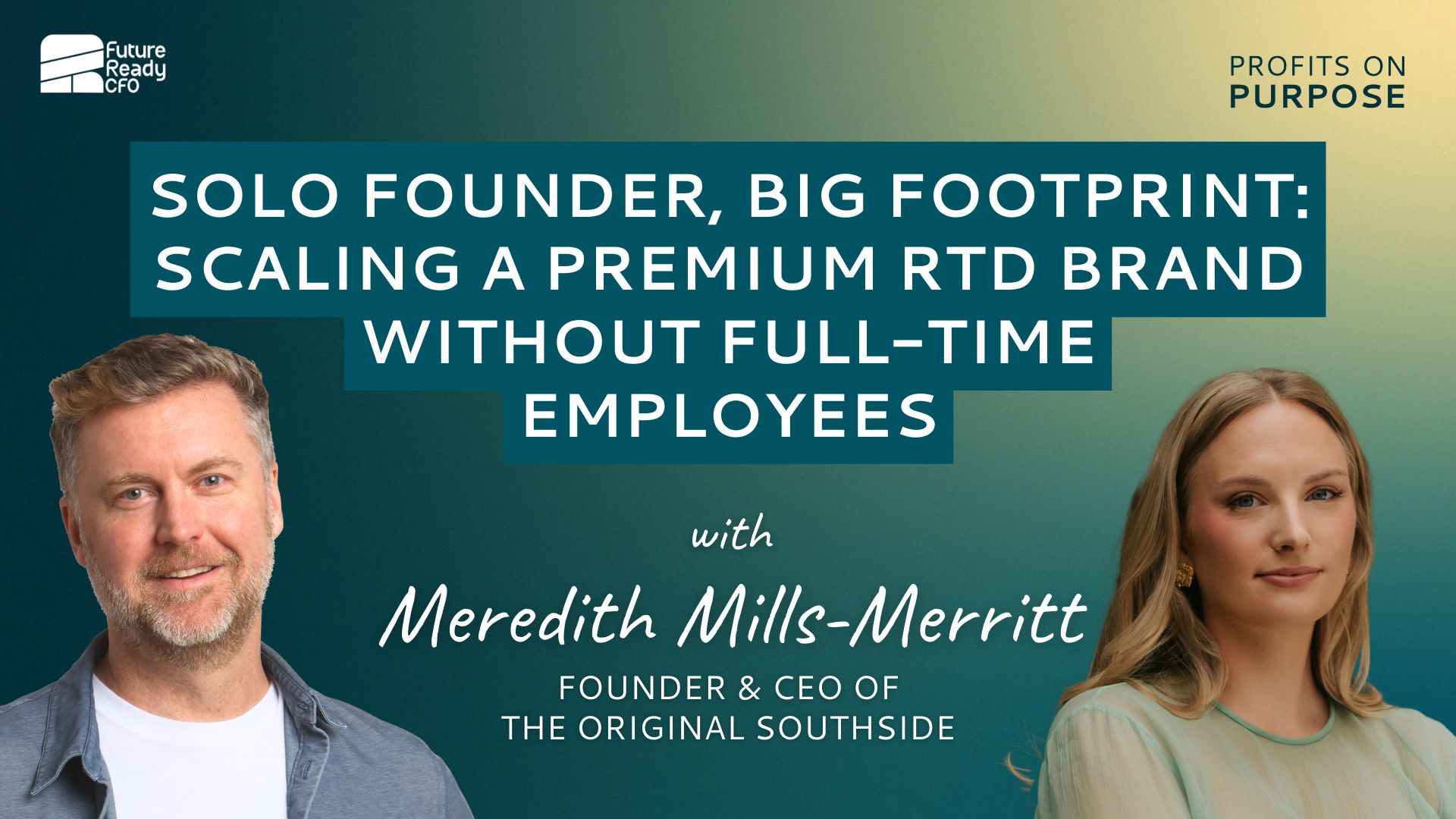
Episode Description
What happens when your gut says yes and every financial data point says run? Meredith Mills-Merritt, Founder and CEO of The Original Southside, found out firsthand when she signed a six-figure Florida Panthers sponsorship just months after brick-and-mortar launch — no CFO, no full-time staff, and a friends-and-family round that had barely closed. In this episode, Meredith walks Nate through the financial tightrope of scaling a premium RTD cocktail brand at speed: how she pitched distributors before she had consumer demand data, why she ignored the advice to go slow, and what it actually costs when you keep the wrong person on payroll three months too long. She also shares her surprisingly rigorous approach to tracking ROI on brand-building spend — and the Hampton polo event that worked brilliantly one summer and completely flopped the next. If you're a founder trying to balance mission, margin, and momentum, this one is for you.
Key Takeaways
-
Navigating alcohol distribution laws across the US enhances strategic market entry and compliance.
-
Rapid growth, chosen over cautious expansion, requires strategic risk management to maintain stability.
-
Agility and focus are essential in resource-limited environments to drive effective decision-making.
-
Trusting instincts over data can lead to innovative solutions and unexpected successes.
Building a robust advisory structure without a full-time team fosters strategic guidance and flexibility. -
Quick decision-making on failures and team changes ensures clarity and maintains momentum.
-
Balancing mission with profit is crucial for sustainable growth and long-term success.
See More from Meredith and The Original Southside
Listen to the full episode to discover how Meredith's experiences can inspire and guide you on your entrepreneurial journey. Don't forget to subscribe for more insightful conversations!
I hope you enjoy this episode!
Give it a like, share, and subscribe to not miss the content coming your way weekly.
– Nate and the Profits on Purpose podcast team




Transcript
-----
00:00 Introduction to the Journey
02:05 From Family Recipe to Business
04:12 Navigating the Alcohol Industry's Complexities
07:25 The Decision to Scale Quickly
10:34 Funding and Marketing Strategies
13:47 Communicating with Distributors
15:51 Balancing Data and Intuition
19:12 The Risks of Sponsorship Deals
21:48 Building a Supportive Team
27:30 Navigating Board Structure and Control
30:41 Learning from Mistakes: The Importance of Team Dynamics
35:14 Accountability and Performance Management
38:10 Measuring ROI in Branding Initiatives
42:59 Strategic Decision-Making for Market Expansion
47:05 Saying No to Opportunities: Staying Focused
49:51 Reflections on the Entrepreneurial Journey
-----
Nate Littlewood (00:06)
So what actually happens when you sign a six figure sponsorship deal just a few months after you launch with no CFO, no full-time employees and frankly not much of a safety net? Well today's guest did exactly that and it seems to be working.
Welcome to Profits on Purpose, the podcast for e-commerce and CPG founders who are looking to scale their businesses both profitably and purposefully. I'm your host, Nate Littlewood from Future Ready CFO, where I help seven figure e-commerce and CPG founders turn financial chaos and confusion into clarity and confidence.
Anyway, today's guest is Meredith Mills-Merritt, who's the founder and CEO of The Original Southside. Meredith took a family gin cocktail recipe, zero experience in the alcohol industry, but a background in beauty brand management, and she turned it all into one of the fastest growing ready to drink brands in the country. In just 20 months, she's gone from launch to over 25 states. She's landed deals with Whole Foods and Total Wine along the way, and also signed a sponsorship deal with the Florida Panthers that she openly admits could have been a complete disaster.
What's even more remarkable than all of this is that she's done it all as a solo founder with no
Excuse me, no full-time employees. Anyway, in today's conversation, we're going to be digging into the financial tightrope of scaling a CPG brand at breakneck speed. We'll be looking at the bets that paid off, the ones that almost didn't, and what it actually looks like to manage cash, inventory, and distribution when you're building a plane that's taking off. Meredith, welcome to the show. It's great to have you here.
Meredith Mills-Merritt (02:05)
Thank you so much for having me.
Nate Littlewood (02:08)
Of course. Well, I always like to get this conversation started just learning a little bit about your origin story and background. Tell me, how did this company get started?
Meredith Mills-Merritt (02:19)
Absolutely. So you touched on it a little bit. It was a family recipe and it was something that I grew up drinking that my mom would make all the time that I then adopted and would make all the time. And I really fell in love with consumer goods and consumer behavior. When I graduated from graduate school, I landed my first job with a prestige beauty company where we were really focused on product innovation and brand management for acne products.
And taking things from concept to launch, looking at the data, seeing what the trends might be was just so fun and fascinating to me that when COVID hit, I wanted to do something for myself. I always say that it felt like I had this entrepreneurial fire in my brain. So I always wanted to do something for myself. I just didn't know what it would be. And with my beauty background and the beauty category being super saturated,
seeing all that happened through COVID, I didn't feel like I could make a compelling enough product to compete in that sandbox. And so as many of us did during COVID, which was maybe overindulge here and there in alcohol, I decided to take a risk and hire a company to commercialize my family recipe. And ever since then, it has been off to the races.
Nate Littlewood (03:37)
Amazing. Well, you walked into this, I guess, without really any background experience in the alcohol industry. as I'm sure you now know better than most people, it's a notoriously complicated industry in terms of the distribution systems and so forth. Take me back to the early days here. What are some of the things that you perhaps underestimated most about this experience? And what are some, I guess, of the biggest lessons that you've learned in the past couple of years?
Meredith Mills-Merritt (04:12)
For me, I think just how regulated this category was. I was familiar with making products that had restricted ingredients in the beauty world, salicylic acid, retinol, things like that. Those went through the FDA. But when it comes to the TTB, which is what governs alcohol, and then you take into account the state by state laws, especially for spirits at certain percentages and ABVs.
I completely underestimated just how complicated it would be. And there's a reason that people describe selling alcohol in the United States, like selling to 50 different countries, because each state has different rules and regulations. And that has been something that I have had to learn and very fast, like you said, as we've scaled at this rate. So that is definitely at the top of my list.
Nate Littlewood (05:08)
Okay, that's an interesting analogy to talk about it almost as 50 different countries. Like, give us a sense for just how different to, you know, different states could be in terms of the rules and regulations.
Meredith Mills-Merritt (05:21)
Absolutely. So I will take my home States as the example. So I currently live in Southern California, but I grew up and was born in Oklahoma. That's where this recipe came from. So Oklahoma, you are not allowed to sell spirits in grocery stores. So you have to work with a network of independent liquor stores. And because we're 10 % alcohol by volume, even some States that do allow for you to sell in grocery stores.
We are above the ABV threshold. Florida is a good example of that. So Publix, we can't be in the normal Publix locations. So then you'd look at California where anything can be in the grocery store. You have spirits, wine, beer, RTDs, you name it. And I would just got so used to that, that when I got this whole thing started, I thought, it's going to be like this, you know, for most places, that is not the case.
And again, I think my naivete is what allowed us to innovate a really fun, interesting, different, delicious product. But knowing what I know now about that 10 % alcohol by volume plus the spirit space, you can see why larger organizations and people who have had more experience in the industry do what they do.
Nate Littlewood (06:37)
By that, you mean that they would actually design the product a little bit differently. So that's correct. More easily complies with the state regulations. Absolutely. Interesting. Interesting. OK. So one of the things you mentioned when we chatted the other day is that when you were speaking to people about this business and getting some advice, everyone kind of told you to go slow and take it steady.
But you made a fairly deliberate decision, from what I understand to do the opposite and go fast. Walk me through that. What made you confident that speed was the right play here and how do you think about the financial risk of saying yes to markets before you're actually ready to get into them?
Meredith Mills-Merritt (07:25)
Absolutely.
We fully planned on taking what was described to me as the Tito's approach since Tito's stayed in Texas and in Austin for a really long time and then made the deliberate decision to only go to markets that asked for them versus trying to beat someone's door down. So when we got this started, we fully intended on taking that advice with ready to drink canned cocktails. Not only is the category super saturated, but it has been changing at the speed of light. have seen those flavored malt beverages kind of take a turn.
You've seen premium formats, spirits based formats like The Original Southside take off. And when I was getting that advice, I know it sounds crazy to say as a gut feeling, if we could keep up with it, that we should try to do this as best and as fast as we can to get as much of a footprint as possible.
The reason behind that was we realized that we were filling gaps in certain distributor and retailer portfolios that we didn't know existed, which was a huge benefit to us at the time. And so we were the only certified organic gin-based cocktail for a lot of these people. And my school of thought, our board of directors school of thought, our investor school of thought was, let's take up as much of that space as we possibly can.
And all of the markets approached us. There was not a single market that we talked to that we're currently in that didn't actively approach us first because we didn't want to, again, waste our time, breath and effort beating anybody else's door down. It just came for us a little bit faster than we had thought. on the financial side of that, kind of like you said, you have to be
really strict with your spend. have to be really clear on your fundraising efforts. You have to be really clear with your inventory and warehousing solutions, which is something that we're constantly doing and evaluating week over week. But on the other side of that, you can't trademark a liquid. I can trademark everything around it, which we have done to protect ourselves, but there is nothing stopping someone coming out with another Southside and trying to compete.
So with that, what I felt would be the best protector is to take up as much space as possible in this category that continues to change day over day.
Nate Littlewood (09:47)
Okay, so I understand what you're saying from like a footprint and presence perspective but one thing that almost every earlier stage founder will say is that kind of getting onto the shelf is really the first part of the game and You then have to figure out how to get yourself off the shelves, right? With I mean, I'm not sure how much money you've raised But if you're willing to chat about the the fundraising you've done that would certainly be interesting but you know
I'm assuming that we're not sitting on tens of millions of dollars here in terms of capital. So how are you thinking about financing the marketing of all this when you have set up such a large sales, such operational footprint?
Meredith Mills-Merritt (10:34)
I wish we were sitting on tens of millions of dollars. That would be amazing. I think every founder does. And it's especially harsh coming from the big budgets that I was used to working with. But with that, will say, so when we went out for the only fundraising we've done to date is our friends and family round. We were targeting a million dollars. We ended up just raising about 1.5. So we were very fortunate to have that support.
Nate Littlewood (10:37)
You and me both.
Meredith Mills-Merritt (11:01)
We started that in 2023. So pre-launch and have continued that through. actually closed it at the end of 2024. So that has carried us through until now. We're launching a bridge round here shortly. And to think about the financing of the marketing, there were two things that I knew for sure. The first was, I don't want this to look like a startup. is going to personally, this is just, again, I didn't think that anybody was going to trust a really kind of
down and dirty looking startup. From my prestige background, I wanted this to look like as big of a brand as possible from the very first day out on the market. I wanted it to feel like this has been sitting on shelf for years and I wanted the consumer to be more attracted to it from that standpoint. On the other side, the second thing that I wanted to do was get as many cans in hands as possible to have it be not only a flavor play, but also a lifestyle play.
because we had seen this in the beauty industry where if it was something that felt more aesthetic, people would buy it. And even if they didn't like it, it was something that flew off the shelves. so having the perfect packaging, not cutting corners, making sure that we felt really good from the very first day. So with alcohol in particular, because you have to navigate the three tiered system, a lot of your communications at first aren't directly to the consumer.
It's from you as the supplier to the distributor. Then once you take that off, you go distributor to the consumer. So once you, to your point, it takes a lot of time. It's taken us 20 months since we first launched in brick and mortar, which was around May of 2024 to get onto the shelves that we properly need to be on in order to shift the conversation to us, to the consumer.
So we've spent majority of our time and money paying attention to the distributors so that they would take us on and they would support the brand and now we're just kind of approaching the consumer but in the meantime the through thread was tastings tastings tastings that's where our money was always best spent
Nate Littlewood (13:17)
That point you just made about the evolving focus of your communications from the distributor to the end customer is a fascinating one and something I haven't really thought about before. Tell me a little bit about how you do that. What is the message or the pitch that you give to a distributor when you don't yet have the end market demand data? You don't yet have the customer base. How do you get them interested in you?
Meredith Mills-Merritt (13:47)
For us, it was a two-pronged approach. The first was here's how much money you're gonna make because they're not gonna bring a brand on that's not gonna make the money, that's not gonna fly off of their shelves. They not only have to believe in the product, but they also have to see the margins. I mean, that's the down and dirty side of it. Like if they're not hitting their margin percentage that they want, they're not gonna take you on or they're gonna be more hesitant to take you on.
The other part of that is we were very strategic in that we picked handful of markets when we first launched to prove the concept, New York, Florida and California. So we sold through our first production run and we used that as leverage to be like, listen, we know people like this. We have zero brand awareness. We've been able to sell this many cases. Imagine what we could do with a larger distribution network. Our margins are leading industry margins. So for ready to drink cocktails, they suggest
that your margins should be between 30 and 40%, that's best practice. We're sitting at about 47.4 % right now. So we have been able to scale at a really healthy way for us, all the while protecting our margins and having those distribution partners.
Nate Littlewood (14:54)
Okay, I like it. Gotcha. So you mentioned something really interesting the other day, which was that every time, I think, please correct me if I got this wrong, but you said something like every time you've trusted the data over your guts, you subsequently came to regret that decision.
As I think you know, I'm a fractional CFO and I spend a lot of my time helping founders make decisions with data. And it sounds like you have lived through a few examples where that didn't really work out for you. I was wondering if we could start off maybe talking about the Florida Panthers example, if it's a good place to start, but tell me a little bit more about that. Like what's, what's happened and what have you learned about the right balance of following your intuition versus the data?
Meredith Mills-Merritt (15:51)
Nate, I truly believe that if you had seen the situation that we were in when we made the decision to partner with the Panthers, that you would have been like, I quit. And so that is, think, the prime example that I'm talking about. So mind you, the year is 2024.
We just launched in brick and mortar in May. We had been exclusively direct to consumer via our website for the months prior because like I said, we kind of soft launched in January, which is dry January by the way. So that timing was just nasty. Not ideal. So the person in partnerships that we were talking to, their girlfriend lives in New Zealand and had seen us on Instagram. And mind you, we were putting no paid ads behind it. It was just organic Instagram.
So they reach out and we have a conversation. And to your point, this is a, this at the time that it was presented to us would have locked us into a three year sports partnership that was not for the faint of heart. But when we looked at, okay, Florida is our number one state that we wanted to support. had the best distribution network there at the time, sports and activities and kind of.
Daytime forward things were always where we knew that this drink needed to live eat and breathe. So we took a look we negotiated our pants off and Decided to give this a go because the other risk to that is there was the opportunity that we may not have been the best supplier to them being so new which is something that I think a lot of people also kind of forget where
I didn't have the delivery network of an Anheuser-Busch or a Diageo. We were still kind of figuring it out as we went along. So there was a risk on their end that we couldn't make deliveries that, you know, they weren't going to be able to sell the product that maybe their fans wouldn't take to this beverage. So I think that's interesting to kind of touch on too, but if you were to have looked at
our kind of monthly forecast, if you were to have looked at everything that we had raised to date, if you were to have looked at the stage of the company that we were in and really look at the hard data, this would have been a fast no from anybody. And I say that all the time. so people are, know, being so transparent about it, I think is important. But because we took that risk so early on, it really was kind of a Cinderella story, so to speak, in that the product did
as well as we could have hoped it to do within the arena and with our partners. With that, we were also able to show not only the distributors, but also the retailers like Total Wine, like ABC, or even kind of the independent mom and pop stores that, listen, like there's real interest in this product. So we upgraded our distribution network to a more multinational partner.
We were able to leverage that into additional door openings, all of which ended up making sense. And then once you're kind of in that network and getting that awareness, you have fans from other States that come in. And that is what has allowed us to expand and kind of show that we're much more legitimate than just another RTD startup.
Nate Littlewood (19:08)
Okay, so there's a lot to unpack there. First question. Did you ever go through the process of thinking what's the absolute worst thing that could happen here? Like if this doesn't play out and it's a big flop, what did that picture look like?
Meredith Mills-Merritt (19:12)
Yes
Yes. So for us, the biggest impact would have been financial more than anything because of the sponsorship fee. So we took a look at, over the three years that they're asking for, what would we have to do to protect ourselves if we're committed and tied in to these numbers? And it would have been a much slower national kind of distribution play. So we would not be in as many markets as we're in and able to support them the way that we are. We would have had to figure out, it a problem with the product? That's something that we discussed. Would we need to reformulate? Would we need to lower our cost of goods? Would we need to, like I said, we had pretty healthy margins, but it doesn't mean that we want to keep paying what we're paying. And what were the areas that we could really trim the fat on? And I think
What I love about my board of directors is they are cowboys. They are innovators and they push to do things that would make me or you uncomfortable. And basically they were like, yeah, sure. You can think about what the worst thing that's going to happen is, or because you're so new in your business and you just launched, you can say what's the best thing that's going to happen. And we just got.
super lucky that it was the best case scenario for us and that they ended up winning the Stanley Cup for the second year in a row, which is crazy. So all of those tiny things added up to this big miracle. And they say that, know, success is part luck, part strategy, but luck really did play a role for us.
Nate Littlewood (21:09)
Yeah. Meredith, you've said, you've referenced we a number of times when you're talking about decision making. You're a solo founder. You've also mentioned a couple of times that you have a board of directors behind you. I understand there might be a couple of fractional people supporting you as well. Can we talk a little bit about the team? how, how have you gone and gone about setting up a board of directors? What does that look like? What is the, know, how often do you engage with them?
and beyond the board of directors, what are the people, the fractional people look like who are helping you actually run the business?
Meredith Mills-Merritt (21:48)
Absolutely. think a lot of founders and individuals can relate to that. And so that's the first piece that I'll say. The second piece that I'll say is to build out the board of directors. It was at first, know, mostly family members or trusted people that had helped us during this process. As we started to fundraise, we assigned a dollar amount to a board seat. And then that's how we had people kind of transition on board to see if they were super interested and
you know, wanting to support in a more aggressive manner. We don't ask really anything of our investors other than keep on loving Southsides, keep on supporting us the way that you're supporting. We meet monthly and have those board meetings. We also meet monthly to have our P &L meetings, make sure we're keeping up with forecasts, what's our spend look like, and then all of that information also gets relayed back to the board of directors.
with the fractional people on our team, they did not join us until around the middle of last year. So from launch around, like I said, May of 2024, I was so low until about the middle of last year, which was a little bit more than I could keep up with, which is why we needed the help. have no full-time employees. Like you mentioned, we're purposefully decentralized so that we can be flexible and nimble, which is what the beverage category calls for, especially when you throw alcohol into the mix. So again,
Where I lack insight is I have no industry experience. So finding someone with industry experience was non-negotiable. So we have two people with industry experience and one person that just has much more experience in their kind of subject matter experts. So that person is, I worked with them in my beauty days. They are supply chains and operations focused as it relates to.
all of our manufacturing that we constantly do because as you know, with CPG, you have these big dips, you refill, then you deplete, you refill, you deplete. So he has been instrumental to our team. Same with our VP of the Southeast. like I said, Florida, really important state for us. When we took a look at the flavor profile of this beverage, we knew...
that it was going to need to be in a region where people were more open to the higher ABV, more open to the use of cane sugar. So it was not a low calorie or low carb play. So that marketplace became really expensive. Plus having the boots on the ground support for the state of Florida where we do have this large partnership was extra important. And then the last piece of that puzzle is someone who can help me grow in advance as a, know, CEO who will eventually transition to
the board as a founder is a chief operating officer. And so that person could joined us with decades of experience with a large distributor, VP of spirits for two states. And it has been absolutely instrumental to our growth and for all of the negotiations that we constantly have to have as well as
There are things that are priority items to me, and I say this all the time, sometimes I think founders don't necessarily make the best CEOs. And I don't know if you've seen that in your kind of line of work as well. We're not able to be as objective as we need to be. And there are things like I touched on that are really, really, really important to me that may not be important in the grand scheme of things. And so finding a team of people that level you out and say, Hey, this is more founder brain than CEO brain for now has been.
additionally impactful for us.
Nate Littlewood (25:23)
Tell me a bit more about that. I you're absolutely right, by the way, about the founder CEO thing. I've actually done a couple of past episodes on this.
Tell me about the founder optimism element here, because one could argue that that was potentially at play with this sponsorship deal. Like the founder says, yes, this will be fantastic. Yes, it's going to be wonderful. No problems. We'll cover the sponsorship fee with sales. Everything's going to be great. How do these people around you help moderate that and guide you towards balanced decisions?
Meredith Mills-Merritt (26:01)
I may be one of your founders who is more realistic, which is just a fancy way of saying pessimistic.
And so walking the line, walking the line of I have to be positive because if I'm not, this whole thing spirals out of control. the CEO of Nvidia actually has some really interesting dialogue on this that I have done a few sub-sec articles on in terms of he straight up says that he wouldn't do this again. And I think that having that conversation is also really interesting. I'm not saying that that's what I'm saying for myself, but understanding.
that you have to wake up every day and effectively stay delusional is balanced by the people that you surround yourself with. And then you as the founder have to walk that tightrope that is the middle ground. So every day when I wake up, there's a whole assortment of issues. There's a whole assortment of things that are happening. And let's take our packaging, for instance. When we did our first production run, we did
digitally printed cans versus direct print cans. I was devastated because I hated the micro gap at the top that showed aluminum. And everyone around me was like, what are you talking about? This looks fabulous. And I said, no, this is something we're changing on the next run. Nobody else cared about me. It did not impact the launch of our business. It did not impact anything that I thought it would impact.
or that I was worried that it would impact. again, because I'm so close to it, that's one of the decisions where, yeah, sure, great. We changed it over time. Now our cans are amazing. You can, mean, you got to see them over the weekend, but it's little things like that, that I'm so stuck in the weeds. I can't zoom out to that 80,000 foot view, which is why I have my team in place to do what they do, which is to level me back and say, Hey, you're not thinking about this the right way. You need to be looking at X, Y, and Z versus what you're focusing on.
Nate Littlewood (28:01)
Where did that get you to in terms of board size? Like how many people are on it?
Meredith Mills-Merritt (28:06)
We currently have four people, which we only had four seats available. And so that's really kind of just in the articles of incorporation of our company is how we decided that because we didn't want this to necessarily get out of control as well as we wanted to keep as tight of a leash on it as possible. And so I think
What I love about this podcast is it talks about kind of the unsexy stuff of foundership, which is this was such a risk from the beginning with my own personal investments, with family investments, with friend investments. The last thing we wanted to do was lose control of it. And so in the articles of incorporation, how do you protect yourself and your baby and build not only a board, but also a board structure?
that has the company's best interest in mind, but keeps out people who may not have the best interest going forward. And so for us, we felt that a financial barrier would help protect us because that person is then very well incentivized to see the success of this company through. And so that was the thinking for us on that. We have an advisory board as well, which has
Which is small, small but mighty. And it's made up of professors who oversaw this project, who fostered my education in my graduate programs, who turned me on to consumer goods and brand management. And they serve as kind of an additional resource. But in terms of the day to day, down and dirty, that's where my consultants come in the month over month.
progress review, where the board of directors comes in and then ad hoc questions, comments, concerns is where the advisory board comes in. And I also really try to make an effort. have a very structured set of Monday meetings across the board, which kind of helps tie everything together as well.
Nate Littlewood (30:14)
Gotcha, gotcha. Well, I must say it sounds to me like you've been incredibly thoughtful about how you've structured this and have, you know, multiple levels or tiers if you will, like these groups of people around you to help make decisions and remove bottlenecks and so forth. You're certainly a lot more sophisticated in this regard than a lot of the other founders that I talked to.
We've spoken about a number of the wins that you've achieved, like you and this small but mighty army of yours. I want to flip that coin over and talk about maybe some of the biggest mistakes or challenges that you've encountered so far. What have been some of the biggest disappointments that you've encountered on the journey so far?
Meredith Mills-Merritt (31:06)
Just like you can have an amazing set of people, you can also have a less than amazing set of people. And for us, the biggest mistakes that we would make, especially in the early days pre-launch, were trusting people who did not live up to their expectations and keeping people on for far too long, which you know as well as I do.
that can be not only a detriment to the bottom line, but also to the organizational health as a whole. So the advice that I received from my dad, is a lifetime, he's an attorney, he's a businessman, was the first time that you think about firing someone is when you should do it. And that was really difficult for me because to your point, while I'm being realistic about the situation,
I didn't have the industry experience to say in a more quick way, hey, this actually isn't what you were supposed to be doing. So let's keep them for a couple months longer. Well, a couple months can be anywhere from six to $30,000. And then you're really, really upset with yourself that you're like, my gosh, I could have saved this amount of money had I made this decision when I was first thinking about it. And I think people
And the people that you surround yourself with are the most important pieces of the puzzle when it comes to getting to the goal that you've described. So for us for this year, our forecast is 26,000 cases. So at the beginning of the year, and when we set this forecast in Q4 of last year, we took a really hard look of, we have the team members in place to get us there? And we did another organizational shuffle.
which is also why we don't have any full-time employees, which is why we keep tests on a 90-day rolling basis. If you have hit your 90 days and you haven't shown us what you were supposed to show us, I'm so sorry, it's not gonna work out. And just being really strict with that. But it's taken us almost two years to get that in place.
Nate Littlewood (33:13)
So your dad's advice sounds extremely wise. Did you heed that immediately when you heard it? It sounds like you did and you dragged things on.
Meredith Mills-Merritt (33:23)
I sure did. I sure did because I really, the difficult part is, especially when you like them as a person and you aren't treating them like a number, which is something that I really tried to do. try to foster, even though we're a completely remote organization, I try to be as people first as possible. And as a CEO, when you put that hat on, I'm a first time CEO. I'm very young as well. And.
It was really difficult for me. had led and managed teams before I had let people go before, but there was just some additional high stakes and kept them on for a little too long. I wanted to believe in them. really did. We, you know, did the whole, monthly conversation. did the check-ins, we did the this, we did the that, and it just didn't end up getting us anywhere. And so when you turn around and you've kept someone on for
six months and they were on for three months too long and you look at what they did or didn't accomplish, it just kind of adds insult to injury for everybody because A, they weren't doing themselves any favors and you also didn't give them the proper feedback to grow as an individual. think that's the other piece of this where that was a really tough.
call for me because again, I do feel so young and this is my first time being a CEO, you who am I to give this person who has more experience in an industry than I feedback. It's a weird loop. And I think that it was excellent advice from my father, but I wish I had heeded it earlier for certain individuals that were a part of our company for a while.
Nate Littlewood (35:01)
Okay, so how have you gotten better at that over time? Like what were the hardest parts of heeding your dad's advice, I guess?
Meredith Mills-Merritt (35:14)
The accountability factor, think is the biggest thing. Numbers don't lie. again, he, you know, figures don't lie, but liars figure. So that's, that's the, that's the part where we, like I said, we have these weekly meetings. We also have our monthly PNL meetings where we discuss every single person, including the people on the call. I mean, you're pretty much being asked, you know, do you feel like you have done what we've asked you to do?
And then we look at our regional salespeople, look at the tastings agencies we use, we look at the PR company that we retain, we look at every line item across the board every single month and we say, did we get value for this? Because if the answer is no, then that clock starts ticking. And if it's been more than 90 days, let's say for an individual who's responsible for a regional market, then we...
really have to do a deep dive and week over week when we have our Monday meetings, we check in and we say, Hey, okay, you know, you've got 30, 60, 90 days left. You know, here's what your expectations are. Do you think you're going to be able to make up for it and go from there? So having the team accountability as well for me was important because when it was just sitting with me and I thought, okay, this person's going to get better. I can foster it myself. I can take it on myself. I can have the conversation myself.
I think that's where a lot of us founders get lost, where is we think we can do it all. And that's just wasn't it for me. And so tapping in the team and tapping in the people who did have the experience and did have the authority to say, Hey, yeah, no, your gut feeling on this person is correct, was super helpful.
Nate Littlewood (36:55)
I'd love to be a fly on the wall for this Monday meeting of yours. It sounds pretty freaking intense if I can be honest.
Meredith Mills-Merritt (37:02)
They're not they're intense and we have a very set agenda but we do it with the best of intentions which is great because we all want to grow together every single person I feel so lucky care if this is my baby it's their nephew is how I describe it so I'm very fortunate to have surrounded myself with people like that and I think the other thing too is it is so easy
to have things get out of control so fast. So the second that you take your eye off of one thing, you have no idea how south it can go. So we try to wrangle all of that every Monday and just see what happens.
Nate Littlewood (37:44)
Okay, sounds like a pretty tight ship you're running there.
Meredith Mills-Merritt (37:49)
I'm trying.
I'm trying.
Nate Littlewood (37:52)
So we can ask for. So I wanna circle back to something you mentioned just now, that you're looking at all of these expenses and line items and asking yourself, did we get value from that? Which is kind of indirectly saying, like, is there a positive ROI here? Correct.
For someone who is from the branding world, you will be more familiar than most about how difficult it can be to prove ROI and build the financial argument for lot of initiatives that are branding related. I'm curious what your perspective on that is. You've come from the branding world. You sound pretty savvy as a founder in terms of how you think about the numbers and apply them.
apply that to a business which is so focused and such a core part of what you're doing is brand building. How do you approach that?
Meredith Mills-Merritt (38:50)
My educational background when I did my MBA was really heavily finance focused. I thought I wanted to go into investment banking or management consulting, and I quickly found out that that was not what I wanted to do. So I do have a little bit of kind of the quantitative and qualitative balance where people with my background obviously tend towards the creative and the design and the brand, but
as a brand manager for some of these different products and brands and places, you sort of act as a mini CEO. It's very cross-functional. was honestly perfect training for what I find myself doing. And to take your example, let's look at brand awareness, which is notoriously impossible to track and very expensive. So for us, we had to have the decision of, what does a more positive return look like for us as we try to build this brand awareness? And for us, it was,
If we do an event, what were the outcomes surrounding that event? And by that, I mean in an area, were we able to upgrade our distribution network? Were we able to open additional retail doors? Were we able to find leads that would lead us to other quantifiable things? And if the answer was yes, we kept doing those events. And if the answer was no, we cut it.
An example of that is we did for two summers, we're not going to participate this summer because last summer it was a different answer than the first summer, was an event out in the Hamptons out in Long Island where it was polo themed and our launch year that we did it, it just went off like dynamite. It was great. We were able to open a number of retail doors. We were able to use it as an example to upgrade our distribution network from Park Street.
which for those in the industry, Park Street is effectively self distributing versus kind of a more serious distributor. So we were able to get a more serious distribution partner. We were able to go into a number of new doors out across, you know, all the different neighborhoods and the Hamptons. And so we were like, yep, great. Okay. We're going to do it again next year. This obviously did so well for us. It's only going to enhance the partnership. So then we do it last year. It's slightly more expensive year over year. These fees people want more and more as you know,
And we upgrade the design. We decide, okay, this was one of our most successful events in our launch year. We're just going to really go all in. We did not see a single thing from it. And so it was like a night and day difference. so to your point, trying to run such a tight ship, trying to quantify what's success and what's not.
is an ongoing conversation month over month because what worked for you previously might not work for you now. And so we decided that that was kind of the example where we were just going to say, okay, we know what works and it's tastings. We don't need to spend the money on these branded events anymore because we have enough going for us that we can really just hyper-focus on
the local tastings, the chain tastings, the chain placements and supplement in between with other things instead. So I would say, yes, it's extremely difficult to quantify those returns sometimes, especially for us in the stage that we're in, but the little things like distribution, sales, how can we attribute to it after the fact that has helped us along the way.
Nate Littlewood (42:21)
Okay, I see. Looking ahead into 2026 and beyond, I would guess that you've got a lot of options and choices in terms of where you go from here. We could be doubling down on the marketplaces you have. You might open up new marketplaces. I think you're only one skew now, is that correct? That's correct. I'm not sure whether expansions of the product catalog are on the radar at all, but
What are some of the most complicated decisions that you're kind of grappling with as we look into 2026 and beyond?
Meredith Mills-Merritt (42:59)
The way that I like to put it, because we are such a small and nimble team, is if I am a kindergarten teacher and each market is one of my kindergartners, I can't pay attention to all of them all the time. There's always gonna be a problem child, there's always gonna be a star child. So how do you manage that is the most important thing for us going forward. So we all sat down and identified our top five kind of.
priority one states in terms of focus and that came from what are the state laws and what are the opportunities for expansion with chain partnerships and things that make us a lot of money and how to what is our working relationship like with the distributor there because there are certain markets where no matter what you do it may just not be worth it but there are other markets
that you may not have paid attention to that did really well. And so at first sniff, you'd be like, if I put more money into this, this is going to be more successful. Right. So we actually have a way and month over month, we track sales per market. We do it by region. So Northeast, Southeast, Midwest, you name it. We track the dollar spend. We track the dollar sales, and then we show kind of what
the return on that might be and anything over a 2.5X is like a green light. We're like, okay, great. We're going to keep doing this. Anything under 1.5, we reevaluate. So there were certain regions last year where we poured a ton of money into and it didn't go very far. And then there were certain regions where we poured a little bit of money into and it went super far. So that's actually how we re-
realigned all of the expectations in terms of spend. And so for 2026, that's our biggest piece of the puzzle is just making sure that the areas where we are spending money are actually resulting in what we want it to result in, which is easier said than done. So.
Nate Littlewood (44:54)
Tell me more about that.
Meredith Mills-Merritt (44:57)
Yes. with certain markets, there are a lot of opportunity to work with tasting agencies, to work with regional brokers, to work with a number of things that you hypothesize could work to lead to those additional sales. I'll use Florida as an example, because we had the retail support, because we had the Panther support.
We thought, okay, this is going to be a no brainer bringing someone on on a small monthly retainer to open up additional retail doors and support us in the market is going to just three XR efforts. was not the case. So then you take a look at the Northeast, which we had largely used last year because it was our first summer as a test market for some of these new States, Connecticut, Massachusetts.
And those markets without any attention did amazing. And so for this year, we've reallocated some of that spend to say, Hey, okay, this didn't go as far for us in Florida. Let's test it out in the Northeast instead and see what happens. So kind of just evolving there.
Nate Littlewood (46:16)
Gotcha, gotcha. Okay. So one of the things I observe with a lot of the founders that I work with, especially during the initial onboarding phase is they'll rock up with 20 or 30 different priorities slash projects slash shiny objects that they're wanting to spend time on. And I commonly have to say to them, listen, if you tell me you've got 30 different priorities, I'm hearing that as you've got none. It's not possible to have that many priorities. You sound like you've
done a pretty good job of getting focused and it sounds like you've got some pretty good systems behind you in terms of tracking the impact of these things. I'm curious though, what are some of the best opportunities that you've forced yourself to say no to?
Meredith Mills-Merritt (47:05)
The sparkly stuff, like you said, is really exciting and enticing to me and really difficult to track the return on. And most of the time there's really not because we work with such a strong PR partner. We get brought opportunities all the time that are awesome, but just for objectively larger companies with bigger budgets and
As the founder, not the CEO, as the founder, I'm like, my gosh, the inclusion in this event or the feature here, I know would be game changing. But then when you put the CEO hat on and you bring it to the team and you bring it to the board, they're like, this is a ridiculous amount of spend and there's no world where we can justify it. It's not like the opportunity with the Florida Panthers or LSU athletics where they purchase the product. It's you donate the product.
and you pay this amount of money. so for us, just staying true to our more critical tactics, which are those industry festivals, because you can have the tastings. They're typically a little much lower in terms of spend and people arrive in a consumption mindset, which I think is the other thing to mention here because it's alcohol versus beauty or something of the sort.
If you are in the wrong place at the wrong time and people aren't wanting to drink or there was no reason for you to be there anyways. so keeping those industry festivals, keeping those key partnerships like the Panthers that do purchase product from us or any sort of more owned, call it a liquid to lips event. That's where we really try to stay in our lane.
because we know that that works. But I would say the most difficult ones to your point are, know, hey, you could be included at the PGA for, you know, this astronomical amount of money and there'd be all this coverage and this, that or the other. Yeah, that sounds awesome, but it's just totally not realistic.
Nate Littlewood (49:10)
Yeah, yeah, yeah, okay, I hear ya, I hear ya. All right, well we're have to wrap things up pretty soon. I wanna ask you a question that I guess is an invitation to reflect back on your journey so far. I wanna rewind to the point just before you started this company and assume that the current version of you from today is able to sit down with this young entrepreneur
for a little bit of a chat and conversation. What advice would you give to this younger pre-entrepreneurial version of yourself?
Meredith Mills-Merritt (49:50)
wow. I love that. The theme that I commonly reference is be careful what you wish for because you just might get it and then you get it and you're like, you don't think past that point. I think for me as a young entrepreneur and founder, getting on Whole Foods shelf was like my end all be all.
Well, now I get an email that we're expanding into over 107 new whole foods stores. so once you have it, what are you going to do when you get it? Having more of those conversations in terms of longevity and management and operations can be difficult when you're first starting out, because you're like, why would I plan this far? Because there's a chance that it wouldn't happen. So.
I would spend some time talking to younger Meredith about maybe having some of those plans in place and we make do.
Nate Littlewood (50:58)
Okay, I assume you've you must I guess implicit in your answer there is that maybe Whole Foods is not all you wish for and that maybe it's a little bit a little bit more complicated than what you'd once anticipated is that am I reading between the lines correctly?
Meredith Mills-Merritt (51:16)
No, you're like, it's everything I could have possibly wanted and more for this brand, which is so exciting. And so to see the work pay off, you're like, this is the highest high. It's amazing. But then you kind of go into the panic factor of this is really real. We're going to be on some very real shelves. We're going to be held to some very real metrics, not that we weren't prepared for it and not that it's not something that we thought of. But I think to the full extent.
of what does it take to launch? What does it take to maintain? What does it take to stay on shelf? Because just because you're selected for core doesn't mean you're not going to get an email, you know, a couple months after saying, Hey, you're being kept at this store and cut from this store. And I think the what ifs or the hows or the doubt of could I have done more for this store versus this store? What am I doing in this market versus this market? So some of the super kind of gritty details
are there, but I do say, think to all entrepreneurs, like shoot for the moon. And if it happens, great. If it doesn't, you're still out there amongst the stars. So you better be sure you actually want to be out there with the moon and the stars, because I think there's a lot of people who, once they start this undertaking, it's super overwhelming. So just making sure that, yeah, you know, you signed up for this, but do you really know?
what you've signed up for is that.
Nate Littlewood (52:44)
Meredith, you have been amazing. It's been such a blast having you on. I have a huge amount of respect for the way you're going about building this business. I think it's really, really cool. And I hope you keep on shooting right past the moon. Thank you. Before I let you go, is there anywhere you would like to direct people to learn more about you?
Meredith Mills-Merritt (53:01)
No.
Absolutely. So you can visit our website, which is just drinksouthsides.com. Or if you want to peek into what our world looks like, our aesthetics, our fun stuff, you can visit us on Instagram, which is also just drinksouthsides.
Nate Littlewood (53:23)
I'll include all those links in the show notes below. But thank you again, Meredith. I really appreciate you joining us today. Take care.
Meredith Mills-Merritt (53:29)
Thanks.
Want more like this?
Join our newsletter list and every Thursday morning you can look forward to actionable insights and free tools for scaling your brand.
We hate SPAM. We will never sell your information, for any reason.
