
Mission First, Impact Later: Building a Purpose-Led Brand | Jess Haghani | Lucille Health | Profits on Purpose
Apr 22, 2026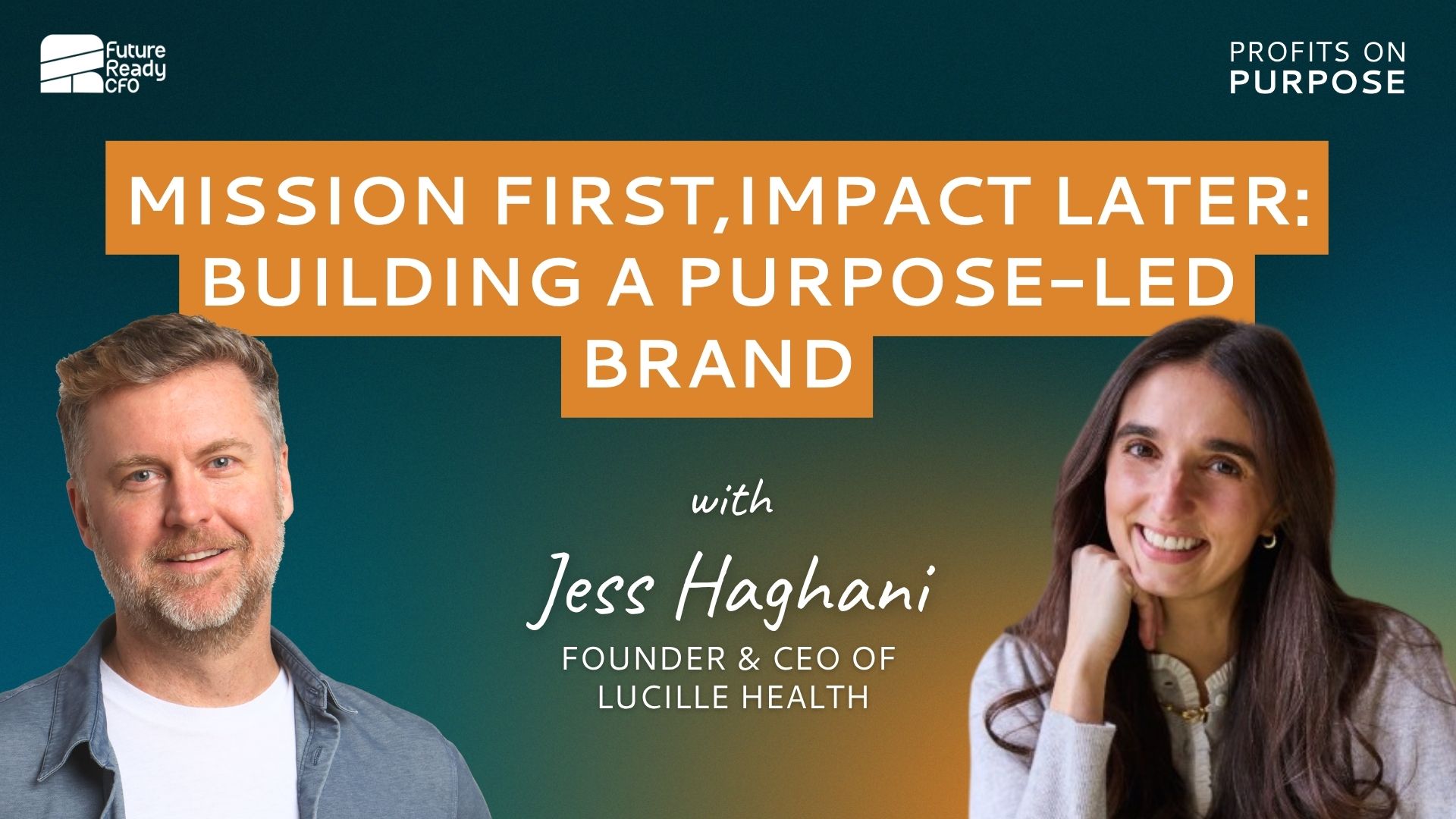
Episode Description
What does it actually look like to build a business where the mission isn't layered on top of the product— It's the entire reason the product exists?
Jess Haghani is the Founder and CEO of Lucille Health, a better-for-you nutrition brand built specifically for aging adults, a category that has received almost no meaningful innovation in decades. In this episode, Jess walks us through her journey from private equity at KKR to founding Lucille, why she chose simplicity over complexity in her business structure, and how she thinks about the real tension between mission and margin. She shares the pricing math that helped her get comfortable with a premium product, why repeat purchase rate is her north star metric right now, and the hard-won insight that you have to earn the right to make an impact through every small decision you get right.
If you're building a purpose-led business and wondering whether profitability and mission are really compatible— this one is for you.
Key Takeaways
- Purpose-driven startups achieve impact through small, consistent decisions embedded in daily operations.
- Building a profitable core first is essential for sustaining mission-driven impact.
- Brands thrive when the mission is ingrained in the product, creating authentic differentiation.
- Focusing on depth, not breadth, enables transformative impact in purpose-led businesses.
- Early financial discipline supports mission expansion and impact growth over time.
- Aligning purpose and profit ensures business longevity and societal impact.
- Shifting from investor to operator mindset enhances strategic clarity and purpose alignment.
See More from Jess and Lucille Health
Listen to the full episode to discover how Jess' experiences can inspire and guide you on your entrepreneurial journey. Don't forget to subscribe for more insightful conversations!
I hope you enjoy this episode!
Give it a like, share, and subscribe to not miss the content coming your way weekly.
– Nate and the Profits on Purpose podcast team




Transcript
-----
00:00 Introduction to Profits on Purpose
02:12 Jess Higani's Journey to Entrepreneurship
08:43 The Need for Better Nutrition for Aging Adults
12:25 Choosing the Right Business Model
15:25 Balancing Profitability and Purpose
18:44 Pricing Strategy and Product Decisions
22:19 Targeting the Right Customer Base
25:06 Leveraging Financial Background in CPG
27:27 Navigating Impact and Quality Decisions
31:31 Key Metrics for Success
34:45 Advice for Purpose-Driven Founders
-----
Nate Littlewood (00:05)
Have you ever asked yourself whether Purpose and Profit are actually compatible or whether one of these always comes at the cost of the other? Today's guest has spent years wrestling with that exact tension and she's now building her answer to it from scratch. Welcome to Profits on Purpose, the podcast for seven figure e-comm and CPG founders who are navigating the intersection of purpose-led entrepreneurship with the realities of needing to generate a profit.
I'm your host, Nate Littlewood from Future Ready CFO, where I help e-commerce and CPG founders turn financial chaos and confusion into strategic clarity and decision-making confidence. Today's guest is Jess Haghani who's the founder and CEO of Lucille Health.
After starting her career in senior housing development, spending time in real estate private equity at KKR and earning her MBA from Harvard Business School, made a bet that a lot of investors would never make. She actually decided to become the founder instead of the financial backer. Lucille Health is a better for you nutrition brand built specifically for aging adults.
A category that has been almost entirely overlooked by today's CPG industry. Jess is doing something rare here. She's building a business where the mission isn't just a marketing layer that kind of sits on top of the product. It's the entire reason that this product and business exists. Today, we're going to be exploring what it actually looks like to build a purpose-first brand. The trade-offs that founders face when profit and mission pull in different directions and what Jess's journey from investor to operator has taught her about building something that lasts.
Jess, welcome to the show. It's so great to have you here.
Jess Haghani (02:11)
Thank you. Yeah, so happy to be here. Very excited to talk all about this topic.
Nate Littlewood (02:17)
Likewise, we're just, you've described watching what happened to your grandmother as a very important and defining moment for you. But I've realized that there's a difference between noticing or observing a problem and actually deciding that you want to go and start a business to solve it. I was wondering if you could tell me a little bit about how and when you crossed that line.
Jess Haghani (02:44)
Absolutely. I'd say, you know, I'd start out by answering this question that the shift wasn't a single defining moment. I think for a long time, I felt like a bystander myself. What was happening to my grandmother was, or, you know, very much so organically going on in my family, it was becoming a huge priority for a lot of us to help take charge of her care. And she was doing so much work for herself. And we were just observing as a group and
with my personal interest in the space, how so many of these options just lacked better nutrition, better ingredients, cleaner ingredients, and really a dignified brand. And so I would say that it was really less so a single defining moment and more just a slow accumulation that eventually became unavoidable. And I could just see very clearly spending a lot of time with her and being involved in her care that the system was failing her. The products were low quality clinical.
And honestly, a little dehumanizing, I would really encourage you next time you're in a grocery store or pharmacy to just take a look at one of these legacy shakes and look at the ingredient list and the nutrition panel. So for a while, it really just sat as a frustration for me. I was still working at the time and I wasn't thinking about being an entrepreneur. wasn't embracing the founder mindset or really thinking about entrepreneurship as something that I could do. But at some point over the past couple of years, and I think it was a combination of
asking myself two big questions. Number one, if this is so broken, why has no one fixed it? And really trying to understand the systematic reasons as to why we're in this position in the first place where older adults make up almost 20 % of the population, they're getting less than 1 % of food and beverage innovation. The options out there have not kept up with the standards and the needs of older adults over time. So that was question number one. And question number two was a lot more personal.
if it's not going to be me, then who's going to do it? And so I think over time, I just started asking myself those two questions over and over. And with that, it just became really difficult to walk away from. And I think that was the turning point where it stopped becoming something I was noticing and just really frustrated by, but actually took it into my own hands and founded Lucille to start fixing the problem.
Nate Littlewood (05:07)
interesting. Two really powerful observations you made there. I'm curious on the first one though, why hasn't anyone already done this? Where did you get to with that line of inquiry?
Jess Haghani (05:21)
Yeah, it's a great question. think after spending a lot of time with that question, I think there's a few reasons why, and it's probably these reasons don't encapsulate all of the reasons why, and I'm probably missing some, but there's a couple that really stand out to me. Number one, it's, I think as an entrepreneur, you naturally want to create a product for yourself or for your friends, for your cohort of people that you naturally
understand the shopping behaviors of the dynamics that you are the end consumer of, that you get to enjoy the fruits of your labor and what you're working on. And as a byproduct of that, there's no 85 year old, 90 year old entrepreneur that's really out there trying to create a better for you product for that demographic. And all of the focus in young entrepreneurs is much more, you know, narrowly focused on our cohort millennial Gen Z.
Um, I also think that it, it just has been run, it's been grandfathered in, or it's been run by these incumbent brands for so long that that has just become the standard and trying to challenge them definitely is really difficult. And I think that that, um, that scares a lot of people or that, you know, turns people away that the market is controlled by two pretty large.
companies that it will, you we know that it will be difficult to kind of break in and capture market share from them. But I don't think that that's a reason that it can't be done. I just think that that's a challenging thing. And then I think lastly, just culturally in the U.S., we have a really different perception of our senior citizens and the elderly here relative to other cultures around the world. You look at Japan, they are leading the demographic shift.
much more outweighed to 65 plus, they're about 30 % 65 plus. They're innovating 30 % food and beverage, new products per year focused on 65 plus. In the US, there's a 19 % disparity gap. And you look at cultures like that in Asia or other countries in Africa, and the grandparent is the core, core of the family all the way up until the end. And they are oftentimes living with their adult children and their grandchildren at home, very much so involved.
in that family life still. And in the U.S., for better or for worse, there's obviously huge benefits of the senior care economy and assisted living economy that we have set up here, but it's not as replicable in other places around the world. In the U.S., we have over 30,000 senior living communities. And I think that given the size of that, we're sending a lot of our grandparents and parents away from us.
And when, of course, families are still very much so involved in their care, but there is a disconnect, obviously, when they're not spending so much time with them on a day to day. And so I think you put all of those factors together and you, you start to understand why. A, there's a huge opportunity here, but why this has been traditionally untouched and really why it needs to now change.
Nate Littlewood (08:42)
I I see. And I understand that some of the early thinking that you did behind what has now become Lucille Health was actually the subject of your final paper at HBS. Can you tell me a little bit about what you focus on in that research and how it has evolved into the business today?
Jess Haghani (09:03)
Yeah, definitely. I just for context, I had started Lucille during my second year at HBS. And so in the last quarter of school, I took probably one of the most profound classes during my time there. was called Business Solutions for the Global Poor. It was taught by Kashan Rangan. He was incredible. And we discussed a lot of topics, but the class really centered around when and how businesses and nonprofits should participate in serving those less fortunate than us and how to
stoke and shape your own leadership journey towards making a positive difference in the world. And again, at the time it was starting Lucille, we had recently incorporated, we had raised the first round of our financing. And the final paper, was the very last thing I wrote at school, and very much so felt full circle writing this kind of about my next chapter I was about to embark on.
But it was really about the kind of company that I hope and believe that Lucile will become really the broader societal impact, how we're going to give back both in the short and the long term. And I would say it was pretty expansive. Maybe some would say it was a little idealistic, but I was rereading it in preparation for this.
And I just so firmly believe that you have to dream big and seeing or being fast forwarded one year from now is really cool to see how many things we are still actively engaged on and working on and being able to actually bring those to life. So I think what changed was not the ambition. It's just how much closer I am to reality now. I think when you start building, you realize that impact isn't one huge decision.
It's really the accumulation of teeny small decisions that you're making on a day to day and what those trade-offs are. things around ingredients, taste, packaging, pricing, distribution, asking those questions, what the trade-offs are there, what are you willing to make, what are you willing to sacrifice, how does one decision impact many others? I think each one of these topics has huge implications to the business at the whole. So the vision of wanting to make a huge difference on older adults and their nutrition is absolutely still there.
But I think what I learned and especially in rereading it is you're actually earning the right to have that impact, to make that impact through all of the small decisions that you're hopefully getting right or getting the majority of them right on a day to day.
Nate Littlewood (11:36)
That's a really interesting way to put it. And I definitely want to circle back to some of these, you know, decisions in a little bit. But before we get there, I wanted to take a minute to just talk about the business model decision and the company structure. There's obviously a lot of different options or ways that you could have organized the business that has now become Lucille Health, right? It could have been a nonprofit.
It could have been a social enterprise. could be a B Corp. I'm not sure. Maybe you are pursuing B Corp status at some stage. I don't know, but could you walk me through how you decided on the right business model for this entity? And were there any notable trade-offs or compromises that you had to make along the way?
Jess Haghani (12:24)
Yeah, definitely. So I thought a lot about structure in the early days, especially being at HBS. These were a lot of conversations that we were having in class and learning all about different sorts of business orgs and what are the trade-offs between them, because there are trade-offs between all of those types of businesses that you just listed.
For us, ultimately, in the beginning, I think it came down to really choosing simplicity in the face of this pretty challenging endeavor of building a startup. And I definitely don't want that to sound like a cop-out because I don't think it is. I just think that startups are incredibly difficult. Building Lucille or building anything from scratch, as you know, is an unbelievably hard mountain to climb. The probability of success is low. The execution challenge is massive.
And so I think I made the decision really early on that I think and still believe it was quite pragmatic to just not make it harder than it needs to be by structuring in a different way. The standard for-profit structure, it's worked for a long time, you over hundred years. And I think it most importantly gives you the flexibility to focus on building something that actually works.
And I think irrespective of the structure that you have, and I think this is really important, irrespective of the structure you have, you can always pursue your highest ethical goals and standards. Like there's no reason why, you know, just because you're a for-profit doesn't mean that you need to hold yourself to the highest ethical goals and standards. Like that always has to be true. But in my view, I think we want to build something successful first that will give us more options down the line. think a really good example is what Patagonia did.
You know, they… they did, they actually had two pretty distinct moves worth separating. The first was to become a certified B Corp that they didn't do until 2012. And I believe the company was founded either in the maybe eighties or nineties, maybe even earlier than that. And then in 2002, they transferred all the ownership to different entities to help have the dividends go back to the planet.
I think you take an example like that and it shows you that they proved that their business model worked. They proved that they had unbelievable products and people wanted them around. But not until they saw a little bit more scale were they able to really have the impact that I think Yvonne Chouinard was always planning on having. But he absolutely followed the viewpoint of building something successful first and then having more options later.
And it's pretty incredible what they have committed, committed to doing, but I think that that's generally my viewpoint. I think B Corp status is a really interesting path to pursue. And that maybe is something in the shorter to medium term that can have much bigger positive implications on the business as well.
Nate Littlewood (15:24)
Yeah, you made a really, really important point there that I want to just dwell on for a minute, which is that you said essentially that we need to be financially viable first before we kind of think about and, you know, layer in more seriously the impact, the giving back and so forth.
And I think that is something that I see a lot of purpose mission led founders just get back to front, right? They come out of the gate way too strong in terms of their give back, their 1 % for the planet or their 10 % for the planet, whatever it is, and just over commit themselves to the charitable or mission side of the business. And unfortunately do so at the expense of their own retained earnings and profitability. And if you don't have those retained earnings, then you cannot afford to invest in the growth of the business.
You know, with all the goodwill and favorable intent in the world, it doesn't matter if the business is not financially sustainable and viable. I just wanted to talk on that point for a minute because I think it's a really, really important one.
Jess Haghani (16:32)
Yeah, guess another thing I just add on to that quickly is that it's really tempting and that's really hard what you're describing. Like I think generally giving people benefit of the doubt, they, we all want to help. We all want to give back, especially businesses that are so purpose oriented and mission oriented. Even for me, like a very tangible example is at launch recently, I wanted to, or
I was thinking about partnering with a, a older adult nonprofit and give some sort of proceeds or a match one-to-one during launch week or launch day to that company. And I kind of had to hold myself back and be like, okay, Jess, you're just getting going. What are the true goals of the business in the short term? All of these things will come, but you need to prove a little bit more out first.
At the same time, think that there are, you know, that felt something on a, on too big of a scale for us. On a smaller scale, we can still have impact every day, every week. For example, we're, you know, giving some pro, you know, more limited, but some products still that's definitely making a huge difference to a local homeless shelter that's very focused on older adults here in Boston and a food bank at a geriatric clinic in Chicago.
Like there's ways that you can still give back and live your purpose and your broader mission every day without going overboard. And the idea would be to make sure that you keep having those small things that you're feeling in the DNA of the business without blowing it out of proportion relative to the size and scale of your business today.
Nate Littlewood (18:13)
Yeah. Yeah. Interesting. Well, we've talked about, you know, the big picture, the company structure and the need to be financially viable in your own right. But I want to get a little bit more granular here and zoom in on some of the specific pricing and product related decisions that you've had to grapple with. Maybe already, if not, you you will be grappling with in the near future.
So let's start, start here talking about pricing the other day when we chatted, you mentioned that this is kind of a premium product right now, and it has a premium price tag to go along with it. And I think you indicated to me that that kind of bothers you a little bit because it kind of means that a lot of the people who perhaps need this product the most, maybe not the ones who are able to afford it.
How do you kind of reconcile that tension and how do you see the pricing strategy and go to market strategy evolving over time?
Jess Haghani (19:15)
Yeah, so yeah, as we spoke about the other day, I think it's something that I think about a lot. And I honestly don't think that there's a perfect answer early on, but how I'm thinking about it is through a couple different lenses. First off, Lucille, sure, is considered a premium product in a traditional sense. It is slightly more expensive than some of the legacy shakes, but that's because of the cost of raising the bar and the standard for better nutrition.
So, we're not just increasing price for the sake of increasing price. We have much higher quality ingredients. We actually don't share a single overlapping ingredient other than water and salt with the incumbents. We have better macronutrients and micronutrients and more ethical packaging for the planet. So those are all of the inputs as to the reason why we had to increase the price slightly.
But I also think, you know, the more I think about this question, it's really important to zoom out and look at where this sort of product sits within someone's budget. The swing or the difference between a legacy shake priced at $2.50 or $2.75, let's call it, and Lucille at $3.50 actually has less than a $200 impact to annual spend.
And that's assuming you're purchasing 24 shakes a month for a full year, less than $200. So to me, I've been able to really get comfortable with this because an annualized $200 increase for a radically better product from a function perspective feels like a very manageable difference, even for low income. This is not a category like cars or luxury goods where being considered premium is actually a 60K swing in price difference. This is less than $200 annualized.
We're really hopeful that the marginal price difference between Lucille and the legacy shakes has, or is really absorbed by what this means for a customer's health outcomes, their happiness, their joy, their enjoyment of actually drinking it than just the price sticker. So I don't know. I hope that we're just going to continue to prove it over time.
And I guess the very last thing I would say about it too is that we just keep hearing again and again that they're, is tremendous waste from what exists in the market today because people don't like the taste, they don't like the flavor, they don't like the way it makes them feel. And so you're spending $2.75 on a drink that you're not even finishing. And so what does that look like when you're spending $3.40 on a shake that you're finishing, you're getting all the nutrition benefits from, you're actually enjoying, you're proud to be the consumer of, it's bringing you an emotional positive attribution as well as a physical.
So I think putting all of those things together, we feel really excited about where we are today and hopefully over time being able to get closer to price parity as well as we are able to increase volume.
Nate Littlewood (22:18)
So a lot of founders I talked to who were pursuing a mission led brand, the way that they think about incorporating mission into their business is they'll have a primary target or a primary customer group that they'll sell to. And that's essentially a for-profit business, but then they'll say, Hey, but we also want to support this other charitable cause.
And we're going to give X percent of revenue or profits or whatever, to these people who can't really afford to buy a wonderful product, you know, otherwise. The approach that you've taken here is to say, well, no, like my targeting and the product is the mission, right? Like these people need this product. I don't need to be gifting it to other people because by giving these customers something that they genuinely need, like that's, the mission is inherently ingrained in that, you know, product market fit, was there ever a time when you considered the former approach here and perhaps going after a customer that had a higher ability to pay or was larger in terms of addressable market and then adding on the, you know, the seniors component as more of a charitable arm?
Jess Haghani (23:33)
That's a great question. No, I think that we have always been so almost like narrowly laser focused on older adults because they are the overlooked population in food period. And so there is no scenario in which we ever wanted to flip that. Like our product needs to be for the end user as our primary purpose and not as a secondary afterthought or not as
charitable giving, like we need to innovate, we need to be on the cutting edge of exactly who this product is for and serving first and foremost. So that was never really a consideration. I'd also say that luckily in this category, we get to be covered by insurance. so we, depending on your insurance plan and your reimbursement stipulations, that will also definitely help some customers get access to it as well.
But yeah, our primary purpose has always been leading with the product and being very narrowly focused on who it is for and how we can create the best possible thing for them.
Nate Littlewood (24:42)
Mm-hmm. I see. see. And you've come into this Jess with a finance investing private equity background, which is a little bit of a unique background for a CPG founder. Tell me what are some of the ways that you think that background might be helping you right now in the early stages of the business?
Jess Haghani (25:05)
Yeah, definitely. I think my coming from an investing background, so yeah, as you mentioned, I spent one year in real estate investment banking and four years in real estate private equity and spent a little bit of time doing some looking at some consumer deals during my time at HBS. And I think that my background really helps in that I have a pretty clear understanding having been on the other side of the table of what makes businesses work and don't work. So I think a lot about unit economics, cognitive behavior, what drives loyalty, repeat purchase, and what are the different ways that you can scale? Like what does the roadmap look like? So I think spending time in the investing seat really gave me a framework for making decisions that aren't just intuitive. They came from deep pattern recognition.
Like that was one of the best parts about investing is you're seeing so much deal flow that you're naturally getting pattern recognition on things that go well and don't go well and how to avoid them. So a lot of the decisions that I'm making are hopefully being influenced by a lot of what I had seen in my previous career.
Nate Littlewood (26:18)
Gotcha. And do think there's any obvious ways that it's actually hindering you or hurting you?
Jess Haghani (26:25)
For sure. think the flip side and being on the other side of the table is that you've seen time and again how hard it is. think that I saw businesses and deals fail. And I think that that awareness sometimes makes it harder to stay confident and really optimistic. I think that the analogy I use is that sometimes it's easier to climb a mountain when you don't fully understand how far away the peak is until maybe you're a little bit closer to there.
So I think the challenge for me is just holding both, being realistic about the difficulty, but also staying steady and being able to wake up every day and just put your one foot in front of the next to keep working towards your goals. And I think that that's just a hard thing to do. But overall, feel really grateful for all of the time I spent in investing. think it gave me an amazing framework and of course, all of the incredible mentors and people who helped shape my career in the early stages. think, yeah, everyone was really influential.
Nate Littlewood (27:26)
Interesting, interesting. I'd love to understand and forgive me, Jess, if this next question's a little bit premature. I appreciate that you're still relatively early in the journey here, but I want to explore the topic of impact with you because I have a feeling that you're going to have an interesting perspective on this. So I have this equation for impact, which is basically breadth times depth, right? You imagine a rectangle.
So you could have a very, very deep impact, but with a small number of people and your rectangles got, you know, a certain area, or you could have a shallow impact with a very large number of people and your impact rectangle could have exactly the same area. Where I'm going with this is that I anticipate that at some point in your future, you may have a decision to make about things like ingredient quality or product quality.
Right. And you'll have a choice about potentially paying more for a better quality, more nutritious ingredient. But the implication of that may be that you need to raise price in order to protect your own margins. So I can see a possible temptation here where you could get drawn into having a much, much deeper impact by having better quality ingredients, but doing so will price some of the existing customers out of your products.
Again, I realize we're early days here, but I'd love to get your thoughts on that. And if there's any frameworks that you're aware of or tools that you might use to help navigate that sort of decision.
Jess Haghani (29:07)
Yeah, so my bias is for sure strongly towards depth first, always, especially early on. The goal for us, number one, is to do things exceptionally well rather than many things adequately or less well. And I think that's what drove many of our decisions that you can actually see today. We only released two skews, chocolate and vanilla, for example.
And while we have these huge ambitions to re-imagine what older adult nutrition looks like, staying focused and narrow is a really big advantage for us in the short term. On the cost side, I think about it pretty simply too. I think there are certain things that we're just not willing to compromise on quality for. And I think we already saw that put to the test in initial formula development. There were tons of trade-offs that I could have made impacting cost, taste, ingredients, macronutrients, micronutrients, but ultimately we have our North Star.
And we need to stay grounded towards working towards that. And that was a very helpful framework of really like laying out things in an Excel of all these different inputs and figuring out what are the things that we are just not willing to compromise on point blank. I think if input costs go up temporarily, sure, we'll probably be able to absorb that in margin. think a lot of companies do, but if it's more permanent, then maybe the price will have to reflect that.
But lowering quality to hit a price point just doesn't make sense for us. would break the whole core value proposition entirely. But I guess I don't see it as a, I don't think of this as such a stark trade-off or a trade-off as stark as it seems. If the product is genuinely valuable, if it's genuinely better, people will prioritize it even in constrained budgets. think that's our whole thinking around even if you're buying 24 of these a month, you're still less than $200 difference. So the focus is to build something so good, no matter what, that it continues to earn its place every single day with our customers.
Nate Littlewood (31:13)
So Jess, I realize we're still early days here, but as we look ahead for the next six months or so, what is the one financial metric that you're going to be looking at or thinking about to know if the business is really working?
Jess Haghani (31:30)
Repeat, repeat, repeat, repeat purchase rate for sure. I think at the end of the day, that is the single metric that tells you whether the product's actually working, whether you have a product that people like it enough to keep coming back to absorb it into their habits, to keep showing up. And so I think you can drive a ton, maybe an unlimited amount of first purchases through marketing efforts, but if people don't come back, it doesn't really matter. So I think that's the big signal that we're focusing on.
And I think in, again, it's only been like about a week or eight days, some of the early messages that I'm getting from people, it's, it's proving the thesis that we had at the beginning, which is that Lucille is a need to have product. It's something that people continue to go back towards. That's why we sell it in larger pack sizes than just a four for a single bottle or four. This is sustaining a lot of people's nutrition. It's helping them get, you know,
stay independent for longer, get back up on their feet after recovering for something. It's for the long haul. And I think that focusing on that and focusing on repeat is a very, important metric for all CPG, but especially those at a slightly lower price point than more premium products that can absorb that cost.
Nate Littlewood (32:53)
I 1000 % agree with you. And I think repeat is a fantastic metric to be looking at. I'm to put you on the spot a little bit here though. What is the repeat purchase rate that you would be kind of happy with or satisfied to see as an outcome?
Jess Haghani (33:08)
Yeah, I think right now we have subscriptions set up every two weeks, four weeks, eight weeks. think realistically it's somewhere between the four to eight week standpoint, depending on really what consumption rates are, because we have a couple of different use cases here. We have the main use case where you're probably drinking one, maybe two loose seals every day or every other day.
But you have a lot of people that are incorporating it into their habits, but just not necessarily every single day. But on the days that they don't have as much appetite or they just need a, you know, faster grab and go, or they're just feeling that they need to supplement their meals. Maybe they didn't eat as much at lunch with a loose seal in the afternoon. think that we're still discovering all of the different use cases possible. And I think that will better inform what I think the true repeat will be.
My hunch is that it will be somewhere between the four to eight week mark. But I could also see two weeks for packs of 12 also be options, but that's definitely a lot of Lucille to be consuming, but that would be great.
Nate Littlewood (34:22)
Well, Jess, if a founder were listening to this and they came to you and said, Hey, I want to build a business that actually does something meaningful like Lucille, but I don't want to sacrifice building a real company to do it. What advice would you give them?
Jess Haghani (34:44)
So first off, I would say that this is the very first time in my career that I feel like in my heart, in my bones, that what it means and what it feels like to work for a mission-driven company. And the feeling is hard to explain, it, like my cup couldn't be fuller from that perspective. And I think that that was lacking a little bit in some of the roles that I was doing before. And,
Nate Littlewood (35:11)
K.R. didn't make you warm your heart? I'm shocked.
Jess Haghani (35:14)
In different ways, but I think that I'm like, I really feel like my cup is so full from the mission of this business and just the positive impact that I have. And I feel that way from people reaching out and saying how much this is impacting them or their family or their grandmother or their parent. But I also, I just feel it within me that I know that this product needs to exist.
I know, what sort of positive impact, like I can really feel that. And so my general advice would be to find something that makes you feel that way. But obviously that can be really difficult. But I would say when you're evaluating whether or not to start a business that does something meaningful, like don't treat purpose and profitability and performance as a trade-off. I think the best version of a purpose-driven company is one where the mission and the business reinforce each other.
And so I would say focus on solving a real problem. Do that in a way that people are actually willing to pay for it. And I think if you get that right, you're going to build something that's meaningful and sustainable. And if you don't, it's going to be really hard for that mission to survive. And I think the best impact that you can have is to have the business sustain a lifelong mission.
Nate Littlewood (36:30)
I love that. love that. Jess, you've been a dream guest for Profits On Purpose. This is exactly the sort of stuff I love digging into. I really, really respect and appreciate the way that you've thought about this and the way that you have incorporated mission into the very fabric and DNA of the business. It's beautiful thing to say. Congrats on the launch and wishing you the best luck as things ramp up.
If people would like to learn more about you or the business, where should we send them?
Jess Haghani (37:02)
Definitely. So on social media, we're at Lucille Health. We're documenting our journey. So follow us there. If you want to purchase, you can do so on lucillehealth.com. Use code welcome. And you can also find us on Amazon. If you type in Lucille Health drinks, we're working on our SEO, but Lucille nutrition shakes, anything like that will work.
Nate Littlewood (37:24)
Amazing. If you do go to Amazon and you type in Lucille Health, you might have to scroll down a couple of pages, but you know, invest the time and effort scroll down because when you hit click on that, that listing and then make the purchase teaches the Amazon system that that is the search result for that query. So please do that. Well, thank you again, Jess. Great having you here. And I will include all those links in the show notes below, but thanks again for coming on the show and best of luck.
Jess Haghani (37:52)
Thank you, Nate. Thanks so much.
Nate Littlewood (37:54)
Take care.
Want more like this?
Join our newsletter list and every Thursday morning you can look forward to actionable insights and free tools for scaling your brand.
We hate SPAM. We will never sell your information, for any reason.
