
From a Thousand Stores to National Scale: How Byte'm Brownie Bites Is Building a Brand People Actually Trust | Jack Davis & Jacob Tubis | Byte'm Brownie Bites | Profits on Purpose
Apr 08, 2026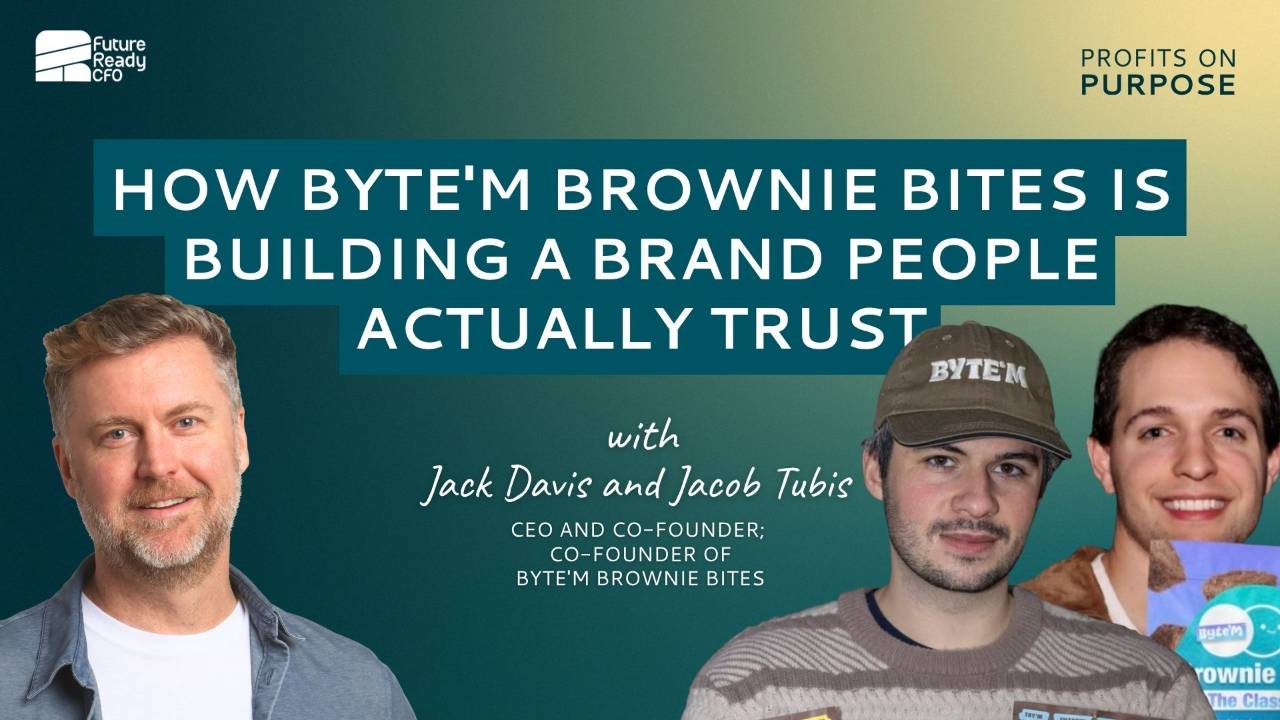
Episode Description
Jack Davis and Jacob Tubis, co-founders of Byte'm Brownie Bites, have spent the past year doing something most emerging CPG brands avoid: going bodega to bodega, store to store, building nearly a thousand retail doors in New York City- fully bootstrapped. In this episode, they get candid about the real financial realities of scaling a physical food brand, from the cash drain of retail promotions to the supplier nightmares that cost them thousands of dollars with zero accountability. They also dig into the decision to hire fractional financial support early, why simplifying operations beats chasing "200 IQ plays," and what they'd tell their younger selves about partner communication before things go sideways. With Expo West behind them and a national launch ahead, Jack and Jacob are at an inflection point- and they're refreshingly honest about what it actually takes to get there.
Key Takeaways
-
Building a community-driven brand matters more than just economics as direct engagement and emotional connection outweigh immediate profitability.
-
Quality over cost in ingredient selection can justify a premium price by focusing on flavor and ingredient quality.
-
Strategic focus on offline relationships builds market trust faster than e-commerce alone through physical retail presence and personal visits.
-
Bootstrapping can sustain a brand while maintaining mission integrity by scaling without sacrificing purpose.
-
AI is a powerful support tool but not a replacement for human oversight, enhancing efficiency while requiring human judgment.
-
Clear communication and trust are critical in supply chain relationships to prevent costly misunderstandings.
-
Long-term vision and flexibility are key in growth strategy, empowering adaptation with ambitious end goals.
See More from Jack & Jacob and Byte'm Brownie Bites
Byte'm Brownie Bites
Jack Davis
Jacob Tubis
Listen to the full episode to discover how Jack and Jacob's experiences can inspire and guide you on your entrepreneurial journey. Don't forget to subscribe for more insightful conversations!
I hope you enjoy this episode!
Give it a like, share, and subscribe to not miss the content coming your way weekly.
– Nate and the Profits on Purpose podcast team




Transcript
-----
00:00 Introduction to Byte'm Brownies
01:39 Founders' Background and Early Ventures
03:05 Brand Positioning: Premium Mass Market
05:06 Focus on Clean Ingredients and Cost Structure
07:12 Retail-Centric Go-to-Market Strategy
11:16 Future Plans: E-commerce and National Expansion
12:34 Bootstrapping and Financial Strategy
15:37 Managing Seasonal Demand and Cash Flow
19:58 The Role of a Fractional CFO
20:41 Balancing Trends and Long-Term Growth
26:08 The Importance of Delegation and Expertise
32:29 Navigating Challenges in Manufacturing and Partnerships
37:53 Leveraging AI for Business Efficiency
40:29 Reflecting on the Journey and Lessons Learned
-----
Nate Littlewood (00:05)
Welcome back to Profits on Purpose, the podcast for e-commerce and consumer products founders who are looking to scale their businesses, both profitably and purposefully. I'm your host, Nate Littlewood from Future Ready CFO, where I help seven figure brand founders build the financial and operational foundations that they need to scale to eight figures.
Today, I have two guests joining me, Jack Davis and Jacob Tubis, who are the co-founders of
Byte’m Brownies, which is a premium brownie brand taking the New York City food scene by storm. Together, these guys have built Byte’m into nearly a thousand retail doors all across the city and even beyond, think. From iconic stores like Fairway and West Side Market to neighborhood bodegas.
All along the way, they've kept this thing bootstrapped and they've stayed true to their belief, which is that clean, premium ingredients don't have to mean an ultra premium price tag. But that road has not always been a smooth one. From manufacturers disappearing overnight to suppliers losing thousands of dollars worth of product without a whole lot of accountability. These two have certainly learned some lessons the hard way about what it really takes to scale a food brand when not every partner has always got your back.
Jack, Jacob, welcome to the show. I'm really looking forward to chatting about the journey with you guys.
Jacob Tubis (01:35)
Thanks Nate, likewise.
Nate Littlewood (01:38)
Cool. Guys, I'd love to get started here. Just learning a little bit about your backgrounds and the backstory of the company. Could you each give us a quick intro? Tell us what you did before and how did you guys come together to be running this brand?
Jack Davis (01:53)
Yeah. So my background is in tech. I actually met Jacob in college at American university. We graduated 2020 and we met each other around 2016 in the freshmen dorms.
Jacob Tubis (02:07)
Yeah. On my background, yeah. So Jack and I became friends freshman year of college. We went to the gym a lot. We got into the food scene. Jim kind of went to the wayside. We always had a lot of business ideas along with our other friends in college, but we were just always really pushing, trying to like learn more about how the business world works, how finance works broadly. Around COVID, we decided to go into a protein ice cream company that was very short-lived, but we fully developed that product. Yeah.
Nate Littlewood (02:31)
Okay.
Jacob Tubis (02:33)
So a bit early there, think our friends who are in this space now like smear case, protein pints, sweetgant, a lot of them have done a much stronger recipe than we had initially.
Nate Littlewood (02:42)
So one of the things I found really interesting about our conversation the other day was the brand positioning that you spoke about, which is premium mass market. Can you tell us a little bit about what that actually means and how you came to be positioning the brand that way?
Jack Davis (03:04)
We think there's a lot of companies that have done a really great job. So we talk about Tate's cookies and I think they're a really great job where it's a slight elevation compared to Oreos, Chips Ahoy, your classic chocolate chip cookie. But it still is a mass market product in the sense that it's not only in an Air 1 or like a, you know, very high end luxury store in New York City. So mass people can enjoy that product. You don't need to have that premium, you know, dollar in your wallet.
I think another great one was Poppi. You could find them kind of in a Walmart, but even some of those high-end stores because it really has that great brand value.
Jacob Tubis (03:41)
Yeah, I think going into the broader elements of it is we've noticed that, you know, consumer palates, you know, my grandfather came here back in the fifties and the food was terrible in the U.S. He came from Germany. You know, consumer palates have become increasingly more complex. Consumer demands for their products and the quality of it have increasingly become higher, which is a good thing because we should have more accountability from our food chain.
But so many people choose, especially now, to focus on the protein, to focus on the creatine, the ashwagandha, the lion's mane, or focus on these hyper low calorie options, you know, with different sugar substitutes. What we've seen are historically, you know, the Ben and Jerry's of the world, the tastes like Jack mentioned, have really succeeded because they focus on the quality in terms of the flavor and the enjoyability and kind of rooting back to what food is initially as this community activity where people have a sense of joy to it that, you know, the macros just don't tell the whole story on.
Nate Littlewood (04:34)
Okay. Interesting. Something else that I wanted to ask you about, you seem to have quite a focus here on clean label, higher quality ingredients. Am I reading that correctly? And if so, what would you say that actually means in terms of your cost structure? The stance you've taken on ingredient quality, does that mean the cost of goods sold is five, 10%, 50 % higher than it might otherwise be?
Jacob Tubis (05:05)
Yeah, I'd say the best way to frame BITEM is as a flavor first company. So our priority is giving you a quality product that tastes as good as Jack's mom's recipe or the bakery brownie you grew up with or your mom or grandma's recipe. So it's really not compromising on the sense of like what a true brownie is. It's very chocolatey. It's very rich. It's very, you know, strong vanilla and butter notes. And it has just that sense of like satiation that you get when you have the
Beyond that, we work to have the cleanest we possibly can within the form factor, given we are a shelf stable product. So it's really just on the highest quality flavor profile, making sure it's something that's accessible to people, hence the premium mass market of something really, you know, it's a little treat everyone can enjoy. And then working from the cleanest possible options that we can get towards that.
Jack Davis (05:52)
Yeah, I'll add a couple of things. think, you know, with a lot of things, there's always a diminishing return. So we try to get that like maybe an eight out of 10 in terms of amazing taste. But you know, the brownie is not wrapped in a gold foil or anything like that where it costs $30. But obviously there's other competitors out there that use a lot of these gum binders or vegetable oils to make up for it. And we don't have as cheap a price point because those are usually substitutes that take out the flavor, but bring down the cost.
So we are more expensive, but we try to find that middle ground where it's again, a mass market premium. It's everyone can, you know, go out of their way to maybe pay an extra dollar or two, but we're not trying to charge an arm and a leg where it's like 10 extra dollars just for a brownie. it is a yeah, 10 to 20 % maybe more expensive than like a bottom of the barrel brownie.
Jacob Tubis (06:43)
Yeah.
Nate Littlewood (06:44)
Okay. Interesting.
And talk to me about go-to-market strategy. My understanding is that you guys have had a fairly retail centric focus thus far. In a lot of the brands and clients that I work with, we'd often opt to have a little bit more of an e-commerce focus earlier on because of the better cashflow terms and the ability to iterate and pivot and evolve.
How did you settle on the more retail centric approach and how's that kind of working out so far?
Jacob Tubis (07:19)
Yeah, I mean, I'd say to start, we actually, happened to work right around the block from Pop-Up Grocer in New York, which is, you know, a very beloved, that's a great introduction to market for a lot of people. I mean, it really sort of kickstarted because originally we had planned on going e-com focused. Jack was working in tech sales in the e-com space and the influencer marketing space. And we saw in retail the reaction we had so quickly, even with, you know, different branding that we have now, which is performing a lot better.
It's so quickly snowballed and just grew and we have these great retail partnerships. We wanted to make sure we were continuing to fill. And there's something about the immediacy, especially in New York of all places where the CPG community is just so prominent right now. It's thriving at just growing so rapidly that being able to run to these people, even if the cashflow terms are a bit worse, even if it's a bit more difficult to have to go bodega to bodega.
It gave us a lot of experience that we think is making us much more savvy and much more prepared for the national launch and now for our scaling and e-comm that we're going into.
Jack Davis (08:19)
And I think, know, add to that, reason we originally went into pop-up grocer was to add trustworthiness so that people knew there was like a physical place and we could film some videos, UGC or other kinds of content that people could see this is an actual place you can buy the product. People online know it's like, you know, a legitimate thing, not just an AI product, which there's a lot of those these days. that the...
there was like a lot of opportunities where other people just told us, maybe, you know, it's doing really well here. Maybe go to Butterfield Market, which we love those people on the Upper East Side. And then one thing leads to another. All of sudden people are telling you to put your product in X, Y, and Z. And we got reached out to by a lot of retailers, obviously as well. They saw the product in their hot spot. So we really love Pop-Up Grocery. It's a really great springboard and they really focus on bringing in new brands to start with. There's some other, you know, editors now that are also doing a really great job and like similar services of bringing new brands and giving them like a market, a place to launch the product.
Jacob Tubis (09:22)
Yeah, and I think too again, it's very unique and it's honestly a strategy I wouldn't necessarily recommend for many products. Generally, beverage is the best to go sort of that bodega route first. We just felt for our brand specifically, we thought about what the essence of a brownie is. It's very community driven, it's very nostalgic driven, and it's very sort of like in a relationship of people just having such strong emotive ties to it and then disconnect that existence stores before that between, know,
At first-rate store, Brownie, we always think of as like a hockey puck traditionally, then normal two bites, bites, all that, where they taste delicious as a kid, but for our current palates and the palates of now 70,000 people we've sampled to, it just doesn't match up with the strong emotive reaction of the product. And because we're so community-driven, being in these stores had a lot more value than the sheer economics of the thing.
Jack Davis (10:11)
You I'll come to one other point real quick. Like you were saying, you know, retail, is very like cashflow based. so we had a pretty good point, even though we have a lot of inbound offers to like expand even to further retail, we thought thousands like a clean number. So we might try to focus a little bit more on the DTC. We have a lot of demand there too. And I think you can control a little bit more your economics. So I think,
Nate Littlewood (10:11)
Same.
Jack Davis (10:38)
You know, there is always a question of like what to do, but I think each company is different. And I think D2C, it's like really great opportunity as well. So we're going to focus more on that area just because we've been so focused, like had sound on retail. I think they're both great. You just got to like weigh your options depending on the brand and like, you know, how it's starting.
Nate Littlewood (10:55)
Okay. So first chapter was a thousand ish retail stores, which I understand have had a fairly New York geographic focus. It sounds like we're getting close to the end of that chapter. The next chapter is about e-commerce and direct to consumer. What happens after that?
Jacob Tubis (11:15)
Yeah. So, I mean, we, we're very fortunate that we have a lot of great upcoming distribution partners for national scale. We've, you had some really great, I will say, you know, it's, it's a caution. So for those who don't know expo West is the largest food and beverage show in the country. Focus on natural products. And we're very fortunate that our undergrad actually paid for us to go there effectively.
Nate Littlewood (11:35)
wow. So you guys just got back home last week, right?
Jacob Tubis (11:39)
Yeah, yeah, we've got back from that. We were already moving more towards this direction. We're very fortunate that Unifi chose us for the Up Next program, which is, you know, their American brands program. So we're already working with them on onboarding for a few really exciting locations we'll announce soon. We've had the chance to, you know, talk to some other great buyers, investors, you know, everything at Expo that really are pushing us in an exciting direction for that sort of chapter three we're on.
Nate Littlewood (12:03)
Okay. Cool. Cool. Talk to me about the cashflow and the money side of things. Getting into retail and retail distribution is a notoriously expensive exercise. And a lot of businesses like yours can go for many, many years with cash outflows by the time you're playing for all the promotions, the coupons, the free fills and so forth. Am I correct to understand that the business is fully bootstrapped thus far?
Yeah. And are you intending to keep it that way or is there plans to raise some money at some point?
Jacob Tubis (12:40)
Well, I think the way that we view the whole company is, know, much as again, in sort of the community sense that we really value long-term partners in whatever form they are, whether they're advisors, eventual investors, or, know, if we continue to do it on our own, really focusing on like having people who understand the mission of what we're doing over like any short-term interactions. So our end goal is for Byte’m to be the biggest Brownie company in the country. Hopefully expanding on that, we'll see.
You know, the goals in between are where we're flexible and it just depends on what partners and opportunities come up.
Jack Davis (13:13)
Yeah, will say that, you know, a lot of our peers that either haven't like even raised money, they typically do have backgrounds where they're very fortunate. We ourselves too, are, you know, pretty, pretty fortunate. Not maybe as fortunate as some of the other brands we know, but I think there is, it does take a lot of real capital. Like I'll call that out because, you know, there's a lot of people maybe listening that want to start a brand and it's, you know, not free. Obviously that's why there's a lot of...
People either take like loans or different investments from VCs. Um, I mean, it's realistically too hard to compete with a lot of these companies, you know, like Coca-Cola, Pepsi, whatever it is, um, without taking BC eventually, you, you probably will want to grow fast and fast even compete feel slow at times where it's over five, 10 years compared to bootstrapping a company to that size. would probably take a hundred years like Coca-Cola or Pepsi did.
So where it's like, you know, open to, we've talked to a lot of different people. We haven't raised yet. lot of our peers like have started to raise money that we know.
Jacob Tubis (14:18)
Mm-hmm. Yeah, I mean, I'll... yeah, go ahead, please.
Nate Littlewood (14:22)
What's it to say? Sounds like it could still be on the radar at some point then.
Jacob Tubis (14:27)
Yeah, I say. I mean, again, we're very end goal driven. The means of the thing, like we wanted to be community focused, we wanted to have positive impact, everything that's very essential to us. But, you know, the means of partners that we work with, as long as they're driven towards the same goals as us, we're very flexible as, you know, how we get there.
Jack Davis (14:43)
Yeah, I think the goal really matters. Like obviously again, to the time horizon, like if you're trying to grow a really fast brand, like you probably will need VC money. But if you go, you know, if it's slower and you're trying to do a less of a national business and you're like, start, you know, more in these farmers markets, you can obviously take a lot longer, but you might not, you know, be able to sell it eventually with that for as much money or like grow at net nationwide again, because realistically again, you're competing with like Coca-Cola, Pepsi.
So I think your goal really matters and like what the consumer wants for the brand ultimately. And like nothing's wrong too with like having a slow steady business that's going to take a bunch of years. So you just got to have that at end. would say.
Nate Littlewood (15:25)
Absolutely. To me, is Brownie demand highly seasonal? I'm thinking there might be a bit of a demand uptick in winter. Is that accurate?
Jacob Tubis (15:36)
I would say historically that's been the case. What we're finding is similar to like before cookies hit the market and you know, Ben and Jerry's too, that like one thing that's a real advantage in the premium mass market category we think is that it can be have heavy periods obviously during like the winter historically, but also form factor convenience elements. We know a lot of people like during this past summer, we had tremendous uptick in some stores because people just want to go to the park. They rip open the bag. They share it with their friends at a picnic.
And I, you know, part of that too, is with our form factors, having the bite size changes it from traditional dessert product, which would very much be very winter dependent into something that's snack focused. and we think, you know, that element of convenience, which is such a key term, I think in this space is essential to what really determines like how you can be move away from just being a very seasonally dependent product.
Not that that's wrong, but it makes much more versatile product and as we expand, we're going to rotate out different SKUs that we think is going to keep demand up throughout the year.
Jack Davis (16:38)
They definitely enable easy consumption and even different types of consumption. think Graza and some of these other new companies that released recently are very cool. There's a peanut butter.
They do like a cool upside down flip and then there's a honey department. think it's, yeah. It's like honey in a tube. It's really cool.
Jacob Tubis (17:00)
Yeah.
Nate Littlewood (17:01)
Okay. Okay. So what I'm hearing here is we've got a bootstrap brand. You, gather you've put some of your own own money into it. I don't know. I'm not going to ask what the magnitude of that is, but I'm assuming you're not exactly drowning in cash right now. but we've got a business that has somewhat of a seasonal pattern to it. You've got potentially new product, new product launches coming out, throughout the year to, you level things out.
And then you've got, you know, the, the ongoing lumpiness of, you know, purchase orders and productions and supply chain, which like everyone in the physical goods space kind of deals with. There's a lot of moving parts there, right? From a cashflow and profitability perspective. How are you guys going about managing all of that and staying on top of it?
Jack Davis (17:53)
Yeah, we recently too hired a fractional CFO and then we're like a fractional accountant, like bookkeeper, because that stuff is very important. Even if a lot of people think they have a background in that stuff, you know, it's probably good to even hire a person that has experienced it or like done that work with multiple businesses. So that's, that is one thing we did just to make sure that stuff is solid and they work with other, I would recommend getting referrals, you know, in the food space specifically if you're in CPG.
Jacob Tubis (18:22)
Another thing too is we're focusing on simplifying everything. So before it was sort of what we call 200 IQ plays. know, it's these ideas that you really try and do these things that are, you know, if everything lines up just right, it's an incredible opportunity. But when you're scaling out and growing long-term, you know, those plays are just as likely to be the cog in the machine as they are to be, you know, even more likely realistically the cog in the machine, rather than your sort of like Hail Mary opportunity.
So trying to like… remove ourselves and give ourselves strategic opportunities for these sort of like high risk plays, but not have it be the type that would jeopardize any other key element of business. Because now we have people who rely on production partners or retailers, everyone.
Jack Davis (19:04)
Yeah, it's not bad to take bets that have a lot of upside or, know, even like amazing amounts of upside. But if you continuously are taking bets like that, it can slow things down of just doing the simple, like, you know, day in, day out. that's why too, you know, again, growth, you gotta be somewhat steady with it. We think we might do a little bit like more direct to consumer.
Like we were saying a thousand stores is like a good amount. We're always open to continuing to expand, like you gotta you know, a of companies typically, I think fail from expanding too fast compared to not expanding fast enough feels like.
Jacob Tubis (19:37)
Mm-hmm.
Nate Littlewood (19:38)
Okay. Cool. I want to circle back to the fractional CFO thing. That's an interesting decision to have taken for a couple of founders who are at your stage. How many people in the company, by the way?
Okay. Okay. So two of you plus the fractional folks. Talk me through how you decided that that was something that you needed, but that was the type of support that, you know, the company was missing.
Jacob Tubis (20:14)
Yeah, I think on our end, what we realized is that we're a type of product that can perform really, really well as we increasingly scale. But the early stages of it are the most uncertain just because, you know, it's very easy when you're starting to be following a trend. It's very easy and it's a very smart move a lot of our friends have done, for example, of following the protein elements right away, of following the fiber elements, of following, you know, better for you, hard elements, which are both, you know.
Real things that should be pursued, but also very much like trendy things that are very useful to lean into for natural channel and easy promotion and growth. However, we really think that there's tremendous upside in the long-term by focusing on a more, again, the premium mass conventional play. So it's focusing where we love to partner with any, you know, natural market and everything. have a product that, you know, works by and large for a of these markets, but it's not necessarily the thing that the early adopters are going to be jumping for.
But is the thing that, you know, like a soccer mom is going to be buying 20 of for all the kids at soccer practice as it grows out as a company. So it's a balance of getting people excited, which is more on the D2C channel. Also trying to expand and prepare the sort of foundation of our business for, you know, really significant national growth as we keep scaling up.
Jack Davis (21:27)
Yeah, I think, like fractional CFO, it's hard for someone to be a master at everything realistically, as much as I think a lot of founders are like, you know, I can do everything 100 % to the maximum, but realistically, you're probably not amazing at like branding, know, product photography, social media, sales, know, finance, legal, like it's hard to do all that. So I think at the end of the day, you'll eventually want to bring on people that have a background in that.
And obviously there's great AI tools now, but it's hard to know what you don't know. So it's hard to even, you know, ask some of these questions. You don't know the right questions to even ask where those people can help guide you and what other brands are doing and what is normal, you know, amounts, like figures in your space, like how much money you should be spending on, you know, trade promotion, for example, or what your, you know, margin actually should look like stuff like that.
So I think that, we went to a couple of different talks even where people were talking about finances and we thought it was the right decision because we think we're really great, you know, these other parts of the business. We think we're good at that too, but hard to be doing it again, you know, all at the same time. So I think sometimes you can do your best work when you step out of the way and let like other people do that role that could be even better, you know, than you.
Jacob Tubis (22:47)
Yeah. Well, I think it's really opportunity costing a pair of advantage. Even if you are the best person in all of these spaces, know, CPG is a complex industry. There's a lot of depth to it, but fundamentally almost every single decision you make isn't necessarily that difficult. It's just the sheer amount of them. And that's what makes it a very difficult industry because you're spinning so many plates. So no matter how good you are at spinning any one plate or even any number of plates.
It's probably going to be the case that you need to outsource some elements because you know, until AI is considerably better than where it is right now, you just can't manage everything on your own. It's just, it's impossible and it's irresponsible, especially to the people who rely on it's been a physical space too, who rely on your product, reduce your product, you distribute your product. Cause it's not just you, no matter what, there's so many people throughout the process. So you have to be accountable to them and to the brand that you're building.
Nate Littlewood (23:40)
Yeah. Nice one. I, I really respect the self-awareness and discipline.
Jacob Tubis (23:49)
I mean, it's easier to say than to practice. Sometimes we get distracted like Jack making a website a day on a whim. You know, it happens. Yeah. It's just, it definitely is just the balance of all the things. And there's also so much of the learning of this too. know, neither of us went to business. I grew up in a family business, but some of these like scalable elements you're mentioning, like balancing all the plates, especially early on, are going to provide a lot of efficiencies and upsides because you at least know how to talk the talk loosely enough when you have other people.
Jack Davis (23:51)
Of course, they're always
Jacob Tubis (24:19)
Cause it's trust over there.
Jack Davis (24:21)
Yeah, I think too, it's good to be a lifelong learner. And like, I totally know what you mean about like the dopamine hits where it is exciting to be learning and trying them out. But yeah, I got, you know, we actually changed out our packaging too. I actually designed it originally, but at the end of the day, wasn't, you know, the best ever. And that was one of the best decisions was to redo the packaging, get a professional. But I think, you know, it brought us from point A to point B. It doesn't make sense, you know.
we say for a founder to spend all this money on an agency right when you're starting to brand. Like you haven't launched the product in the market yet. So, yeah, things always steps with, you know, different parts, I guess.
Jacob Tubis (25:00)
Yeah. And I mean, even towards that too, so much of it is network. And I think that's something that people, you know, it's a word that's thrown around all the time, network, community, all of these buzzwords, relationships. Like really the depth of the just people that you meet, especially in CPG, there's so many people who are willing to work with you to collaborate, to co-op, and really like build something special. You know, like for our design on our current packaging, that only came through through a mentor of mine from where I went to law school.
who to business school there, connected through the school, happened to be his roommate. He tried the brownies, loved it and gave us, you know, gave us a fantastic rate, worked with an incredible team that in full transparency, we wouldn't have been able to work with if we didn't have that relationship because they're incredibly talented. Yeah.
Jack Davis (25:47)
Yeah. One last thing too, is I feel like a CEO's job is more so like orchestration and rather than again, like being like a master at all these different tasks, like we were saying. So you're really orchestrating all these, not just like people, but tasks and like making sure they all kind of fit together. Yeah. At the right times, you know.
Nate Littlewood (26:07)
Yep. Yep. I appreciate the perspective. Really interesting. Changing gears a little bit. I would love to chat about some of the more difficult parts of being a founder. When we spoke a couple of weeks ago, you shared with me a couple of interesting horror stories on the manufacturing and supplier side.
Tell me what, what has been some of the toughest moments in the business's history to navigate through.
Jacob Tubis (26:38)
You know, I'd say generally one of the toughest things for me, because again, we really do care about like the community stuff, the relations and everything, is what you have people that you view as partners that you really try and be understanding of and like, you know, give up a little bit to, you know, get more and hopefully build more with them that, you know, will talk the talk, but then they don't walk the walk, which is, you know, it's really tough to see because you're really relying on these people assume that they like care about what you're building. But the difference between the two can be really tricky.
And an example I'd say is we had a delivery that we were expecting. The company used our account for shipment, but then they ended up shipping it. didn't get any notice from them, requested notice. They didn't respond on it. It got lost in transit and rather than even, you know, offering a concession of like 50 % off and we purchased the product. They said, that sucks for you. And they're like, you can buy more.
Nate Littlewood (27:34)
Was it purchased on your shipping account?
Jacob Tubis (27:38)
Yeah, even though we didn't have notice of it nor did they ask us about it either.
Jack Davis (27:44)
Yeah, that was rather unfortunate. But I think production too is like one of the hardest parts. And so, yeah, we always try to be mindful of that. But it does always feel like for us, it's been even more so adverse than some of our peers. But I think too, it's like, you know, sometimes when you go through these challenges in life, you know, even if it was like divorce or something, I haven't experienced that. But actually, like, I think...
or sign up Americans or something like that, get divorced. But when you're experiencing that, it feels like you're maybe one of the only people in the whole world experiencing that thing where there's actually so many other people. So think a lot of other CBG brands as we talked with them have also had really, really hard times specifically in production. So it's good to be aware of that. But yeah, we've had tons of stuff. That was one of a list of, it feels like 10 or 15 different things. It's almost like every week there's like...
Jacob Tubis (28:38)
Was just emotively the one that hit hardest, not financially, there have been plenty more.
Nate Littlewood (28:42)
I see. Well, it sounds like you've been beaten around quite a bit with this operations and supply chain. And you just mentioned there's been quite a few of these instances. I assume that as a result of all that, you've learned a lesson or two about how to vet people, you know, how to trust people, whether or not you should trust people.
If you could turn the clock back to an earlier version of yourself and give some advice to the younger founders who were just starting out with this journey and had all these new partnerships, relationships to, to forge. What would you do differently? What, what advice would you give someone who hadn't yet made the 10 or 15 mistakes that you guys have?
Jacob Tubis (29:27)
I think, and this is one Jack's been really good on pushing me on, is really focusing on being very, very clear with partners. It's very easy for you to get in your head and focus on what your needs are. And I think that has been a real, real recognizing, you know, it's very easy to recognize other people are people, because of course they are. But like, it's so easy for us just as humans to get so in our head and be in the context of what we're thinking about, of what we're doing, and that being the center of the world, because it is the center of our world. Right, right.
you make these assumptions to partners or even if you say clearly, you're not thinking about where they're at, rather than just giving them just the objective truth of the thing or explaining it clearly. Part of it explaining in a way that they can actually understand in the frame of where they're at. So, know, when we see emails now, we try and go, you know, bullet point by bullet point, this, this, this, this, this, and be much more straightforward rather than trying to, you know, go through the general niceties we went before. And it gets like...
Jack Davis (30:23)
We don't try to be mean either though, it's not the same.
Jacob Tubis (30:25)
No, no, it's not like, know, of course it's still the hope you're doing well, all of that, but it's very clearly outlined in the thing. It's like, do this, please do this, please do this. Can you do this? That sort of thing. that way it forms the actual proper paper trail. And it's not something you can say, you want to call promise this to us. And they're like, we didn't and they did, but you can't prove it. So. Right.
Nate Littlewood (30:46)
Okay. Well, that's really good advice to be, I guess, clear and detailed in terms of what you require and what they require. Have you done anything differently in terms of contracts and, know, on the legal side, or are you more likely to go and physically visit any of these partners now? Yeah. Is that an important side of it?
Jack Davis (31:09)
Yeah, I'll say we always were trying to visit the places. think you should definitely like, you know, this industry specifically more than others, but even in tech, would recommend it. It's a lot more like, you know, hand check deals, like person to person visiting the physical locations. but I think too, that it's just like, you really gotta get to know some of these people on a person to person level because you're really going to be working with them, you know, day in, day out.
And yeah, it's just like super people business. feel like this one was like, a lot of these old handshake deals we've, you know, heard about from other companies too, even like Coca-Cola and Pepsi and stuff with factories.
Nate Littlewood (31:48)
Yeah. How are you guys thinking about AI in your business? I recall from our conversation the other day, you both kind of mentioned to me that, you you're more, you think of yourselves a bit more as generalists as founders rather than being kind of experts in any one area. And I think you made the point that, you know, in this day and age of AI, like that's an easier and easier stance to take because AI can help you go deep on a specific, you know, discipline or vertical very quickly.
How, how, how, like how and where are you guys using AI in the business today? And what role do you think it plays in the business, you know, a year from now?
Jacob Tubis (32:28)
Yeah. So, so to start, actually, when I was in law school, I was really, I was a fellow in data privacy and then was doing space telecom law at the FCC and an internship. So I always came from a very skeptical angle, despite also being, you know, sort of like a tech lover. So it's a balance between the two of recognizing privacy doesn't exist in this country, like in this country. So be prepared for anything you put even confidential information. It might be safe today, but you know, economic interest changed. The law changes over time.
So biggest caution is to be careful about what you put down. Like, is it something that you're willing to have put out there five, 10 years down the line? The second one is I think on our end, it's about using it as a tool. A lot of people are using it for emotional connection and an age of increase in like disconnection from other people and not feeling that they're heard by other people. I think what we really focus on is trying to use it as objectively as we can as a resource. It's not a person.
It's not like some thinking intelligence of any sort, but it can't things. For example, we had a big PO that required special, stickering on our case packings and I was going less physically editing it. Jack pulled up Claude and within 15 seconds we had this entire list that would have taken me three and a half hours. Yeah. a lot of tool purposes towards it. And there's a lot of ways to think about how another party might act. Not actually expecting that to be like you're chatting with another person.
Jack Davis (33:54)
Yeah, I definitely will say the curve on improvement, like in terms of the models is like pretty staggering because I remember we actually used ChatGBT a year ago, maybe not even a full year ago, like a couple months ago. Yeah, to try and do that same task Jacob was doing and it messed it up. So it was not, it was not there.
Jacob Tubis (34:12)
Whereas it was supposed to be like a number case slotting and it wasn't even, it was doing like asterisks and like semi-colons. It was terrible.
Jack Davis (34:18)
So it was like a pattern basically you needed for these stickers. the, you know, the other model was able like Claude and stuff, obviously it's improved a lot. Um, and you got to, there's like some, you know, a lot of people talk about prompting and stuff like that, but it was able to do it was like very astonishing. Um, but I think that. Like, you know, there's a lot, you could almost talk about AI, right? For like an hour on this podcast. Cause it's like so much is happening.
That's I think, um, in the food space, the best opportunities to use it are probably like related to emails and we don't use it a lot there right now either. But I think it's hard to, you know, take it as it is now and apply it unless you like into the factory, right? Cause there's not, we don't have, you know, physical robots or like most people don't have, you know, robots like working on the line. So it's mainly, it would be in like emails or like website optimizations where you have like a chat agent that if someone purchasing something, can like a customer rep.
But we tend to one, there's like budget for all that stuff and we don't have that budget. And then two, think a lot of people like the human touches, so they would get annoyed if we had like a customer service rep, some AI agent that is sending them in like a loop. yeah. We're like open to, you know, adopting some of these things, but like I was saying, even adding it into email, if we had an agent that was responding to emails as they come in.
I think some people wouldn't be a hundred percent pleased, you know, if we were, they found out they were talking to a bot and all of that stuff too. It's stuff at the end of the day that you might want to be working on that task because it is a very important one. So you want to check it before it sends out. And that's the problem with a hundred percent automation, versus like, again, yeah, like 80 % automation. Yeah.
Jacob Tubis (36:06)
I say not trying to use it to minimize the human interaction, the relations element, more use it for the aggregations. Like if we do a social media post, for example, and we're asking people and let's say we're not getting this now, but like 10,000 comments, it's very hard to through and document every single comment, but you're able to use chatbot essentially to like pull out and aggregate it into like different groupings. So it could say, okay, people want, you know, more fudgy brownies or they want this kind of flavor, that kind of flavor.
And using it more as a means of you know, being able to sort of like comprehend mass data or like on legit, I too. like if we're trying to update our case pack sizing, then rather than having to example them, because of course we'll test it out. We can be like, okay, the options available in terms of pack sizes. This is what the pack looks like. What's the optimal and most efficient way for shipment. So it's more on these efficiency side rather than removing that human touch to it, which we think is really central to any physical product and especially food props.
Jack Davis (37:06)
Yeah, I think it's really great. A lot of data really is so confusing. I think too that, you know, you don't want it to become necessarily a super crutch in the sense that you follow a hundred percent of everything it says because, I don't know. Like I think 80 % of the time it's probably pretty useful to listen to the advice if you ask about any topic, but you still want to maybe think about it.
Nate Littlewood (37:29)
Certainly spits out some nonsense occasionally.
Jacob Tubis (37:33)
Definitely. Especially Chad, unfortunately.
Nate Littlewood (37:36)
Yeah. Looking ahead into 2026, what are some of the most difficult or complicated decisions that you think you guys are going to need to make?
Jacob Tubis (37:52)
I think it's going to be how we increasingly scale and provide greater value to our consumers. Our ambitions long-term are to definitely be at a more competitive price point compared to more conventional products. That's part of in terms of like any form factors we introduced, we're very excited that we're working on a much smaller pack size, which would be really great for like C-Store, Bodega, Airlines, all of that, that we've gotten great excitement for.
Okay. And also how we're able to expand our product lines to be more exciting and cool flavors that, know, consumers are going to love, especially on the e-comm channels and aggregate downward. We're also not moving away from our main product line and our main goals of making the product accessible. It's so easy when you're the middle of your product 24 seven, and especially when you're in like the founder in the food ecosystem constantly that your product is like such old news to you. You don't want to keep talking about your product, promoting your product for the same thing. You always want some like new buzzy thing to do. It's like, we have this new
Rowney, oh, we have this new promotion on Engl- but the realistic thing is market penetration is so, so, so incredibly tiny for pretty much any emerging brand. mean, even, even Poppy's out. What is it like 10, 15 % penetration?
Jack Davis (39:04)
There was like some article that was talking about the penetration of a lot of these big brands and like not everyone knows these, you know, big brands to us.
Jacob Tubis (39:13)
Yeah, and long and the short of it is just you're in such a bubble when you're doing this and it's important to recognize how much bigger the scope is and trying to constantly reach out and expand to new audiences and don't get comfortable with where you are, especially if your ambition is growing.
Nate Littlewood (39:29)
Got it. it. Cool. Well, I appreciate all the thoughts there guys. You've, you've had an interesting journey here and it sounds like you have taken a very mature and self-aware approach to thinking about what each of you two can do well, what you can't do well, when and how to ask for help. And, you know, I really respect that.
I'm going to ask you another question about kind of looking back and reflecting. know I asked you something similar to this earlier, but let's go right the way back to the beginning of your journey as co-founders of this business. It's like day one, the company has just been set up. Given all you've learned about running this business since then, and all of the surprises that you've had, what advice or heads up would you give to your younger self?
Jack Davis (40:28)
You know, challenges will rise because it's foolish, no matter how many podcasts you listen to, people you talk to, that nothing would go wrong, right? Like with, you know, with any business, you're guaranteed to have multiple like things go wrong. So I think that you should plan for room of margin, right? And realistically, but I think that the direct answer, if there was like one thing specifically to tell myself, it was either, yeah, maybe like look into other food scientists maybe.
Nate Littlewood (41:04)
We haven't even talked about food scientists yet. It sounds like that's a whole nother side story that we missed over. There was a bad food.
Jacob Tubis (41:11)
Well, I think the main thing more than that, it's just making sure the partners that you're working with right away, you understand exactly what they want out of it. And you make very clear, know, it's really easy, especially when you're like, you know, you're wide-eyed and everything is saying, we're going to be the biggest Brownie company in the world. Now I say it a bit more seriously, that we think that, but like to, come into it by like really getting to understand the community a bit.
Nate Littlewood (41:34)
Words, wise words. appreciate it guys. Listen, this has been a great conversation. Lovely to have you both on the show. Before I let you go, if people want to learn more about you and what you're up to, where should they go? I will include this in the show notes.
Jacob Tubis (41:50)
Yeah, absolutely. I think the best way, honestly, is through LinkedIn. So JacobTube is for me, Jack Davis for him. Also on Instagram, @bytembrownie. TikTok, we're expanding out there to @bytem.brownie. Yeah, we have personal pages too, so bytem.jacob, bytem.jack, and then our website, bytemfood.com.
Nate Littlewood (42:10)
Awesome. Cool. Well, thanks again, guys. Appreciate you coming on and good luck.
Jacob Tubis (42:14)
Yeah, thank you.
Nate Littlewood (42:16)
Take care.
Want more like this?
Join our newsletter list and every Thursday morning you can look forward to actionable insights and free tools for scaling your brand.
We hate SPAM. We will never sell your information, for any reason.
