
Controlled Depth Over Premature Scale | Kevin Larkai and Monté Burrow | Blackleaf Organic Vodka | Profits on Purpose
Feb 25, 2026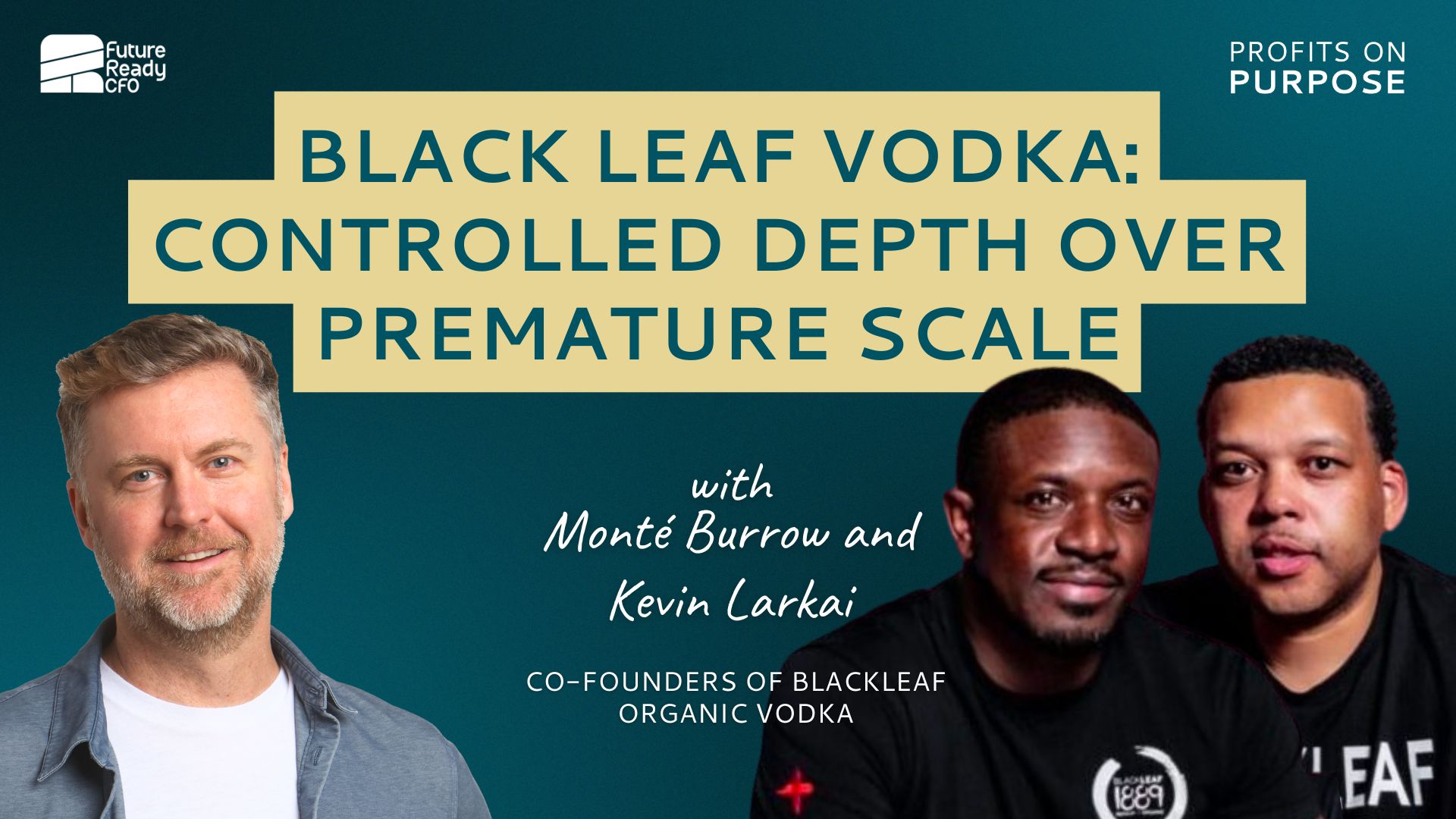
Episode Description
In this episode, we dive deep into the realities of scaling a capital-intensive business with limited resources.
Kevin and Monté share candid insights on navigating the three-tier distribution system, managing inventory with long lead times, and making tough prioritization decisions when opportunities far exceed available capital. We explore their current fundraising journey—raising a $2M seed round—and the surprising lessons they've learned about investor relations (hint: it's a numbers game that requires 500+ conversations). They reveal creative tactics like leveraging "influencer investors" with survey tools to generate warm intros and how bringing investors into their "brand world" over cocktails drives better conversations than traditional pitch decks.
Kevin brings a finance background while Monté has hands-on spirits industry experience, creating a partnership they describe as "organic" and perfectly aligned. Their philosophy of "controlled depth versus premature scale" offers valuable wisdom for any founder facing the tension between growth ambitions and resource constraints.
Key Takeaways
- The power of organic relationships over formal pitches. Building genuine relationships with investors can be more effective than traditional pitches, leading to warm introductions that accelerate funding and partnerships.
- Resource constraints push founders into sharp prioritization. Limited resources force founders to focus on what truly moves the needle, ensuring efforts align with available resources and prevent overextension.
- Data and instinct need to play together in resource-constrained environments. Balancing data-informed insights with instinct enhances agility and accelerates smart pivots without paralyzing action.
- Ownership of purpose creates moments that resonate beyond product. Creating emotional experiences can forge stronger connections than traditional selling, building loyalty and turning customers into advocates.
- Intentional and cultural fit in founding partnerships enhances resilience. Partnerships with aligned goals and complementary skills are more resilient and effective, navigating challenges nimbly.
- Fundraising as a relationship-driven and systematic process. Effective fundraising requires persistent relationship management and strategic timing, cultivating trust over time.
- Scaling requires balancing ambition with operational readiness. Growth ambitions should be tempered with operational infrastructure to ensure the foundation supports expansion without risking brand integrity.
See More from Kevin & Monté and Blackleaf Vodka
Listen to the full episode to discover how Kevin & Monté's experiences can inspire and guide you on your entrepreneurial journey. Don't forget to subscribe for more insightful conversations!
I hope you enjoy this episode!
Give it a like, share, and subscribe to not miss the content coming your way weekly.
– Nate and the Profits on Purpose podcast team




Transcript
-----
00:00 Introduction to Blackleaf Vodka
02:07 The Vision Behind Blackleaf Vodka
05:08 Complementary Skill Sets of Founders
07:57 Navigating Financial Challenges
10:37 Focus and Resource Allocation
12:33 Inventory Management Strategies
14:33 Balancing Operations and Finance
17:59 Funding Journey and Future Plans
20:13 The Realities of Fundraising
21:59 Engaging Investors Effectively
26:42 Opportunities Post-Funding
29:01 Data-Driven Decision Making
31:57 Team Expansion and Future Hires
-----
Nate Littlewood (00:06)
Welcome to Profits on Purpose, the podcast for e-Comm and CPG founders who are looking to scale their businesses, both profitably and purposefully. I'm your host, Nate Littlewood from Future Ready CFO, where I help seven figure e-Comm and CPG founders make confident, data-backed decisions that drive profitable growth, all while helping them sleep better at night. Anyway, today's guests are Kevin Lacai and Monté Burrow, who are the co-founders.
of Blackleaf Vodka, which is the first ever French organic vodka company in the United States. This story is a real masterclass in building against the odds. These guys met through a chance encounter in Cognac, France, and have been through navigating distributor rejection to becoming an award-winning challenger brand that's gone toe-to-toe with industry giants.
And know, Monté and Kevin are building something pretty remarkable here and they're doing it through grit and highly complimentary skill sets. One of the things that I really respect and appreciate about this business is the way that they're balancing mission with margin in one of the most capital intensive and heavily regulated industries out there. This conversation gets into the real challenges of scaling a spirits brand from the fundraising grind, the three tier distribution maze, and the constant tension that exists between data and instinct when resources are tight. Kevin, Monté , welcome to the show. It's great to have you guys here.
Monté Burrow (01:43)
Thanks for having us, Nate.
Nate Littlewood (01:45)
Of course. Well guys, I love the backstory here and you know, I think a good place to get started is just talking a little bit about your history. I'm curious, could you tell me a bit about the moment that you realized that this was more than just a project and you know, that it actually needed to become a real business.
Kevin Larkai (02:07)
Yeah, so I'll kick off. So the vision kind of started with just being a dreamer, right? I'm a firm believer in we get to shape the future, right? And I mean, everything from the products that we use to just everything that becomes a fabric of our society. So when I was on vacation in France, I had this, you know, chance meeting that ended up being what we think is the future of vodka, right? Which is looking at it through an organic sustainable and premium lens. So created the product and then the reality hit that this is business at the end of the day. So it was this side hustle, this product that was just there, but the feedback on it was incredible. Everyone that would try it would be like, wow, this is some of the best liquid that I've had. The positioning was resonating with people. So it got to a point where it was like, this is not just some small thing. This is something that could actually have legs and it could actually realize that thing of it being that leading brand in the future.
So, Monté and I joined forces and we were like, yeah, we got to go all in if we want this thing. So, at the time, you know, I was in finance and this is right around COVID when COVID hit and I was managing a portfolio. doing a lot of
When COVID hit, we had to do so many different re, forecast and different scenarios. I can't so at that point, you know, decided to dive all in and just commit fully to building this thing. And at least that's my perspective. I'll see. Monté can share his.
Nate Littlewood (03:35)
yeah.
Anything to add from your end, Monté?
Monté Burrow (03:52)
No, I I think Kevin and I converged at different times in the Blackleaf journey, right? So Kevin, as he mentioned, was the dreamer behind everything and he kind of brought it to life. And as he says, not my words, but he said, you know, I kind of came aboard to help put some lighter fluid on it. But, know, the reality, the reality for me is became real when, okay, I left my nine to five corporate job and I'm sitting in front of my laptop and I'm looking at this bottle and I'm like, let me wash my mouth. But hmm, this is real.
No, it became real very quick.
Nate Littlewood (04:24)
Hmm. Okay. I love that. love that. So I guess what I'm hearing here is Kevin, you were initially at least kind of the dreamer and the visionary. And from what I understand, you, you paired up with Monté because he actually had some hands on the ground experience, like building businesses like this. And, you know, we've, we've touched on your backgrounds a little bit, but Kevin, I understand you spend a big chunk of your career working in finance and Monté , you're from more of the, you know, an industry background.
So there's a lot of synergies there. There's a lot of really complimentary skills. mean, was that just a fluke or did, you were you guys kind of fairly intentional about that? How did that come about?
Kevin Larkai (05:08)
I would say it was intentional and intentional in that, you know, we had the conversation and it just fit like a glove, right? So we had the conversation and you know, where I was weak, know, Monté was also weak. It wouldn't have been that same synergy. So it was easy in that it wasn't like, you know, I was talking to 10 different people and Monté was number two. It was just very natural, but also in just
breaking down kind of the functional areas of a business and what I could focus on, what he could focus on. It was like the perfect pairing. And we've proven that over the years as we work together.
Monté Burrow (05:48)
And I love to add to that, like, sometimes people in business over complicate things, you know, we try to find the right words and right balance. And the reality is some things when it's meant to be, it happens and you just got to recognize it, you know, so I mean, I was cutting my chops in the alcohol space. And I would see brands all the time because you know, from what I do, brands just would always come across my desk. So when Blackleaf was presented to me,
It was like, okay, here we go again. But it was something that was there. Like, I felt it immediately, immediately. And then when I met Kevin, I hate to use the word organic because you know, but that was the through line. It was a very organic, complimentary feel, you know, and it just was something something was there, you know, so as time passed, would always go back to you know what, this is really something that could be bigger than what it is and
We just had a conversation one day. I was like, you know what? Here are some of my goals and ambitions. Here's yours. And they just, they are in a line. You know what I mean? And kind of like when the world speaks to you, listen.
Nate Littlewood (06:57)
Yeah. Yeah. I love that. Well, it sounds like you guys have formed a really, really powerful partnership here. So that's a great foundation to be building off of. So Kevin, you're the finance guy in the room. And one of the things I recall from our conversation a month or two back is that you mentioned that finances, you know, an ongoing struggle for the business business. And honestly, that is something that's pretty refreshing to hear like from a fractional CFO.
you know, or to a fractional CFO like me coming from a finance guy like you, because in my experience, a lot of founders have this fairly complicated relationship with finance and they often, you know, don't like to admit that it's not working. Some of them, you know, aren't even looking at it closely enough to really be aware that it's not working. I was wondering if you could tell me a little bit about your relationship with the business finances and how that may have, you know, changed or evolved over time.
Kevin Larkai (07:57)
Yeah, I mean, I'd say, you know, when you're operating in a space with limited resources. You have to be very intentional about the use of resources. Right. And in order to do that, you have to understand your resources and the oversight and, you know, of all of that, which really is a finance and accounting function. So, you know, from not even having the necessary data, meaning to your point, some found.
don't even focus on it because it's so realizing that, okay, we need to be able to understand our books and understand what's actually happening, understand where we're spending, understand the return on different things. There's a level of organization, There's a level of optimizing where you can actually look at the data and it'll make some sense. So I think challenge was not having any of that infrastructure.
Right? And we always say amongst us or between us that if we focused on just one aspect of the business, it would be world class. But the reality is you got six areas. So, you know, some shoes will drop, but we had to realize that, okay, finance was important. So setting up the infrastructure to be able to look at the data. So that's definitely was a challenge that I would say we've somewhat overcome. But
The greatest challenge around finances, again, just limited resources. So you're constantly having to do more with less. So it's a constant question of where should my money go? And where, you know, because you can't have too many misses because again, you don't have a lot to play with.
Nate Littlewood (09:43)
Yeah, you made a few really, really interesting points there, especially about, limited resources and kind of, you know, reading between the lines. That's both a statement about the people and personnel, but I presume also a statement about like the finance and capital that you have. I'd, it sounds like you're very, very aware of some of the difficult decisions that arise when you're in this seat.
And there's a lot more opportunities and things that you would like to be doing than there are dollars in the bank and people to actually manage them. Tell me a little bit about how you figure out what to focus on. What are some of the, you know, frameworks and processes you use to determine the opportunities that you want to pursue versus the ones that you will pass up on or ignore?
Kevin Larkai (10:37)
I think 1, it's probably 2 things 1 is the constant. Question or thing that we're we're tussling with, which is new markets. Right? It's always a shiny object like, oh, you can get into new markets, but the reality is a market requires additional resources. You have limited resources. So. It's not really a big exercise for us because. Our resources dictate we just need to focus.
Right. So we're very disciplined about new market, new shiny object. No, we're not interested because we need to do this. So that's, I think the decision is almost made for us just with, you know, being able to prioritize and focus. And then the other part is inventory. And this is the trickiest thing because ideally you would have unending inventory just waiting. But again, limited resources, you can't do that.
So when is the right time to pull the trigger? You pull it too late, you're out of stock. If you pull it too early, can't do certain marketing exercises. So it's constantly that you have to really be looking at when things make sense. Like a finance and really looking at your books function.
Nate Littlewood (11:54)
Yeah. Yeah. Tell me a little bit more about that last piece. The, you know, inventory management and sales projecting. presume that there are times when you are, you know, receiving purchase orders from customers and you might have, you know, weeks to deliver that stuff, but that weeks in which a customer expects you to deliver a product is significantly shorter than the amount of time it takes to actually manufacture the product.
So how are you going about making these decisions to figure out how much stock to have on hand and inventory forecasting?
Kevin Larkai (12:33)
I mean, that's that's, you know, it's never perfect, right? It's never perfect simply because again, I can't stress enough the challenges with being under resourced. If we were have trigger points where, you know, we always have something waiting, right? But you have to be very deliberate. And the reality is it's we haven't perfected it. We're constantly just looking. And I would say, you know, even Monté has been instrumental with this just, you know,
coming up with a framework, like, okay, at what point do we need to, let's look at the POs that we have. Let's look at, you know, we know the lead times and you know, the challenges you face is you have the lead times and then you have your circumstances, right? Like over the summer, virus hit. So it was a lot shipping from Europe. So it's managing all of these things, but I would say it's just having a really good process around it.
Um, the has different inputs, right? The trigger, the amount of inventory that you have forecasting what's coming in the pipeline capital that you. Then that you kind of size all of that to determine how much of an order you should put in. on and so forth.
Nate Littlewood (13:49)
Gotcha. Gotcha. Interesting. Interesting. So Monté, you handle more of the operation side of the business from what I understand, but in a capital intensive and resource constrained, you know, business slash industry, like the one you're in, I have to imagine that there's a lot of times where there's a conflict or tension between, you know, the needs or wants of finance and the needs and wants of the operations department.
I'm wondering if there been any times when a financial constraint forced you to make an operations type decision that was either really difficult or something that you, know, a decision that you didn't want to make.
Monté Burrow (14:33)
Yeah, you know, I would say just to caveat the question a bit. So the one thing that Kevin and I found out very early on is we had to be nimble, right? where obviously Kevin brings a lot of finance background into the into the game and myself, both operations and marketing, you know, we kind of get in where we fit in, which makes it makes it a lot less complicated than it would be in another space. Right. So
We're kind of hands on in both spaces. would say, Kevin, I hate to repeat what he said earlier, but I would say the first thing that comes to mind because it's a question or a situation that we are always dealing with is literally going back to that whole conversation about expansion. So if you think about it from an operations standpoint, the brand is solid. The brand can handle it. We have award winning liquid.
And you know, demand we have the distribution network. But the reality is when you're looking at that infrastructure and you have people chomping at the bit, whether those are investors or consumers, hey, when you come to this market, when you come to that market, and then you look at competition and you look at what's going on in other spaces and you're like, okay, they're in places or accounts that we're not right now. You get that itch to jump in, but
you have to be pragmatic, you know what I mean? And so there are times where we're having conversations about, know what, maybe we should go into this market or looking to go into that market next quarter or the case may be. And a lot of those conversations always go back to, you know, the easiest way to fail fast or to fail at all is to do things when you can do them, but you shouldn't do them at the moment. Right. So we're always looking operationally at what's going on.
I'd say we, would almost call it control depth, you know, versus premature scale. So that's something that we're always looking at. And then I would say one other thing is just, we've made the decision very early on to make sure that we are focused on the right thing. So when you're first starting up, especially as a smaller brand, sometimes you lose, you don't think about little things like compliance or.
being getting quote unquote bid with the right partners, but you pay those dues early so that you can have the right runway in in, know, moving forward. So even though it have been easier for us not to, you know, we started to connect with the right partners, like the ASCs and the park streets of the world to handle our back end compliance. And, know, you're, you're spending a little more on insurance and some other things to make sure that you're, you're again, you're set up for success, maybe things that you don't need at the moment, but it
puts us in a position so that we can actually compete in the future.
Nate Littlewood (17:33)
Got it. Got it. Yeah. Interesting. Well, you guys have spoken a lot about, you know, the realities of existing in a capital constrained and resource constrained world. And we're obviously in a very, very resource intensive, you know, expensive industry to be in, like scaling a business like this takes a lot of capital. Remind me how you guys have funded this so far.
And what does the funding journey look like over the next couple of years?
Kevin Larkai (18:04)
Yeah, so we did, we've, you know, self funded to a certain extent, and then we did our pre seed round. You know, we did a successful pre seed round and now we're kicking off a seed round. So that's sort of been the funding journey. The reality is we cannot bootstrap this to success just because of the unit economics and how the industry works. it's, it's raising outside capital is definitely a necessity.
Nate Littlewood (18:31)
Mm-hmm. And how have you thought about, you know, the timing and the magnitude of the amount that you're raising?
Kevin Larkai (18:40)
Yeah, I mean, think this is one where, you know, this is a combined effort. So we've been doing a lot of research on best practices because, know, there's rules of thumb, right? And there's again, best practices. So you can raise too much where it's not beneficial from, you know, the amount of equity that you give up. You can raise too little where you don't have enough time to focus on building the business and you're right back to fundraising, which is a very time consuming exercise.
So I think the sweet spot, at least where we are right now seed is to ensure that you're capitalized to at least put your head down and build for about 2 years. So then you have to run your projections and determine what that looks like. Right? What are your, what are the benchmarks and the milestones you're looking to hit? And what are the, what are the capital requirements in order to get there? So it's.
I think it's been very researched and then obviously, we were pretty well networked within the industry. So talking to other folks in the startup ecosystem, M and a folks just saying, hey, pressure testing our our thoughts. I think that's that's been very helpful and is that size that we need to raise.
Nate Littlewood (19:56)
Yeah. Tell me what are the biggest surprises for you guys about fundraising in 2025 slash 26? Like what are the, what are the things that you've discovered about this process that you weren't expecting?
Monté Burrow (20:13)
It takes a lot of time. Fundraising is a different muscle. I mean, you asked me about alcohol, the alcohol business. I can speak to it ad nauseam, you know, I know it like the back of my hand.
It's surprising how involved even having the right product and a great product, it's a different beast. It's all about relationships, connecting with people. And sometimes you find that you're not even really pitching a brand, you're just building a relationship with someone because people invest in people more than they invest in products.
You know, and you know, you can't just build relationships like that. So it is extremely time consuming. And I think that was one of the biggest shocks to me.
Nate Littlewood (20:59)
Yeah, interesting.
Kevin Larkai (21:01)
I'll echo that and it's a numbers game. I remember, you know, early on you'd hear the stories about people saying, I pitched, I pitched a hundred people. And then, you know, the person will say, okay, where's the next 10 X of that was the next, you know, thousand people. you're like, wait, what you're talking a thousand, but it is like, Monte said it's time consuming and it's a numbers game. So you should aim to have it before you complain.
have 500 conversations, that like aim for more and more and more, but also take the back of what people are telling you to know, hey, is this something that has legs? Well, what are people saying? Why are they rejecting so on and so forth?
Nate Littlewood (21:42)
Are there any particular strategies or tactics that you've found particularly useful when it comes to engaging investors and getting them to move in the direction that you want them to?
Monté Burrow (21:56)
I don't know if this is an actual tactic per se, but again, the one thing we talk about when we talk about our brand is forget who we are for a second, taste the product. The product speaks for itself. Now every product and brand and service, they say that, but I think when we get our product in people's hand, it really
is a different conversation because you gotta think about the world we live in is a lifestyle world even though you're drinking a product, right? We don't create a brand, we create a moment, right? So again, I don't know if it's a tactic, but really getting people to invite them into our world, give them the product, letting them test the product, taste the product, and then having the conversations after that has been very fruitful for us. You know, again,
connecting, building relationships. one of the things that we do, if they're in the right spaces, invite them into our brand world. So for instance, where we have the luxury of, because I'm not pitching a widget, I'm pitching a beautiful vodka. So if I'm having a meeting with you and you happen to be in my area, I may invite you to a local restaurant that carries my brand that curates a great cocktail.
bring them into the brand world as you're talking to them. that seems to connect people in a lot more strategic way than doing something else.
Nate Littlewood (23:27)
It sounds like a great way to do an investor meeting in bar and cocktails with your product. What better way to get a term shape.
Monté Burrow (23:37)
Exactly. Nice.
Kevin Larkai (23:39)
One other thing I would say we found somewhat effective is the network effects, right? reaching out to individual investors is great, but you have people who are connectors that believe in the brand. So what we've been, what we piloted is having those people host kind of investor conversations. So they'll say something to the effect of, I'm a big believer in the brand, come and I will host something around
You know, introducing my network to something that I believe it. So we automatically have that, you know, vote of confidence, right? And it's a warm intro. So it really, really helps in getting people across the line. So we've done that a few times and a good tool that we've utilized is we create a survey. Because again, you know, trying to be efficient in the process, we created a survey that these sort of influencer investors, if you will, can share to their network to.
Gauge interest and then the people that have a positive response, we set up a zoom call or a local thing around that. So that's been 1 tactic that we have used.
Nate Littlewood (24:48)
Wait a second. This sounds really interesting. So you've given the investors that you're speaking with the tool that they can then share with their network. The goal of which is to essentially help you get referrals and I guess other warm intros. that correct?
Kevin Larkai (25:06)
So
it literally has questions. it'll say, know, so-and-so invests. I'm a big believer in this brand, you know, and ask, answer a few questions like, are you interested in the spirit space? If the right opportunity was presented to you, would it be, what are your typical investment checks? So you kind of lay out, know, and you can cater and tailor the questions as you see fit because you also don't want to waste your time. Right. So you got to be efficient.
Nate Littlewood (25:28)
Yeah.
Monté Burrow (25:31)
It's almost like a pre CRM if you will right because obviously yeah, you know when you're looking for things like this you host you this SEC regulations So you got to be careful that you know, you're above stay above board So these are more vetting to see if it would lead to something that we can actually connect with
Nate Littlewood (25:50)
Interesting. Cool. That sounds like a really clever approach. Well guys, we've, we've spoken a lot about resource constraints and the sometimes difficult decisions that it forces upon us. We've chatted about focus and picking your battles and you're obviously in the midst of raising a seed round at the moment. And that represents, you know, a chunk of new resources coming into the business. And so you're going to be able to do things and be afford to, you know,
hire people and open up opportunities that you can't currently pay for. I'm wondering if you could tell me a little bit about some of the most exciting opportunities on the horizon for, you know, the next year or two, like, what are some of the things you're looking forward to being able to do on the other side of this seed round?
Kevin Larkai (26:42)
Yeah, I I, so I would say it's again, just realizing the vision, right? It's we are, we have a very strong foundation. I think the last few years where we sort of done this pilot. We've been masterful in establishing the brand as objectively 1 of the best vodkas in the world. Now, you know, this capital enables us to unlock the value, right? The value in.
Introducing it and going deeper in the markets that we're in and by so doing having the hitting the revenue milestones, which also unlocks value from, you know, at the end of the day, if you're raising capital, you also very focused on your return, right? Being able to hit these milestones. So now when we get to a series a, you know, our valuation have, you know, five X or so, and everyone's happy and, you know, we don't have any hurdles.
In kind of hitting that next step, so I would say it's really just fulfillment of the plan. That's that I'm most excited about in the next year or 2 after we wake up our funds.
Monté Burrow (27:51)
And if I could add to that, again, I think sometimes we get too serious and overcomplicate things. We are in a fun category.
We're an alcohol business. I'm not making paper towels and widgets. I'm making alcohol. So we want to have fun with it. know, like, like, like what really interested me in this space, which is why I've been in it for so long is that, you know, it's fun to be able to see people after a long day going out and enjoying time with their friends and family having a cocktail. It's just, it's something special about being able to create those moments, you know? So we want to be able to scale those moments and be,
within those occasions where people are celebrating.
Nate Littlewood (28:32)
Mm Yeah. Okay. I love that. I love that. So guys, it strikes me that you've found a really good balance here between, you know, uh, making decisions based on instinct and gut feel. It sounds like you both have a pretty good sense of that. And you're also incredibly level headed when it comes to making your more financial or data oriented decisions. Um, what
What do you see as some of the most complicated decisions that you've had to make this far? And are there any particular areas where additional data or information or insights could have been obviously helpful to you?
Monté Burrow (29:20)
I think the question is almost the answer in itself, right? for us having, I don't know if people really understand how valuable having extensive data is to the success of companies and brands, right? So in my day working with one of the largest spurious companies in the world, we spent millions of dollars on data, right?
whether it's Nielsen data, NABCA data, millions of dollars, but having that data gave you, it enabled you to not just have your gut and instinct, it was able to complement and balance those decisions off of that data, right? When you're a smaller brand, you have to be a lot more nimble because it's, do I wanna spend a half a million dollars on data or do I need to spend a half a million dollars on getting inventory, or whatever the case may be, right? So your decision making is a lot more,
gut instinct, you know, sometimes when you're trusting, know, it's the point, sticking your finger in the air and seeing where the wind is blowing. And I don't want to make it make it sound that that that literal, but you know, a lot of times you're dealing with antiquated systems, legacy systems, Excel spreadsheets and things of that nature. And being able to have access to more data would be extremely, extremely helpful.
and beneficial as we're looking at broader forecasting. Now, again, by definition, the forecast is never accurate, but it's a lot more helpful to get an idea of what's going on in the market. What are competitors doing? What are the indices that you can go after from a benchmarking standpoint? You don't sometimes have access to that data. So you're stuck on a lot of legacy systems and dealing with, you know, hoping that the tracking that you've been doing
can lead you and point you in the right direction. And I would say in 2026 and beyond, know, being able to, especially when you go back to the funding conversation, allocate a little bit more of that investment into forecasting and specifically when it comes to seeing what's happening in the market would be extremely helpful for us.
Nate Littlewood (31:29)
Yeah. Okay. Interesting. Interesting. So we've spoken a lot about, you know, financial resources and, the constraints of that represents, but let's change gears a little bit. I'd love to talk or understand a little bit more about team. I understand it's, know, a pretty small team today. as you look ahead to like a post seed round world, how do you anticipate the organizational chart?
is gonna change. What are some of the key highs that you're looking to make here?
Kevin Larkai (32:02)
Yeah, I mean, I think the first thing I would say is, you know, obviously getting a head of sales, right? Someone and even that, you know, just getting someone who can manage our sales function effectively. I think that is that is probably the most important higher that we can make. And then, you know, I think it boils down to making decisions that just take things off our plates. Right? So, you know, operation, someone who can.
almost look a little bit closer on the operations function. You know, someone who can maybe do a little bit more in the marketing execution side of things. So the thought leadership, know, again, Monté has a marketing background, so we could still do that. But the day-to-day execution of it, you know, we would want to focus our energies on, you know, the most important things that move the needle and then kind of shore up with
the org structure. we do have, we very much thought about, you know, what the hires look like. So it'd be more boots on the ground, someone who can hopefully manage the sales function. And then we'll kick off from there, but we'll still be very nimble, at least in the next couple of years.
Nate Littlewood (33:15)
Got it. Got it. And how far through this seed round are you at the moment? mean, do you have clarity at this point on exactly what the amount is going to be, or is there still some uncertainty about the total amount raised?
Kevin Larkai (33:31)
So we know how much we are raising, obviously. It's a 2 million seed round. We just kicked it off. So we have some funds in, minimal, and we also have some commitments. But the reality is, as you know, unless the wire hits, it hasn't been raised. So the commitments are great, but it's important that we just go full steam ahead until we've crossed the finish line.
Nate Littlewood (33:59)
Gotcha. Gotcha. And are you utilizing any debt to finance this or focus primarily on equity?
Kevin Larkai (34:06)
We've been focused primarily on equity, but we are considering that now, you know, we are. So we're starting to look at, yeah. So we're starting to look at some debt options. I think even in a fully funded with equity world, we would 100 % leverage some line of credits as well. So we'd be thinking about that.
Nate Littlewood (34:27)
Okay. Cool guys. This is a been super interesting. I'm really, really intrigued by the way that you guys are going about this. And I think you've got some amazing kind of chemistry and magic between the two of you. It's a, it's rare that I come across a pair of co-founders who, know, just so synergistic and, you know, compliment each other so well. And it sounds like you've got an amazing product you're working on here. haven't had the pleasure of tasting it yet, but
I have to, can I order it through the website by the way? Is there an E I can? Okay. So we can place and fulfill e-commerce orders. Cool. All right. I'll check it out. Well guys, before I let you go, where should people go if they would like to learn more about you or the business, any particular, you know, social sites or websites you want them to check out?
Monté Burrow (35:19)
Yeah, so we're at a lot of places you can find us online at the brand's website blackleafvaca.co not.com. You can also find us on Instagram, Facebook. It's Blackleaf Vodka. You can also check us out on LinkedIn go to Blackleaf’s page. Kevin has his LinkedIn page as well and so do I. So that's just under our names. But yeah, we're you can find out a little bit more about the brand a little bit more about us and you know, we'd be happy to bring you into our community.
Kevin Larkai (35:52)
And as Monté always says small brands don't become big brands without your support. So we we thank you in advance.
Nate Littlewood (36:02)
Of course, of course, of course guys what's been so good having you on I've really enjoyed chatting with you. Thanks for making the time and best of luck for 2026 and closing the seed round I'm looking forward to seeing you go on and do you know great and wonderful things in the year or two ahead. Thanks again.
Monté Burrow (36:20)
Thank you.
Kevin Larkai (36:20)
Thank you.
Want more like this?
Join our newsletter list and every Thursday morning you can look forward to actionable insights and free tools for scaling your brand.
We hate SPAM. We will never sell your information, for any reason.
