A $2M Seed Round, 1,000 Retail Doors, And The BevNet Pitch That Made Him Cry | Brian Bethke | Bear Maple Farms | Profits on Purpose
Mar 04, 2026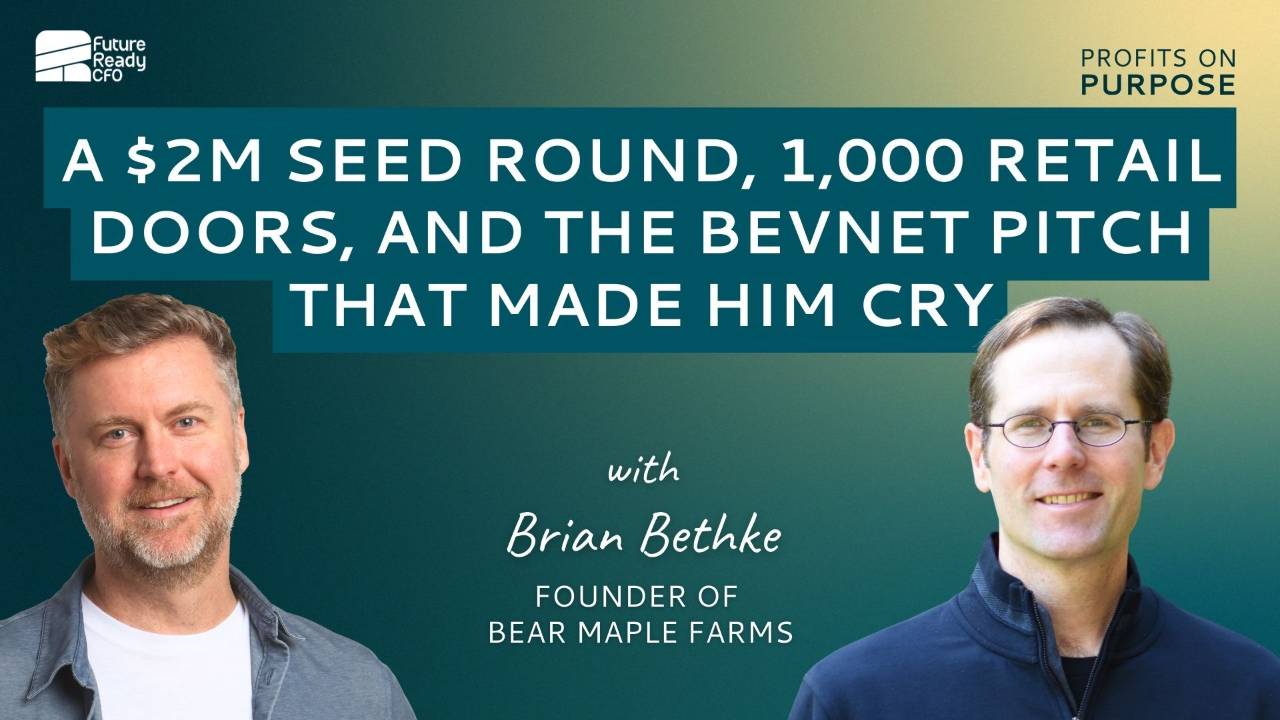
Episode Description
Brian Bethke has done this before. He built and exited a music industry brand — Supro and Pigtronics — before pivoting into the beverage space with Bear Maple Farms, a clean soda brand now in nearly 1,000 retail stores and backed by a $2M seed round. But success on paper hasn't made the journey any easier.
In this conversation, Brian shares the unfiltered story behind Bear Maple Farms: the BevNet pitch contest he lost despite months of preparation, two complete brand repositioning pivots, the data-driven decision to walk away from Whole Foods and build a grassroots retail story first, and the tension between investor expectations and a founder's instinct to extend runway and build sustainably.
As a second-time founder, Brian also gets candid about what he wishes he'd understood earlier — and why getting financial help years sooner would have saved him five years on his first business.
Key Takeaways
- The fastest path to product-market fit is often by putting something out quickly and listening closely to customer feedback.
- Success in retail requires understanding the category management mindset more deeply than most founders realize.
Margins are significantly better with independent stores than with large chains, but they require more time and relationship-building. - Pursuing rapid growth through large retailers like Whole Foods can erode margins and create complex logistical dependencies.
- Engaging a fractional CFO or financial modeling expert early is a game-changer for managing cash flow, runway, and investor expectations.
- Building a company with intentional risk management includes pacing growth, slow expansion, and prioritizing profitability over top-line expansion.
- Bringing family and community into the entrepreneurial journey creates resilience, meaningful connection, and authentic branding.
See More from Brian and Bear Maple Farms
Brian:
Bear Maple Farms:
Special Offer: Use code PROFITS25 when you purchase a case of Bear Maple Farms on Amazon!
Listen to the full episode to discover how Brian's experiences can inspire and guide you on your entrepreneurial journey. Don't forget to subscribe for more insightful conversations!
I hope you enjoy this episode!
Give it a like, share, and subscribe to not miss the content coming your way weekly.
– Nate and the Profits on Purpose podcast team




Transcript
-----
00:00 – Brian's journey from music to beverages.
01:27 – How maple water and ginseng inspired a new product.
06:11 – Lessons from BevNet pitch and rebranding.
11:40 – Understanding category management and consumer behavior.
17:39 – Building distribution through independent stores.
30:09 – Balancing profitability with outside funding.
41:25 – The role of personal connections in entrepreneurship.
47:47 – Connecting with Brian and how to try Bear Maple products
-----
Nate Littlewood (00:06)
Welcome to Profits on Purpose, the podcast for e-Comm and CPG founders who are looking to scale their businesses both profitably and purposefully. I'm your host, Nate Littlewood from Future Ready CFO, where I help seven figure e-Comm and CPG founders make confident data-backed decisions that drive profitable growth, all while helping them sleep better at night. Anyway, today's guest is Brian Bethke, who's the founder of Bear Maple Farms.
Brian brings a really unique perspective to this conversation. He is not a first time founder. He's actually successfully built and exited a music industry business previously, selling to the legendary D’Angelico guitar brand.
Nowadays, he's applying everything he's learned from that to scaling Bear Maple Farms, which is a clean soda brand that's already in nearly 1000 retail stores and has recently raised a $2 million seed round. What I found really interesting about Brian's story and chatting with him is his willingness to share what's actually happening behind the scenes. We're going to be talking today about some of the pivots he's been through in terms of brand positioning
going shelf to shelf with bigger, you know, soda brands like Olipop and the shift he went through from chasing major retailers like Whole Foods to instead building a grassroots data based story. One of the other things we're going to be talking about today is, you know, the very, very real tension that comes up and exists between investors and investor expectations and the founders instinct to extend runway and build sustainably.
Brian, I hope I've done you justice in that introduction there. Welcome to the show. It's great to have you here.
Brian Bethke (02:05)
Yeah, thank you, Nate. It's pleasure to be here.
Nate Littlewood (02:08)
Of course. Well, Brian, I always like to get these conversations started with talking a little bit about your background story. And, you know, what's fascinating about your background is you went from building and exiting a brand in the music industry to what seems to an outsider to a pretty big pivot to now be in the beverage space. Tell me what was it that, you know, drew you into the beverage space and how did you, decided that this was a good thing to do.
Brian Bethke (02:39)
I've always pursued stuff that I'm passionate about. I started playing guitar when I was about 12 years old and I was inspired to play guitar by my idols like Pink Floyd and Aerosmith, Joe Peria of Aerosmith and the Grateful Dead, Lenny Kravitz, all these amazing guitar players and I thought I'm gonna learn to play like that as well.
And that started to lead me down the pathway to start my music industry company. We own Supro and Pigtronics were the two brands we made amplifiers, guitars and effects panels. And eventually my idols who I grew up, grew up in, who inspired me to start playing guitar, started using those products. And it was mind blowing because they started coming back to me and saying, “Brian, thank you for doing what you do because you inspire our music and make my music like you helped me create my art.”
And that was the most gratifying thing I could ever imagine. When I pivoted to, I sold that business in 2020 and in parallel, the pandemic happened. Nate, you lived in New York City as well during the pandemic? And like everyone left the city.
I have a friend who is a photographer and took a photo of Times Square. There's zero people in Times Square. And so my wife and my daughter, who were six at the time, we moved up to the Catskill Mountains three hours north of New York City. And it's bucolic and beautiful and rolling hills and farmland. Our trees outside of our window were all maple trees.
And that was ultimately part of the inspiration for Bear Maple Farms. It started because I said to my daughter, Anna, let's go outside. We'll tap the maple trees and make maple syrup. And she came out with me. Soon enough, I turn over, turn around and Anna's got her head under the spigot and drips of maple water dripping onto her tongue. And she's like, dad, this is delicious you should try this.
And so my wife came out. She's like, what are you goofballs doing? And exactly. So, but maple water is amazing. It's water filtered through the cells of a tree and it takes out all the bad stuff and it stills it with nutrients and minerals and electrolytes. And on top of that, ginseng grows naturally all throughout the maple forest of the Northeast. And I recognize that.
Nate Littlewood (04:51)
We're Memphis-out-of-CPT brand.
Yep.
Brian Bethke (05:14)
And I'd lived in China for about five years. So I'd seen people lined up in Hong Kong buying ginseng hand over foot and just obsessed with it. And so I kind of put those two ingredients together. And that was the inspiration for Bear Maple Farms and Bear Maple Farms because Bear was my nickname growing up. That was what my mom called me.
Nate Littlewood (05:37)
Okay. What's quite the story. I think when you and I first met, was actually at fancy food show a couple of years back. And at the time you were selling or you were positioning this product as a sparkling ginseng elixirs, as you just described. Yeah. But now what you're promoting and offering is more of a clean soda.
That's a pretty big change in pivot in terms of repositioning of the product. Talk me through that, like how and why did that change happen?
Brian Bethke (06:15)
I originally called it a sparkling ginseng elixir because that was to me it was this magical elixir from the forest.
And so I thought, okay, this is what goes on the label. And it took me about, I spent about two years formulating the liquid and getting it completely dialed in. And then I went into packaging and I've never made CPG packaging before. And I called up my friend, Chris Farabay, who had designed guitars for us.
He'd never done a packaging for a, like a soda label or anything like that. But he was like, yeah, I'll do it. So we put a month or two into creating the packaging.
And the next step I went to the BevNet Live, which is BevNet Live is a conference that is everyone who's anyone within the beverage industry is there. It's the who's who of the beverage industry. And they have a pitch contest. It's like a Shark Tank style pitch contest.
And Olipop, Bi, Spindrift, all the brands that have come out in the past 20 years have stepped up onto stage and done this pitch contest. so I got accepted. Yeah. And I got accepted into the semi-finals.
Nate Littlewood (07:22)
Yeah.
Brian Bethke (07:42)
And I was all excited about it and we were still a sparkling ginseng elixir at that point and I get up and do my pitch. I was really nervous about it because I'm an introvert and so I practiced for like three months, get up on stage and I give my pitch and I did a fantastic job and the judges, one of the judges was the buyer from Whole Foods. These were serious judges and I around. They're heavy hitters and I turn around and it's like crickets.
Something did not land. And it was the Whole Foods buyer who says, “Brian, this is delicious. You have really good liquid and can't wait to get it on shelf, but your packaging needs work. And it's like you're calling yourself a sparkling ginseng. Elixir, what's that all about? Elixir sounds like something from Lord of the Rings. Are you marketing the Hobbits?
And you've got… a picture of a ginseng root and a maple leaf. It's really cluttered. You've got all this messaging on the packaging. You've got to fix that.”
So that was really tough feedback to take. know, I'm here. I am thinking I'm going to win the contest. I'm an experienced entrepreneur and I practice my my final pitch over and over and over in the family room. My daughter knew my pitch by heart and I didn't even get to do the final
Nate Littlewood (08:50)
Okay.
Brian Bethke (09:09)
pitch because I didn't make it past the semifinal. So that was interesting learning experience. And I went home, I curled up in bed and cried and I got up the next morning and I called every single, I called up tons of brand designers and people who do packaging and are really good at it.
One of those people that I was turned on to is a woman named Paula Grant. And Paula Grant is, was the number two employee for body armor, which I don't know if you know the body armor story. They sold for like $5.6 billion. It was one of the, well, it was the largest exit in beverage history. So she kind of knows something about packaging. And so I reached out to her. I didn't have a warm intro. I just sent her samples and crossed my fingers and I figured I'm never going to hear back from her.
Nate Littlewood (09:40)
Okay. Okay
Brian Bethke (10:09)
But sure enough, about a week later, she calls up and she's like, Brian, this is really good. I like your product. I tried it. Let's talk. So she helped us do the rebrand for the final, the most recent round of art. And at that point we had become a sparkling ginseng tonic.
Nate Littlewood (10:32)
Okay.
Brian Bethke (10:33)
And the word tonic didn't work either because who loves tonic water? It like no one does. The only time you think of tonic is with gin and tonics. So I kind of needed to evolve the brand a little bit further. At the time I was doing a lot of demos at stores, I would go out and give samples and watch people's reactions. And after 50, a hundred different demos, every single person
Nate Littlewood (10:43)
Yeah.
Brian Bethke (11:02)
lot of people would say, this is delicious. This is really good. This is like a great replacement for a traditional soda. And then they turn the can around and look at the nutrition label and say, wow, this is really clean. Only five calories. I don't know how you do that without stevia and erythritol and artificial sweeteners. And it's got chintzing for focus and clarity.
Nate Littlewood (11:24)
Yeah.
Brian Bethke (11:29)
And so I just took what our customers were saying at that point and put it on the label. so clean soda with ginseng for focus and clarity.
Nate Littlewood (11:38)
I love it. Well, it sounds, I mean, with the benefit of hindsight, it sounds almost kind of obvious way to do it. I had to to ask the awkward question here, but why did it take so long to get to that point? Why? Why not have done?
Brian Bethke (11:55)
I I should have just done this in the beginning, right? Is go straight to the customers and figure out how they're talking about the product. It's actually surprisingly hard to do that in early stages if you don't have a product. Sometimes the journey is you've just gotta put something together and get it out there so that you can get in front of customers and hear their feedback. And a brand, a healthy brand is always evolving.
That's something that I didn't always understand. But as I've done this enough, a brand that becomes static is a brand that is in process of dying. Your customer is always evolving, the market's always evolving, and you want to evolve with it and continually refine how you speak about your brand and how you present your brand and connect with your customers.
Nate Littlewood (12:49)
Yep, yep, okay, I love it, I love it. Well just to finish the origin story piece a little bit, and I'd love to spend a minute reflecting on your journey thus far. You shared the story earlier about going and drinking the maple water with your daughter, and you had this realization, it was a kind of a-ha moment. Talk me through how and when you went from that to deciding that this actually needs to be a brand or a company.
Brian Bethke (13:20)
The real catalyst moment was when I was out in the Catskills and at the time I was working with a business coach named Ben and Ben and I had started coming up with a business plan based around machine learning and LLMs before they had become AI. Wow, chat or GPT2 was around but chat GPT had not come out.
And even the notion of a chat bot was still kind of anathema. wasn't... People were like, what are you talking about? You want to build a chat bot? But I had gotten really excited about it. It was clear to me that this was going to be something in the future. And I had started teaching myself how to code in Python.
And Google had a program called TensorFlow, and you could develop AI programs through using Google TensorFlow. And so that's what I was doing up in the Catskills at the time. And I was in front of my computer coding. I'm looking out the window. I've got this beverage next to me that I cooked up from the maple trees and the ginseng out in the forest. And the sun is streaming through the maple leaves through the window. And I'm like, what am I doing?
I don't want to be coding for the rest of my life. I think I want to be out there. And by the way, this beverage right here, maybe this is my product. Cause there's nothing else like, like this on the shelf right now. Ginseng is been around for centuries. It's well known for immunity, mental clarity and focus and stress resilience. And yet there's no brand out there that focuses on ginseng as the hero ingredient and maple water. It's this perfect natural sweetener.
So that was the catalyst moment. I went back to my business coach, Ben, and I'm like, Ben, you're going to hate me for this. We just worked two months on this business plan and I don't want to do it. It's just not in my heart. I'm not feeling it. I think I want to do this beverage. Ben's an amazing guy. I thought he was going to be upset.
And he looked at me he said, Brian, I think what you're doing is smart. You're listening to what's in your heart and there's only good things can come from that.
It's, it's always been part of the journey for me. You know, it's, it's definitely something that, as I've gotten older, I've, I've gotten better at incorporating my family and my friends and the people around me into that journey in ways that are more and more meaningful. I think that's how I've grown with it.
My business partner, Dave and I, used to always joke that the whole reason why we started that company was because we wanted to build our own guitar pedals and expand our guitar collection and amplifier collection. And it worked. I enjoy sharing the stuff that I'm passionate about with people. For me, that's a big thing is finding the ways to connect with people that are meaningful.
Nate Littlewood (16:43)
with you know retailers like Guitar Center and I think Sam Ash and you were kind of applying that to the CPG industry and I think at one point you were you know focused on retailers like Whole Foods and Kroger's maybe but my understanding is that your attitude towards go-to-market and the retailers that you're looking to partner with has kind of changed and evolved a bit over the last few years. Tell me a little bit about what's going on there.
Brian Bethke (17:13)
Yeah, we in the music industry are we were very, successful selling through the big retailers like Sam Ash and Guitar Center and Sweetwater. And we were going up against brands like Fender and Marshall and Gibson. And we did it very, very successfully. The difference between the music industry, which is only about nine billion dollar industry, CPG and beverages and specifically
It's about $300 billion. So it's about 30 X the size. And they don't refer to the buyers as buyers. They're called category managers and their job is not so much to purchase. It's to manage the portfolio of products on the shelf and optimize the,
Nate Littlewood (17:48)
Yeah.
Brian Bethke (18:07)
the margin, the gross margins, optimize the velocity, even the way the store is laid out is quite scientific. They want to expand the cart size so that the amount of dollars that people spend at checkout is higher. And there's a lot of science. It's very data driven and it's a portfolio management type of approach.
It took me a while to really understand that and wrap my head around it. But now when I walk into a grocery store, it's, I can't see it any other way. It's fascinating. had a mentor who, as I was getting to understand the CPG industry, he said, go to the grocery store, stand in front of the functional beverage shelf and watch how, watch people. And you're going to feel totally awkward when you do this, but no one cares.
just go watch what products do they pick up, what do they put in their cart, what other products do they have in their cart, and start asking them questions. And you really need to get to know the shelf that you intend to sit on because that's who you're competing against and you wanna be able to absorb the mentality of the category managers who are ultimately making the decision about putting you on the shelf.
Nate Littlewood (19:27)
Okay. So how has that influenced the way that you're thinking about the different retail partners or go to market?
Brian Bethke (19:39)
Yeah, we, know, in the, in the music industry, I think we were very lucky because it's as much smaller industry. We got into stores fairly quickly. It's taken us longer to break into those tier one retailers in, in CPG. And at some point we said, okay, well, it's taking some time for Whole Foods to get on board with this. They, they tried the beverage. They love it.
but they're looking for the data story. They say, this is delicious, this is great. And then they look at the spins data, which is the agency that collects all the syndicated data across the industry. And they say, you're not even on here yet. Come back when you have more information that we can base our decision on from a data perspective. And so we said, okay, let's take a step back and how many independent stores do we need in order to equal
Nate Littlewood (20:29)
Okay.
Brian Bethke (20:37)
Whole Foods and it's you know, it's really not that many. It's like 300 500 stores. So let's start there. We decided let's own our backyard and focus on the independent stores through the infra and NCG co-op buying groups in the Northeast and and just crush it. And so that's what we did and we were very successful with it. We that's you know,
what's resulted in closing in on 1,000 stores. And now we are a top 10 brand for functional beverage in the Northeast. We're the largest, like highest growth brand in that region. And so now we can take that model and duplicate it in other regions. And that also gives us a really good foot in the door for the larger tier one retail stores.
Nate Littlewood (21:33)
Okay, so do you think you're at the point now where you have that sales velocity or data story that you need for Whole Foods or is that still a work in progress?
Brian Bethke (21:46)
Yeah, I've got my fingers crossed for sure. But it's a long-term complex type of sale. Sometimes it'll take 10, 15 different conversations before they'll say yes. And even once they say yes, it could take six to 12 months to actually get on the shelf. That's just the way that the industry works. Every large chain store
Nate Littlewood (22:01)
Mm-hmm.
Brian Bethke (22:15)
They have category reviews and it's on cycle. Like every six months to 12 months, they'll review a certain shelf, a certain category, and then they'll look at all the margins, all the velocities, everything upon that shelf and rebalance the portfolio of products that they have on there. So you can't really approach them if it's not open review season for them.
Nate Littlewood (22:45)
Got it. Got it. And how, maybe the answer to this question is that it hasn't at all. So, and if that's the answer, please let me know. But how has your analysis on profitability and margins at these different retailers influence this strategy? Cause I understand, know, Whole Foods is notorious for very high trade spend and know, promotional spend, which translates to, you know, especially once you bake in all the distributor phase,
incredibly compressed margins for a lot of CBG brands. I would expect that the route that you're talking about now, working with these independents, you probably have a significantly better margin. Tell me how margin and profitability is or isn't kind of influencing the thoughts and go to market here.
Brian Bethke (23:37)
Yeah, you've got it 100 % on. The independents are, buying their food co-ops and mom and pop grocery stores. They tend to be more selective about the products that they bring in. And they, I don't want to say that they're not data driven because they are, but they have more independence obviously in the decisions that they're making.
And they tend to bring on products that they personally like and that they're passionate about. They also know their customers very well. So they are a great avenue for a young brand because they will then take those brands that they like and they put on shelf and they'll tell their own customers about it. so the costs are much lower. It takes a little bit more time potentially to
get into all those stores individually, but they're really good partners and we've seen great success with them. The larger retail chains when they're buying for an entire chain, the second you start working with them, they say, okay, and we're gonna expect you to do this amount of free fills and this amount of promos and the trade spend can get really insane.
I've heard stories of trade spend being as high as 40%, which is just nuts. mean, how do you run a business and spend that much on trade spend to sell through these retailers? So it can be a little bit perilous for an early brand to get in bed too early with these larger stores like Walmart and Kroger and Tar...
They're all they're all looking out and trying to make win-win situations. But the fact is that they have a lot of buying power and it's tempting to want to. Because it feels like a really big win to get into three thousand stores all at once to to completely cut your margins to nothing. And that's something that can.
be really destructive to early brands.
Nate Littlewood (26:01)
Yeah, yeah.
I always get absolutely terrified when I talk to founders and they're singularly obsessed with getting into Whole Foods. It's some type of validation. You make it onto Whole Foods, you've somehow got a cool brand. I'm actually working with one of my CFO clients at the moment and figuring out how to get out of Whole Foods. They have too large a presence in Whole Foods and between all the cost inflation they've seen and the ridiculous amounts of trade spend, they're not making
making any money. Every unit that they sell in Whole Foods is actually happening at a loss. And because Whole Foods underpins a lot of the distribution centers, it's now created this really complicated problem where if we get out of Whole Foods, we may not have the volume going through certain distribution centers to keep those DCs open, which then has flow and effects for other retailers. And untangling this is a huge mess.
Brian Bethke (27:01)
Yeah, that, you know, the DCs, the distribution centers, that was something that was very new to me and CPG as well. And with music products, it was one centralized distribution center and you could cover the whole country from that. And it was completely new to me that like, no, you can't ship to that store because they, they pull from this particular distributor out of this particular district.
warehouse and if you don't have product in that warehouse then you can't sell to them and it was like wait a minute what this is a chicken or the egg type of scenario right it's what what comes first do you get the do you open the DC or do you open the stores like how does that even work
Nate Littlewood (27:48)
One of them has to say that,
right? Yeah, I think the average consumer would be absolutely horrified to understand how complicated the backend of logistics are of the products that just magically appear on the shelf somehow. It's mind-blowing. So on this topic of...
profitability and you know beverage brands are notoriously expensive businesses to scale right. This is not a product that does you know particularly well during e-com.
I'm not sure how significant e-comm is to your business, but beverages are heavy, they cost a lot to share, but it's not easy doing direct to consumer with a product like this. At the same time, it's time consuming and can be very, very expensive to go through retail. Tell me a little bit about how you're thinking about scaling in terms of prioritization on profits, profitability versus sales.
You know, bootstrapping versus taking outside money and that sort of thing. was, guess I was thinking beyond Ecom and looking at the Ecom business, Whole Foods and Independence we were chatting about earlier. Businesses like yours are notoriously expensive to scale. And I'm curious how you're thinking about profitability versus bootstrapping versus taking outside money.
Are you trying to scale the top line at all costs and expecting that you'll need a lot of investor money to do that? Or are you trying to take a lighter approach to fund to outside funding and perhaps trying to achieve profitability a bit earlier than might otherwise be the case?
Brian Bethke (29:44)
Yeah, so we raised, I raised a seed round, a $2 million seed round on a safe note with a $10 million valuation cap. The expectation and the model that I built was that we were going to pursue venture capital and private equity fairly early and put a lot of money into top line growth. That was the expectation. The reality is,
is that once you go from the seed round to a series A and take institutional capital, you are getting on a treadmill that is not gonna stop. You've.
want to be able to raise every 12 to 24 months, you need to do a new fundraise. And the typical pathway is you do your seed round, then you do your series A, series B, series C, so on and so forth, until you get to the exit. And every single round, you want to have higher valuation and a larger capital raise. You never want to have to do a down round or a bridge round.
And it can be very, very stressful. it's... So for us, I was very mindful. First off, for every percentage that you raise in early rounds, that gets magnified in later rounds in terms of dilution.
Nate Littlewood (31:26)
Like the dilution magnification or the compounding effect of dilution I guess.
Brian Bethke (31:30)
Yeah, so the goal in the seed round is to raise as little capital as you need in order to de-risk the business in a meaningful way and get to that next milestone. For us, that milestone was we wanted to have 8 to 10 million in revenue and really meaningful velocity and data story as well as, you know, really solid revenue story. We're getting there. We're not quite there. And we also want a meaningful presence in those tier one retailers. So that was the goal.
Ultimately, I decided to slow that growth process, pull back on some of our spending and expand our runway so that we have three to five years with a runway and that we're not rushed into doing a series A before we're ready. I mean, you really want to make those mistakes early and at a small scale. And when we go to a series A and raise institutional funding, it's not going to be to like try things out. It's going to be to scale up something that we're very, confident about. And that is a proven model.
Nate Littlewood (32:53)
Yeah, yeah, you made a really interesting point there about risk and appetite for risk and doing things that you've proven. And one of the, think, really, really important differentiations that I recall as a founder, and I was a bootstrap founder, like I never raised any outside capital, but one of the really important differences I remember between taking the path I did and some of my peers who had raised significant amounts of money was the way we thought about
about risk and what that meant in terms of the sorts of opportunities that we could pursue. When you don't have millions of dollars in the bank account, your appetite for risk is significantly lower because if things screw up and it doesn't work out, there is no safety buffer. There's nothing in the bank to save you.
And if I'm hearing you correctly, it sounds like that's, not that you're bootstrapped, but that's a little bit closer to the path that you're taking. So I'm curious how you're managing that. Like how are you projecting the runway? Like what are some of the financial tools or systems that you're using to make sure that you do have enough cash in the bank and you can get to the place you want to get to?
Brian Bethke (34:19)
Yeah, it's very much financial modeling. I found an amazing fractional CFO that I I work with to build our financial model. And it's highly sophisticated. And in most brands at our level don't really have that type of like a really robust financial model. Yeah. So and that's that's the basis of it.
So the idea is that we're collecting our sales data internally on a weekly, monthly, and quarterly basis. And we're always going back and comparing our actuals versus the model and seeing, OK, what did we expect to happen versus what actually happened? And how are we tracking?
Nate Littlewood (35:06)
Okay. Can we double click on this decision a little bit? Because just purely out of self interest here, if I can be honest, right? I am a fractional CFO and what I find
interesting about you and what you just said is you're a second time founder. You have evidently gotten to the point where you have acknowledged that you needed some help with these financial projections and you have gone and you know, engaged someone to do that for you. I have a lot of conversations with first time founders and they've never worked with a fractional CFO before and a big part of that conversation is like, what the heck does a fractional CFO do?
like and you know I'm basically having to sell them into the idea of actually needing someone like me let alone you know deciding whether I'm the right person for them. So as a second time founder who has engaged this sort of help I'd love to hear your perspective on how you knew that was a good thing to do.
Brian Bethke (36:08)
I love this question because I did both things. in my first business, I bootstrapped and we never raised a seed round, never raised funding. And at that point, I was that founder who came to you and was like, what does a CFO even do? so in the second time around,
It's taken me a long time to understand, like the first time through, my mentality as a young 24 year old founder was that I don't, I'm not gonna go, I need to do this all myself. That I'm not gonna go out and find anyone else. I'm just gonna figure this out and do it because that's what founders are supposed to do apparently. Which is not true whatsoever. And it wasn't until,
I was fairly late in the game towards selling my first business that I very much realized that the most successful people out there who are the ones who surround themselves with a really amazing team, really good mentors, really good coaches, really good fractional CFOs. And it just kind of dawned on me looking at
Nate Littlewood (37:28)
Mm-hmm.
Brian Bethke (37:34)
my peers and my other, people who are building businesses alongside of me, that this is what you do if you really wanna accelerate your pathway to success. And I'm convinced that if I had really understood that earlier on, it would have saved me at least five years in my journey to where I was going in my music business.
And so it's so, powerful. Things like mentorship and finding that that CFO who you can sit down with, who is has the experience, has built these financial models before for other businesses and can help you model out what success is going to look like. And then.
I mean, it's so powerful to be able to take that model and introduce it to your team and say, this is where we're going and this is how we're going to do it. And then we're going to go back to this on a periodic basis and assess ourselves. it gives a really good North Star for decision-making as well.
How does this affect the metrics that we're looking at with this model? know, the gross margin and velocity and cash conversion cycle and all of that stuff is baked into that financial model and why working with someone like you is so pivotal and so powerful.
Nate Littlewood (39:11)
Mm-hmm. Mm-hmm. Are there any other significant differences that you notice in yourself as you contrast, you know, me as a first time or you as a first time founder versus you as a second time founder?
Brian Bethke (39:22)
The thing that comes to mind is what I mentioned earlier is in finding ways to bring friends and family into that journey. And that's been one of the most rewarding parts of it. My daughter is going on 11 years old now and she's like a little person, like she's a little teenager and she's watched this whole journey and I talked to her about
the decision making and what I'm thinking and she knows I'm going on a podcast today and she's like, good luck dad. And so she has started her own brand now. She started a lemonade company and this was, this was inspired for her because she had wanted a puppy dog.
And she campaigned for two years to try and convince my wife, Megan, and I to let her get a puppy dog. And she would post, she posted on the living room wall, meeting, family meeting tonight, seven o'clock, and she would give a presentation about why it would be beneficial for us as a family to get a puppy dog. And I, as a parent,
I hate to say no, would much rather say, well, if you wanted to do that, how would you go about doing it? And encourage her, like this is very entrepreneurial mindset that I'm kind of teaching through this process.
that, okay, I'm not going to say you can't get it. How would you get it? How much is it going to cost? Where are you going to get it? How are you going to take care of it? You know, who's going to take it for a walk? Who's going to feed it and come up with all those solutions? And then if you can solve all that, like I'm I'm good with that. And so so in order to raise the money for the puppy dog, she reached out to my mom, her Grammy.
and she asked for a loan. And my mom is so funny. My mom says, okay, I'll give you a loan, but what's the collateral? If you don't pay it back within three years, I get the puppy dog. this was over three years now. And sure enough, Anna raised all the money and paid back her Grammy. And now we have a little puppy dog, white and fluffy, adorable dog named Sammy.
Nate Littlewood (41:32)
Okay.
That is amazing. That is such a cool story. I love it. Yeah, I love it Have you have you read rich dad poor dad?
Brian Bethke (42:07)
I have, yeah.
Nate Littlewood (42:09)
Yeah, that's coming across with some rich dad vibes there. Yeah, I ready. We'll have to have to have her on the podcast and she can tell.
Brian Bethke (42:20)
I love that process of bringing the stuff that I've learned and giving it back to others. So many people have done that for me along the way. When I went to my first...
My first music conference that I went to, we had no idea what we were doing. We snuck our product into the trade show under our jacket and it was just this box held together with duct tape and the functions written on and magic marker. And there are some people who were, and we just asked for advice and say, hey, this is our product. What do you think? How do we build a business?
And some people are like, you know, I don't have time for this. I'm trying to run my trade show booth. And every once in a while you find someone who's like, you know, you remind me of myself. Let me tell you, know. And those are blossom into amazing relationships. those are, you know, that's the gold in life. Yeah.
Nate Littlewood (43:30)
Amazing, Well, Brian, you've certainly learned a lot through this entrepreneurial journey of yours, and you've gotten a lot further in it than a lot of the folks who are going to be listening to this episode. For folks who are maybe a couple of steps further back than where you are today, and they're figuring out how to finance a business or get into their first hundred doors or something.
Do you have any advice for those people? What tips would you give them?
Brian Bethke (44:02)
The only person that knows, understands your situation is you. And it's so important to own your own decisions and to also surround yourself with really good teams. Find the people that are gonna be your advocate. Find really good mentors, find really good coaches.
And make sure that you are, you know, being a founder, being an entrepreneur, the only thing I can analogize it to is jumping out of an airplane and building your parachute on the way down. It is terrifying and also at the same time, the most exhilarating thing you could ever do. So I think it's important to own that journey and own that process. And at the same time, you've really got to love your product and love what you're doing on a day to day basis. Because otherwise, there's a lot of tough moments to go through.
Nate Littlewood (45:07)
Yeah, I bet, I bet. Well, Brian, I've really enjoyed hearing about the story and thank you so much for coming on and sharing all your perspectives and everything you've learned through now building two of these businesses. Where should folks go if they would like to learn more about you and what you're up to?
Brian Bethke (45:27)
We, actually put together a discount code for on Amazon.
Nate Littlewood (45:33)
Oh, here we go. Cool.
Brian Bethke (45:34)
So PROFITS25 is the discount code. And if you go on, please go and buy a case of Bear Maple Farms on Amazon. My personal favorite flavor is the Yuzu citrus, which I'm drinking right now. And we have ginger, which is the best selling skew, lemongrass mint, which was inspired by the lemongrass and the mint growing in my garden.
That's a really special flavor and cran raspberry is our this guy right here is our brand new flavor and that's been very very popular as well and really good so yeah please go on Amazon buy some Bear Maple and you know this is all about calm meditative focus and energy from from ginseng. Yeah. And it's only one gram of sugar less than 10 calories. Super, super healthy. Yeah. So yeah. And thank you, Nate, so much for having me on.
Nate Littlewood (46:36)
Of course, it's been an absolute pleasure having you. I'm going to include links to the Amazon product links below as well as that coupon you mentioned. Are you active on any of the social platforms? You know, is it okay?
Brian Bethke (46:50)
Instagram is @drinkbearmaple is our Instagram handle.
Nate Littlewood (46:59)
Okay, perfect, cool. Well thanks again, Brian. It's been amazing having you on Profits On Purpose. Really enjoyed chatting about your journey and the brand and everything you've been up to. We'll see you next time. Take care.
Brian Bethke (47:12)
Thank you, Nate.
Want more like this?
Join our newsletter list and every Thursday morning you can look forward to actionable insights and free tools for scaling your brand.
We hate SPAM. We will never sell your information, for any reason.
