Why Selling The Experience Matters More Than Selling the Dress | Manon Martin | Les Aimants | Profits on Purpose
Nov 26, 2025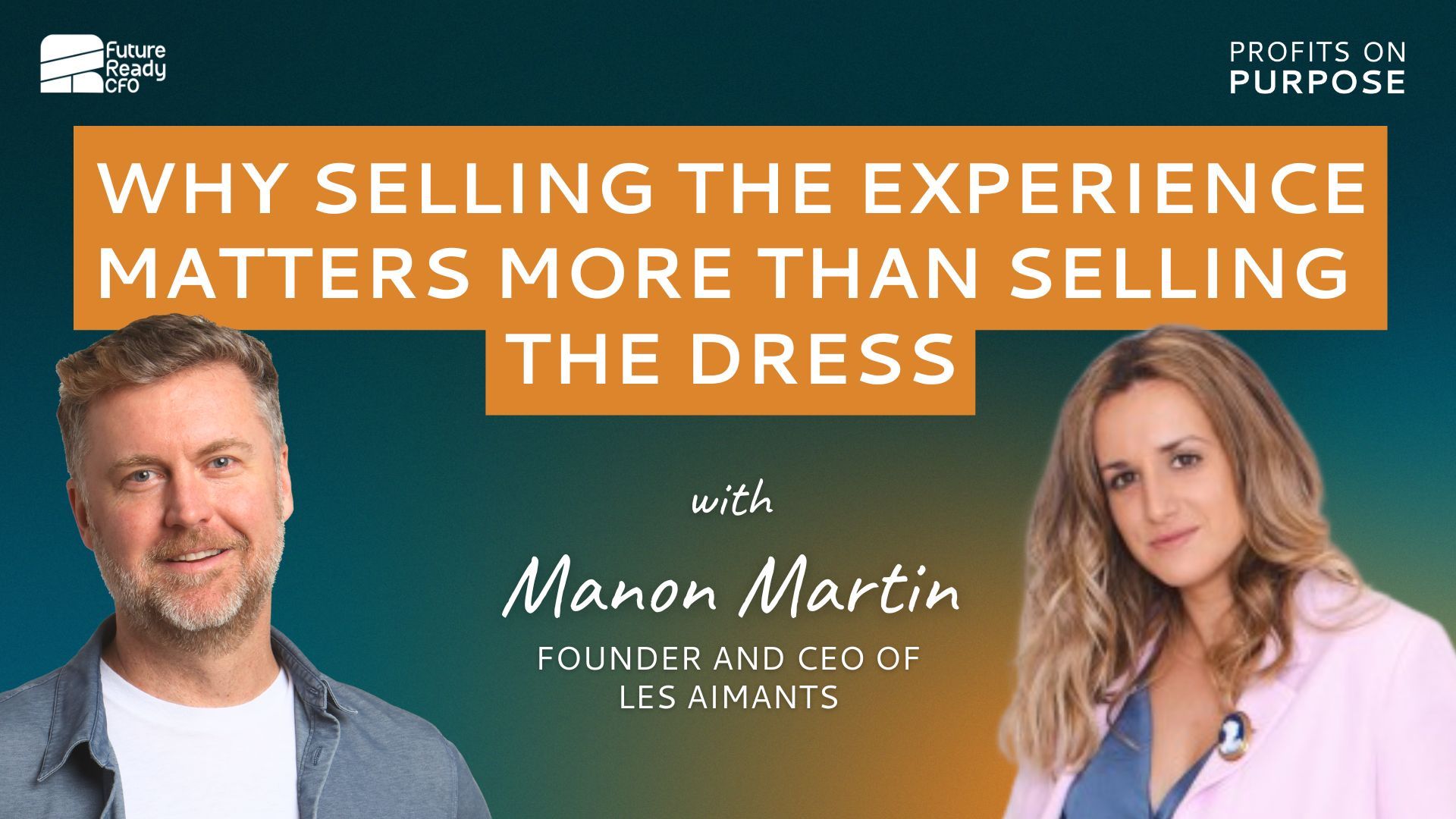
Episode Description
In this episode of Profits on Purpose, host Nate Littlewood interviews Manon Martin, founder and CEO of Les Aimants, a bridal lab in New York that is revolutionizing the wedding dress shopping experience. Manon shares her background in the fashion industry, the challenges brides face in traditional shopping, and how her company addresses these issues through innovative technology and a focus on customer experience. The conversation explores the transition from B2B to direct-to-consumer models, customer acquisition strategies, fundraising experiences, and the importance of financial management in a startup.
Key Takeaways
- Manon Martin transitioned from a technical designer in fashion to founding Les Aimants.
- The bridal industry has long lead times and hidden costs that frustrate consumers.
- Les Aimants offers a customizable wedding dress experience with 3D body scanning technology.
- The company focuses on creating an emotional shopping experience for brides.
- Transitioning to a direct-to-consumer model allows for better customer relationships.
- Referrals are a key driver of customer acquisition in the bridal industry.
- Fundraising and accelerator programs have shaped the company's growth strategy.
- The business operates on a made-to-order model, minimizing inventory costs.
- Customer feedback is crucial for improving the shopping experience.
- Key performance indicators include conversion rates and customer referrals.
See More from Manon and Les Aimants
Listen to the full episode to discover how Manon’s experiences can inspire and guide you on your entrepreneurial journey. Don't forget to subscribe for more insightful conversations!
I hope you enjoy this episode!
Give it a like, share, and subscribe to not miss the content coming your way weekly.
– Nate and the Profits on Purpose podcast team




Transcript
-----
00:00 Introduction to Les Aimants and Manon Martin
01:18 Manon's Journey in the Fashion Industry
03:30 Identifying Problems in the Bridal Industry
06:43 Innovative Solutions for Bridal Shopping
09:57 Creating an Emotional Shopping Experience
13:05 Direct-to-Consumer vs. B2B Strategies
17:54 Customer Acquisition and Marketing Strategies
21:36 Bootstrapping and Accelerator Insights
26:23 Learning from Accelerator Programs
28:23 Financial Management and Decision Making
28:46 Cash Conversion Cycle and Inventory Management
31:35 Customer Experience and Acquisition Strategies
33:37 Key Performance Indicators and Business Metrics
-----
Nate Littlewood (00:06)
Welcome to Profits on Purpose, the podcast for EECOM and CPG founders who are looking to scale their businesses both profitably and purposefully. I'm your host, Nate Littlewood from Future Ready CFO, which is a go-to fractional CFO solution for seven-figure founders who are looking to take a state of financial chaos and confusion into one of clarity and confidence. Anyway, today's guest is Manon Martin.
who is a founder and CEO of Les Aimants which is a New York bridal lab, is reinventing the way that brides shop for wedding dresses with absolutely unheard of lead times and at prices that challenge industry norms. She's a tech star backed founder building from right here in Brooklyn, New York. understand you traveled 10 blocks. Yes. To come and join me on the podcast today. So very, very local.
Anyway, welcome to the show. It's great to have you.
Manon Martin (01:07)
Thank you so much, Nathan. Thank you for having me today. Appreciate it.
Nate Littlewood (01:10)
Of course,
of course. Well, listen, why don't we get started with talking about your background and how you got into this. I understand that you're working in the fashion industry for a number of years before starting this business. Like tell me about that experience and how did you get here?
Manon Martin (01:25)
Sure. So I spent the past decade before starting the business of Les Aimants in the fashion industry. used to be a technical designer, which means that my job was to take the designer vision of each brand new collection into supply chain and development. So I was in charge of everything that goes into prototyping through the supply chain. And over the course of my career,
When the beginning of 3D fitting was coming along, I've made a pivot into bringing new softwares for larger fashion groups to speed up the process and enhance all the development of new collections. And a little fast forward, I've made a pivot into my career in...
2019 around here when after experiencing bad bridal shipping experience. Okay. So
Nate Littlewood (02:25)
This is your own wedding I assume.
Manon Martin (02:27)
No, that was my friend's wedding. my story is really like through one of my friend's wedding, one after the other. But essentially, after many times of shopping for wedding dress in New York City, I realized how the consumer experience was so left off when purchasing such an important piece of clothing, which is your wedding dress. You have to shop eight to 10 months out because this is the industry standard.
You cannot customize such an important piece of clothing because you're buying the designer vision and on the top of that the dress comes but it still doesn't fit your body measurement. And you have to pay an additional like 20 % from the original price of the gown to make it fit and tailor. So on average in America, women will spend between 800 to a thousand of dollars in bridal dress and alteration fee without knowing that they have to make this additional
⁓ purchase after buying the wedding dress. And that's how I made a pivot in my career to move from fashion to bridal with Les Aimants.
Nate Littlewood (03:36)
Okay. Wow. Well, when you put it like that, it's absolutely ghastly from a customer experience perspective. Like how has the bridal industry gotten away with operating like this with, you know, eight to 10 months lead times and all these extra fees. Like, why hasn't somebody addressed this problem already?
Manon Martin (03:55)
⁓ What I can tell you is that it is coming from two main reasons. Number one, you have to look at who is your consumer. Your consumer is a bride, it is an emotional product, and it is also very often a one-time purchase. So as a one-time consumer, the industry really has taken advantage of the customer into imposing their own standard of shopping.
⁓ It is also like it usually represents between five to eight percent of the total cost of the wedding budget. So it is really much in the advantage of the industry to pricing you into making this purchase first. So that's number one. On another end, and that's where I spent about one year to educate myself into why the industry behaves the way how it does. I realized that
Coming from the fashion industry, we call the fashion industry fast fashion, not because we work faster, but because we have a lot of software that automates all the production supply chain. When on the other side, the wedding industry, the bridal industry, the apparel has no software, no automation to track their supply chain. So that creates a necessary communication between all the parties of production when making a wedding dress.
And that this delay, this lack of communication is being pushed towards the final consumer that is paying the dress. So like the timeline, the rush fees, the alteration, like that's what the customer has to pay because there is no production structure on the other end for those.
Nate Littlewood (05:40)
Okay, interesting. So do you think the bridal industry or the wedding dress suppliers, they have a huge motivation here to change or what I hearing from you is that they're kind of happy operating the way they are.
Manon Martin (05:54)
So to give you a little bit of background on how I started, when I built L'Esiment, I really wanted to help the industry. I came with this whole idea that the industry is operating the way how they are. by pushing their consumer to buy a 210 month out, I ended up in a situation where my friend could not buy a wedding dress three months before the wedding and no one in New York City will sell us a wedding dress because we were just too late.
So what happened for those retailers? They are losing on the sales. This girl is going to make a sales from like most likely like a fashion app or online, online or so. So they are lacking on their sales. They cannot, you cannot customize such an important piece of clothing. So you're going to like find your way through like base book custom. So I thought that I could help retailers with building a technology.
where the consumer can actually customize her wedding dress from head to toe with a wedding dress configurator. Buy her wedding dress made to fit her body measurements with the promise of a true fit in one shot. So she does not need to pay for bridal dress and alteration. So with a technology of 3D body scanning, so whenever we get the data of your body measurements, you do like it fits. And at last a software that will mimic what we have.
in high growth fashion industry, it's logistics software that automates the communication in real time with all the parties of production to speed up the process and sell a wedding dress in eight weeks. What I found out is that for an entire year, my first year in business, I was actually chasing the wrong customer.
Nate Littlewood (07:43)
i.e. the industry.
Manon Martin (07:45)
In the
B2B. Yeah, the B2B. So I went out to all the bridal stores with a car with a concept of mix and match and I explained the concept to all the stores of being like, you guys are missing on sales. There is really something about your consumer experience that you haven't tackled. there is a huge opportunity of revenue that you are actually sitting on right now and you're not taking advantage of.
And I realized it was so much harder to convince those retailer. Was it the fear? I didn't know at the time. Until one day I found out that those retailer that create the industry standard make actually an additional revenue, an additional margin through rush fees or through bridal dress and alteration. why change when...
towards your consumer experience when you actually make 60 % gross margin on bridal dress and alteration, or when you make 50 % gross margin on brush fees. And so that's what I wanted to disrupt. And this is one I said, we're making a pivot, we're going DTC.
Nate Littlewood (08:57)
So this, okay, so this all sounds very, very compelling. The reason for them, well, let me rephrase that.
Okay, okay.
Okay, so this all sounds incredibly compelling from the consumer's perspective, but what you've talked about here is a number of different kind of motivations or problems that you're going to solve. It could be price, could be timeline, could be sustainability. I think there's a sustainability angle to this. How do you think about like, what is the problem that you lead with? Like what is the pain point that gets you in the door with these customers and attracts them to you?
Manon Martin (09:39)
I think the, so the free pain point that you describe timeline customization and fees, that is the essence of customer shopping experience. Les Aimants first business model is not to sell you a wedding dress, it's to sell you an experience. Because what we know is that buying a wedding dress is a very emotional product, emotional experience that you go through with your mom, with your friend, even though the generation are
changing and going towards online or whatever, it still remains an emotional process. if you... Sorry.
Nate Littlewood (10:16)
Can we, can we talk about that a little bit? I'm pardon my ignorance here, but I'm imagining a traditional wedding dress shopping experience where the bride, maybe a sister, couple of good friends, mom, auntie, whatever they're all going together and going around these bridal stores and probably making a day of it, having fun, hanging out. How do you kind of replicate that experience where we have a largely kind of digital product and a lot of the process of like fitting and optimization of the garment is happening like.
online or on the computer.
Manon Martin (10:49)
We have two ways of shopping for wedding dresses within Les Aimants. About 70%, 65 % of our revenue is coming from the traditional showroom experience that we cater in New York. You come with your friend, with your grandma, with your auntie, you're still going to have champagne in our store. You're to be able to mix and match wedding dresses, go through a wedding dress configurator, get 3D body scan once you have decided on the product that you want to purchase.
We're just going to 3DBuddy scan you. But the experience itself of the traditional way of entering the store remain pretty similar. However, we now have like 30 to 35 % of our sales that are coming from online with the wedding dress configurator. So we catered, we actually launching this later this week. So like it's a working process from the past eight month. It's a try on at home experience box for our online shopper.
to feel, to experience, touch Les Aimants directly in their living room. So you get online, 45 % of brides actually browse online before entering a bridal store. 45%. 30 % of those, will make a purchase online that is not specifically from like a wedding dress company, Fashion Apparel. So you get into our platform, you customize the wedding dress of your dream on our online platform.
And then you can order a try on at home experience box with the customization of your choices prior making the final purchase online. get a a gamification card with the same experience you will have in store, but directly in your living room to enjoy your mother with your grandmother that could not get out of the house for whatsoever reason with your friend. And you return the box once you're done with.
Nate Littlewood (12:41)
Hmm. Very cool. Very cool. So I spend a lot of time speaking with like consumer product founders on this show and one of the, you know, pretty common patterns in startup land for consumer founders is that there's always this appeal of going after bigger customers, right? So a lot of people will start in, direct to consumer and they'll eventually hope to kind of grow their way into retail so that they can be working with, you know, bigger and bigger customers.
When I think about your business, like the first iteration of it, where you were looking at actually working with the industry, I guess we'd call that a B2B relationship. what's going through my head is like a finance guy is like incredibly long relationships with probably a very, very high lifetime value. And what you're doing now is more of a kind of direct to consumer arrangement.
Where I assume that the lifetime value of each customer that comes in the door is probably a lot lower because, know, unless they get remarried, brides only need one wedding dress, right? Tell me a little bit about lifetime value of a relationship here. Am I thinking about it correctly or are there maybe other aspects to this that I'm overlooking?
Manon Martin (13:48)
Yes, usually.
So in theory, yes, B2B will be like B2B working directly with retailers will be an additional revenue or you could like run a B2B and a DTC. So yes, because you create a partnership with the retailer, they are making the sales on your behalf. They are always bringing you new customer.
In reality, because I've been running it for five years, I can definitely tell you that you are in the middle of the competition with dozens of bridal designers on the same floors of retail. That if you do not share the same value, that is the customer shopping experience, then your retailers, you're never going to sell anything. Because the people that sell on your behalf have to believe in actually
your mission and our mission is the customer shopping experience. On the other hand, we've been running this business for five years. For the first three and half years, we were fully bootstrap, which means that we can only repeat the business through referral, through recommendation, through not recurring customer, but organic. And I can tell you that one bride
Nate Littlewood (14:57)
That is so interesting, yeah.
Manon Martin (15:20)
equal five bridesmaids. So the entire business model that we've been operating is through referrals of customers until we got our first funding. And that it is much more legitimate to acquire one bride through their friends. And on the top of that, when they buy one wedding dresses from you, which equal an average AOV of 2,900 here in New York, which is for an example.
they are also then going to purchase your ready-to-wear collection. So all the looks that comes around your wedding planning, the bachelorette, the city hall, the honeymoon, we cater a collection for it that increase the AOV plus the veil plus the accessory. the yes, like the it is much more legitimate for us to go through direct to consumer because they believe in the vision because they need it and because we
we share the same value as well.
Nate Littlewood (16:19)
That makes complete sense. Yeah. So there's a lot more kind of angles to this than the one I was thinking about. So I just want to paraphrase that back to you to make sure I'm understanding correctly. And also because I think this is a really interesting point that others can learn from. Basically you went into a channel, the channel being an existing bridal store and essentially the value proposition that you had or the way that you wanted to do business was not compatible with that channel. Right. The chat, there was a
for product channel fit, we might say. So rather than hang around in a channel that wasn't working for the way that you wanted to do product, you basically said, well, no, we need a different channel. unfortunately, we need to, you well, not unfortunately, but in order for this to work, we need to have more control over that customer relationship. Have I understood that correctly?
Manon Martin (17:12)
You
understood correctly. Yeah. have to dive a little bit deeper to understand why the industry was operating that way and how do you fix it so it's sustainable for the consumer and it is also sustainable for you as a business. If you want to be that disruptive, it also has to work on the business side aspect of it. We still need to make our margin. We still need to pay our labor. How do you make yourself more affordable quicker?
in all those angles and serve the final consumer a better way as well.
Nate Littlewood (17:47)
Got it, got it.
Manon Martin (17:52)
All right.
Nate Littlewood (17:53)
Okay.
So you've convinced me on the LTV side of things. I can now see that there's a lot more opportunities than I was originally thinking about. But tell me about the other side of the consumer math equation, which is the customer acquisition cost. You touched on this earlier. You talked about the strong referral side of the business and that one bride might have four or five bridesmaids, et cetera.
How do you think about CAC beyond that? Like have you been successful thus far in acquiring customers through paid media, for example?
Manon Martin (18:34)
Yes, so we actually finished our first raise in March this year. marketing is still fairly new for us, but this is what I can tell you what worked for us so far. 30 % of my business is coming from online. We're building the trial at home experience box.
The TryonNet home experience box is going to be deployed through UGC content, through Future Bright2B that do the whole unboxing from home, plus pop-up activation across the US for consumer that will not access our showroom base in New York. Then we have 70 % of our revenue that is coming from the three-state area from New York. And this is from local
collaboration with other brands. So what touched the bride? We know that beauty and beauty touched a lot the bride through the same process of like the wedding journey. So we've been partnering with beauty retailer in New York through events. We've been also collaborating with influencer marketing, UGC content and paid ads for
everything that is ad spend. To this day though, even though we see now an incline through ads, how referral and how organic search remains still bigger than... Yeah.
Nate Littlewood (20:06)
They're bigger than the paid media.
Manon Martin (20:08)
That pay media for us. Like there is something about the trust of a customer. Like we also look at the numbers, like how fast do you convert a customer when they are in your store? And someone that is coming from referral has already like an entryway through the door of trust. that's really, this is what we care the most as a bridal company that sells something that is extremely emotional. This is the emotional support of this bride.
And we see like definitely something more trustworthy through the first bridal appointment when they come from Reginald.
Nate Littlewood (20:50)
Interesting very similar to my own business for what it's worth is a fractional CFO. Uh-huh like cold outreach Yeah, yeah, you know trying to work with someone who doesn't know you. really hard. Yeah. Yeah, almost all of my existing customers
Manon Martin (21:05)
I'm not surprised. And every time, I don't know if you've seen that with early stage startup of like, whenever you get your first, like you hire your first employee, if they're coming from referral, like that's, you will rather to build a job around those people than having like to source for the exact same position.
Nate Littlewood (21:25)
Yeah, interesting. Interesting. So you mentioned fundraising, I think you raised your first funds earlier this year. Seed round. Tell me a little bit more about how the business has been financed thus far. And can you tell me who's on the cap table? Like who was part of that seed round?
Manon Martin (21:42)
cannot tell you who's on the cap table, sorry. can tell you. OK, so here's what I can tell you. I can tell you that we're fully bootstrapped until three years ago. We went to two accelerator, one from the first one that was Techstars. The thing that I've learned that resonated the most after this accelerator.
is one quote that I got from our managing director when it comes to spending capital as an early stage startup was, you do not spend capital based on what you want to do. As the founder, as the CEO of the company, you spend capital based on what the business needs. And that really has shaped the way how we are spending our funds.
Nate Littlewood (22:21)
you as a
Manon Martin (22:35)
through consumer shopping experience. If this does not beneficiate the customer, if this is not going to help us grow our revenue, you do not need to spend it. As a matter of fact, we wanted to open a much bigger showroom this year, but we found out that we have a much bigger retention of sales from online. So we had to pivot the strategy.
from acquiring the customer online and not the one that will be in New York City because one grow faster than the other. yeah, that's how we spend capital.
Nate Littlewood (23:14)
Got it. Mentioned there were two accelerators you've been part of though. Techstars was one.
Manon Martin (23:19)
It's
a lesson and co friends and family program that I just finished on October on August 29. It was a six month program.
Nate Littlewood (23:28)
Friends and Family Program, I haven't heard of that.
Manon Martin (23:30)
Sluson
and co. Okay, so they're based in LA and yeah, yeah, they're they're based in LA and that's also like a early stage founder. They're pretty agnostic. Okay, and so we've been through a six month program through and then seeing the And then seeing the customer shopping experience through the new technology that we've been building So the new configurator and the triumphant home experience box, okay
Nate Littlewood (23:57)
And as someone who's been through two accelerator programs now, tell me what would you recommend for people who are perhaps less familiar with what these programs are and what the benefits are.
Manon Martin (24:09)
So an Accelerator is really like, it's perfect for someone that is first time founder, solo founder, even double funder. It's perfect for someone that needs a support system and education on the base on how to develop, to run, to run a business. It brings a huge network for you to connect with fractional CMO, CTO, CFO.
and bring a structure with a much bigger expertise, I'll say. No, honestly, I had a great experience through my first and my second accelerator. It's meant to really push you on a very short amount of time to develop something new. So my first accelerator, I had 12 weeks to build a software from scratch.
Nate Littlewood (25:06)
Have you ever done that before? What? you ever gotcha?
Manon Martin (25:09)
I came to the program and I remember they were like, they were like, you're the only founder that is not fully tech based. Like you need to build the technology. And at that time we had the idea of building a software to automate on demand manufacturing. So the whole idea, the product strategy was there, but the, the execution like did not start it. Like we needed the fund as well. And so you have a huge support from experts from.
legal experts, developers, to fractionals that really help you putting this together. And same thing when I went into my second accelerator, I had a specific product that I needed to build. And so I only had this focus for six months was just pulling the advisors, the mentors that will be beneficial for us to build this trial net home box, getting the feedback. within six months, we built like
this whole new experience that is launching this week. Amazing. Exciting.
Nate Littlewood (26:11)
I guess it'll already be yeah by the time this podcast
Manon Martin (26:14)
Yeah, that's going to be live by, I hope Friday? October, October, because our Bridal Fashion Week is coming up in 10 days and we have the events for the launch.
Nate Littlewood (26:19)
Okay, which is the first week of.
Okay. Yeah. Exciting. Well, I forward to hearing how it goes. So within these two accelerator programs that you did, tell me what they taught you about finances within these programs. There any foundational finance concepts that they covered or was it really more about the customer and the product and getting some.
Manon Martin (26:32)
I'll let you know about that.
No, the first accelerator was EdTech, so like pure pure tech. And the second accelerator was more agnostic, but with more a lead towards B2B or DTC. What the second accelerator taught me, so like Slowsun and Co that I'm just coming out from, is to test and learn quickly. Like you get X amount of funds, you know that your goal is to reach product market fit.
Nate Littlewood (27:03)
Mm-hmm.
Manon Martin (27:19)
pretty quickly. So you have to be okay into investing capital, making error, learning quickly, pivoting if needed. So as a matter of fact, the example that comes in mind to me with this is we had this whole idea that one social channel will blow up for us given
like the data that we had at the time, given the research and everything. Once we pulled the first dollar, like it never took off. Yeah, it was Google. So like we're like, for sure, we're going to be amazing. We get on a special program with Google and everything. Never took off. So you have to be able like to spend capital, learn quickly, make a pivot. And now, so we are about like four months in really.
Nate Littlewood (27:53)
Can I ask what channel
Manon Martin (28:12)
on advertising and I will say it's been three weeks that we refined and tuned what really worked for us, which was another channel. yes, learn fast, spend quickly, stop quickly, pivot quickly.
Nate Littlewood (28:29)
So one of the things that I spend a lot of time working with founders on is managing inventory and cash conversion cycle. It's pretty common for a physical products company to have, you know, very, very large amount of cash tied up in their inventory. I was curious for a business like yours, how does the cash conversion cycle actually work? Do you know if it's like a positive or negative?
Manon Martin (28:52)
It's definitely positive. We have no inventory. Everything is made to order. When we cash out our sales, it's an upfront and 100 % payment. And we know that when someone book a bridal appointment in our New York showroom, which again represents almost 70 % of our sales, we have about 65 to 70 % conversion rates on sales during the first 90 minutes of the first appointment.
So first it's pretty positive, but then it's like about customer acquisition. So we are good at sales and we are learning into acquiring through paid ads, marketing and things like this.
Nate Littlewood (29:35)
Okay. Interesting. Would it also be the same answer if we only considered the, I guess off the shelf ready to sell.
Manon Martin (29:45)
So then this is inventory. The ready-to-wear apparel represents less than 40 % of our revenue. Maybe even less than this. that's really... That was our marketing product when we started. So when we started and we had no funding, we had to be very much scrappy and creative into how, if I'm making an activation, I'm going to be able to...
sell a piece of product that actually can do a boom on social media. So we started with a slitted side jumpsuit during the pandemic when no one was wearing a wedding dress and everybody was getting married in their backyard. And I was like, okay, like just pull out like, I don't know, at the time probably like 50 jumpsuits in a small production. I was like, give them like...
give them sell them like do whatever you want to do with it but just to get your name out there. So we to this date after five years in business we carry a very small inventory of those and whenever we are out like completely like we reproduce.
Nate Littlewood (30:55)
So listen, I just want to reiterate a few of the things you've said because your business is a little bit different in that it's not purely, you know, physical products and inventory. Like you're very much a technology or a software sort of business, but I want to dwell on this because I think there's a number of interesting things that other founders can kind of learn from you or at least maybe look to for ideas. One is the customer acquisition.
Referral, right? Like you sell to one customer, but then there's this amazing kind of network effect around them. And if you deliver a strong experience to the first customer, there's a very, very good chance that you're going to get, you know, at least five other customers out of that. So that's, that's one point. And I just want people to think about, you know, how you can potentially engineer or design customer acquisition costs into your product. Cause it sounds like you've actually done a really good job of that.
in terms of the way it works. other thing that I think is really interesting about how you've described how your business works as someone who is selling a physical product at the end of the day is the cash conversion cycle. Like it's a customized product. People have to pay for it in advance. They get delivered the physical thing later on. And that has had a very favorable impact on your cash conversion cycle. For a lot of brands that I work with, you know, they don't have that luxury.
You know, they have to buy the inventory well before they actually cross paths with the customer and they constantly have, you know, issues with cash availability. Not really a question. I just wanted to kind of point that out for the benefit of the folks listening, cause I thought it was a really interesting.
Manon Martin (32:35)
No, a good point that so for us it's almost you pay your product and you get it like eight weeks later. Yeah If I was a founder that had that is e-commerce base that is selling a product online and that does not want to sit on the burden of Inventory. Yeah, I'll do pre-orders. Yeah, I only order once I have X amount being ordered so I know that like my
inventory cost is already being paid for. And there is a lot of platform I know now that's linked through your e-commerce like Shopify or Squarespace that specialize into advertising for pre-order and being set up for pre-order. So like your management logistic platform on the back end is ready to take on from those orders. Yeah.
Nate Littlewood (33:28)
Yeah, interesting, Well, as we draw things to a close here, I've got a couple of closing questions for you. Let me start that again.
Well, I've got a couple more questions for you as we draw things to a close here. One of my new traditions on the show is to ask people about their favorite business KPI or performance metric. Is there a favorite number that you have and like to track frequently? If so, what is it and why?
Manon Martin (34:01)
I have one that became almost like the challenge and the fear every year. Is it going to happen? So over five years in business, we never got a single return. Wow. That's the thing that I think that's what drove my actually my phone last last last spring. So
there is this one, like making sure we never have a single return, the conversion rate on a first bridal appointment and the referral via paid ads revenue. Even though we want to acquire a customer through paid ads and through advertising, the power of referrals is when we know that we've done a good job. Because if a customer trusts you enough to send her sister or her best friend or whoever to your
to your platform is that you really gain this trust and never losing the trust of your consumer is the number one value as a customer centric startup.
Nate Littlewood (35:06)
Yeah, I love that. So powerful. So powerful. The one of the other numbers you mentioned just now was the conversion rate on the first visit. Yes. What roughly what is that?
Manon Martin (35:19)
So we have a 65 to 70 % conversion rates on a first bridal appointment. That's amazing. I'll say like in bridal in general, I have no idea how fashion work in the store, but usually because it is a very competitive market and work based in New York, if your customer does not buy on the first bridal appointment, you usually have lost by like 50 or 60 % of your chance of converting this customer.
But yes, that's our conversion rate. so again, as I said, we're good with the sales aspect of it because we're capable on developing an in parallel experience. So we've been hearing a lot from customer in the past that say, I came to your store. I was absolutely not expecting to buy a wedding dress. I was not in the rush. You guys were not my type. XYZ reason.
But because the experience is so cool and you guys really got me, like then I purchased my wedding dress and that's the biggest reward. Amazing.
Nate Littlewood (36:27)
Well, again, to contrast that with traditional e-commerce, conversion rates might be like 2 or 3%. So 65 to 70%. And this is obviously somewhat different. This is like an in-store experience. It's not like just visiting a website. But is there anything else that you think traditional e-comm founders could potentially learn from the way that you've designed that initial interaction? How have you got
such amazing conversion rates.
Manon Martin (36:59)
I'll say get curious and get feedback about whatever you're selling, how can you do it better? So as a matter of fact, when we started L'ésiment, I was not expecting that we will work around like a 3D body scanner. I'll say, well, we're just going to measure the customer and call it a day. But I realized that the more you start selling online, the more you start selling in New York.
the more the word of mouth get around and then suddenly you have a girl from California, one from Texas, one from Miami, that one's the same experience and you're like how do I make sure that whoever comes in New York and is reaching my small business is now getting at scale by crossing the border of the states and so you really have to adapt yourself to technology and you really have to adapt yourself to
the customer needs and wants and generation and how girls what I know is that they want the experience without the assault of tradition. Like they don't want they want to get screwed by in such a beautiful moment of their life. They're willing to spend. Just give them the freedom to do so.
Nate Littlewood (38:16)
Amazing, beautiful. Well, Manon, thank you so much for joining me this afternoon. Thank you for persevering with my highly mediocre French.
Manon Martin (38:26)
No, my God. Oh my God. Beautiful. Beautiful.
Nate Littlewood (38:29)
And, you know, I've really enjoyed this conversation being great to learn about what seems like a fascinating business. And I'm really intrigued by the way you're kind of growing it and evolving it. And I think there's a tremendous amount that other founders can learn from you and the way that you've, you're building this thing. So congratulations and thank you again for joining us on Profits on Purpose.
Manon Martin (38:36)
Thank you.
Thank you so much for having me guys. Of course. Thank you. Thank you.
Nate Littlewood (38:55)
So before I let you go, where should people go if they'd like to learn a little bit more about you personally or the business that you're building here?
Manon Martin (39:02)
The business, you guys can follow us on leszémons.com. This is where you can experience online and book a showroom appointment. Our social media, @lesaimantsbridal. And if you want to learn more about me, I'm pretty active on LinkedIn. I think this is how we connected essentially. It was, So just like at Manon Martin, you can just follow me through it. If you have questions, if you want to connect, like I'm always super excited to speak with e-commerce founders.
Nate Littlewood (39:28)
Okay.
Want more like this?
Join our newsletter list and every Thursday morning you can look forward to actionable insights and free tools for scaling your brand.
We hate SPAM. We will never sell your information, for any reason.
