
The Quantitative Approach to Brand Positioning | Tapasya Bali | My Consumer Brand | Profits on Purpose
Jan 14, 2026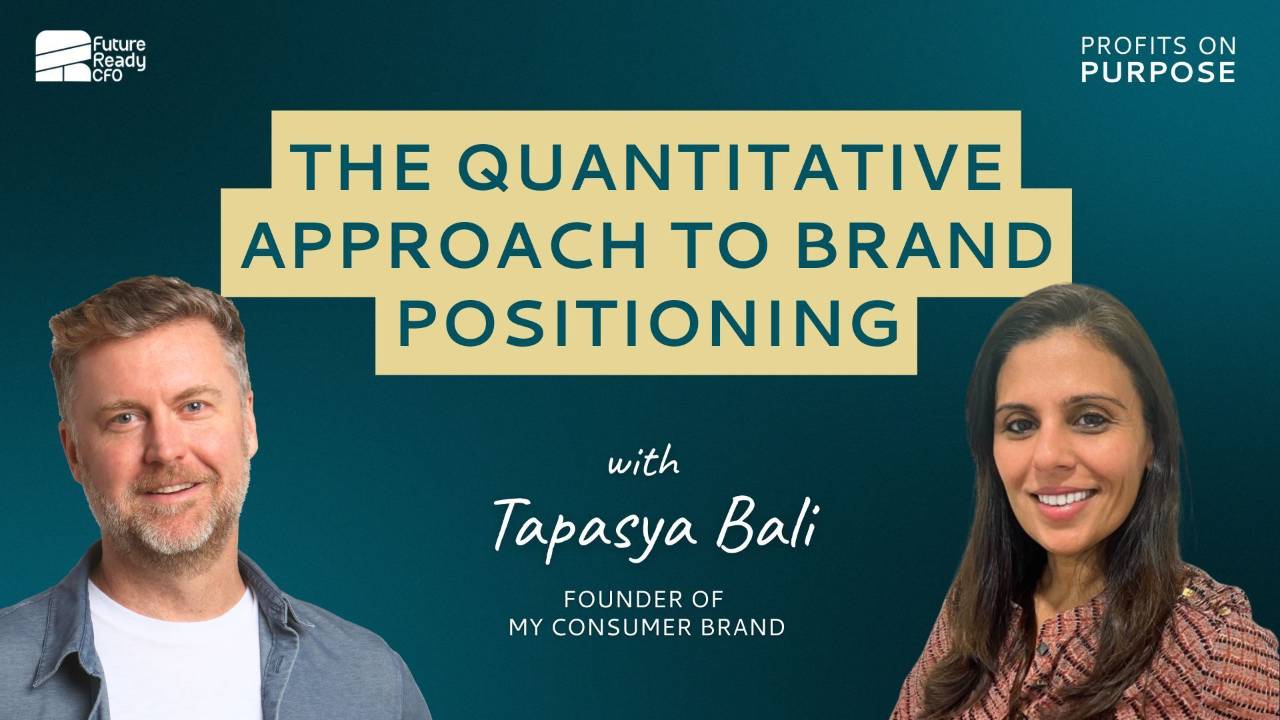
Episode Description
In this episode of Profits on Purpose, host Nate Littlewood sits down with Tapasya Bali, a rare entrepreneur who speaks both Wall Street and Main Street. After 16 years navigating high-stakes finance at Credit Suisse, Tapasya made a bold pivot at the peak of her career to co-found Yogasmoga, an athletic apparel brand that scaled to a $74 million valuation and earned her recognition as one of Goldman Sachs's 100 most intriguing entrepreneurs.
Today, she's building 100 Cal Snacks, a functional food brand tackling the healthy snacking space with laser-focused positioning around the gut-brain connection. Through her consulting business, My Consumer Brand, she helps founders navigate the intersection where brand storytelling meets financial sustainability.
This conversation dives deep into the quantitative approach to brand positioning, the critical difference between market trends and patterns, and why most founders get the timing wrong on both branding investments and financial planning. Tapasya shares hard-won lessons about building teams, managing investor expectations, and why your spreadsheet projections matter more for the logic they reveal than the numbers themselves.
If you've ever wondered how to find white space in crowded markets, when to implement give-back initiatives without destroying margins, or how to tell your company's story in financial terms that investors actually want to hear, this conversation delivers.
Key Takeaways
-
Brand positioning is fundamentally quantitative. Before the storytelling comes deep market research, competitor mapping, and data validation to find genuine white space in crowded categories.
-
Distinguish between trends and patterns. Trends die quickly, but patterns reveal lasting consumer pain points. Gut health was trending, but the gut-brain connection represents a pattern with staying power.
-
Your financial projections are planning tools, not predictions. The value isn't in hitting exact numbers but in forcing yourself to articulate your go-to-market strategy and the logic behind your growth assumptions.
-
Invest in brand positioning before brand design. Most founders skip the strategic foundation and jump straight to logos and color schemes, then struggle with diluted messaging that doesn't differentiate.
-
Marketing Efficiency Ratio matters more as you scale. While margins are table stakes, MER determines your ability to deploy capital effectively and directly impacts exit valuations and EBITDA multiples.
-
Give-back initiatives can destroy value if poorly timed. Unless structured as self-sustaining models, charitable components eat into bottom lines and compress valuations that investors care about.
-
The transition from finance to entrepreneurship is humbling. Even working 12-hour days on a trading desk doesn't prepare you for the sheer breadth of skills and relentless execution required to build a consumer brand.
-
Patience is the hardest skill for high-velocity professionals. Consumer businesses move slower than finance. Retail timelines, fundraising cycles, and shelf placement all require recalibrating expectations from Wall Street pace.
See More from Tapasya and My Consumer Brand
Listen to the full episode to discover how Tapasya's experiences can inspire and guide you on your entrepreneurial journey. Don't forget to subscribe for more insightful conversations!
I hope you enjoy this episode!
Give it a like, share, and subscribe to not miss the content coming your way weekly.
– Nate and the Profits on Purpose podcast team




Transcript
-----
00:00 Introduction to Profits on Purpose
02:06 Tapasya Bali's Entrepreneurial Journey
05:57 The Quantitative Approach to Branding
12:30 Distinguishing Trends from Patterns
14:34 Financial Viability in CPG Businesses
16:10 Incorporating Charity into Business Models
18:19 Investing in Branding for Startups
23:30 When to Start Taking Finance Seriously
24:49 Understanding the End Game in Business
27:10 The Importance of Financial Projections
28:58 Common Mistakes Founders Make
32:41 The Balance of Branding and Finance
36:44 Lessons from Early Entrepreneurship
39:34 Building and Managing a Strong Team
44:51 Key Metrics for Success
-----
Nate Littlewood (00:05)
Welcome back to Profits on Purpose, a podcast for e-comm and CPG founders who are looking to scale their businesses, both profitably and purposefully. I'm your host, Nate Littlewood from Future Ready CFO, which is the go-to fractional CFO solution for seven-figure founders who are looking to turn financial chaos and confusion into business clarity and confidence.
Today's guest is Tapasya Bali, who is a founder that trades in a rather rare currency. She speaks both Wall Street and Main Street. After 16 years navigating the high stakes world of finance, Tapasya made a bold move at the peak of her finance career. She co-founded a consumer brand called Yogasmoga, which is a made in the US athletic apparel brand that scaled to a $74 million valuation.
and earned her recognition as one of Goldman Sachs's 100 most intriguing entrepreneurs. But she didn't stop there. Today, she's building 100 Cal Snacks, which is a functional food brand tackling the healthy snacking space with laser focus positioning around the gut brain connection. In addition, through her consulting business, which is called My Consumer Brand,
She helps other founders navigate the intersection of where brand storytelling meets financial sustainability. So if you've ever wondered how to position a brand in an overcrowded market, when to implement give back initiatives without destroying your margins or how to tell your company's story in financial terms that investors actually want to hear, then this conversation is going to be for you.
So Tapasya, welcome to the show. It's so great to have you here.
Tapasya Bali (02:00)
Thanks for having me, Nate. I'm very super excited about the conversation.
Nate Littlewood (02:02)
Of course.
Likewise, likewise, you have this really, really interesting background and profile coming from both the branding side and the finance side. you're bringing those two pieces together in a really interesting way. I'm very much looking forward to learning more about you. But I thought a good place to start is maybe the, I guess, the backstory of your entrepreneurial journey of voyage. I understand that after 16 years or so working in finance at Credit Suisse, you
eventually decided to leave and launch your own brand. That's a pretty big, you know, I, no idea what you're getting paid, but I assume it was probably a lot back then. It was a pretty big move and you know, position to walk away from tell me a little bit about how that happened. And you know, what made you get to the point where you realized, Hey, this is something I just need to do.
Tapasya Bali (03:02)
Yeah, absolutely. I mean, frankly, wasn't a tough, it was a very tough decision. It wasn't an easy decision. I was getting pretty well paid. I was on a trading desk and it was the height of my career. wasn't something like, sometimes people make a switch when they're against the wall, like they get fired or laid off. There's changes in an organization and you're forced to make a decision and go into business on your own.
But for me, it was a very conscious decision. I was doing very well, but at the same time, I didn't make the decision very easily. It took me a while to figure out, A, it was the new brand, my own brand getting that traction. Was the product market fit? it have a high probability of success? I had the early signs.
And when I reached sort of, you know, some good traction points, I made that decision. It wasn't easy to say, okay, I'm just walking away from this and let me just go launch a business because it's my passion. So it was definitely a very difficult decision, but a very calculated move as well.
Nate Littlewood (04:13)
Looking back, are there any parts of that transitional move that you think you perhaps underestimated and ended up being more difficult or more complicated than what you'd anticipated?
Tapasya Bali (04:26)
Yeah, absolutely. I grew up in sort New York energy, New York trading desk energy. So I was really working very hard. I wake up early in the morning, be at my desk at seven. I thought at the time I was working pretty hard. But I totally underestimated the amount of work that's required and the many hats that you have to wear.
it's not one thing you're focused on, right? When you kind of, you know, in your own business, there's all these multiple hats you're wearing, you have to learn a lot of new things that can be challenging. You know, we don't have all the answers fed to you. Whereas if you're in a finance role, typically, you know, if you know sort of, if you're working on a specific product, you know the ins and outs of it, you don't see the breadth of various things, right? You can excel at that one thing.
for your own business, that's not the case, right? And especially if you're running it, you need to kind of be responsible for a lot of things, right? So that's definitely very challenging and that requires time. So you have to put in the hours and the work and the research that goes into learning and then excelling and optimizing.
Nate Littlewood (05:39)
Got it, got it. Well, it's obvious where your expertise and knowledge of the world of finance came from, but talk to me about the other side. Like where did your passion and interest in branding come from and how did you kind of cultivate that as someone who'd spent 16 years on a trading desk?
Tapasya Bali (05:57)
Yeah, I mean, to be honest, I don't consider myself to be a very creative person. So when I look at branding, I look at it in a very quantitative manner as well. it's, yes, it's storytelling, but in terms of before the storytelling, you need to figure out what your positioning is. And that to me is actually a very quantitative process as well. You really need to go deep into seeing and researching who are the competitors, right?
what are you playing with, who are you up against, right? So that requires a lot of research, a lot of detailing, a lot of mapping to really figure out where that white space is, right? In the consumer space, you're not like, you're rarely inventing something that's revolutionary or new, but you are finding pockets of space, which is kind of unaddressed, right? So for that, it's not just you're sitting there and saying, I feel like this.
Yes, you might feel like there is a white space, but you need to validate that with the data. So from that perspective, feel brand positioning is very quantitative. But yes, then you can update that brand positioning, and you have to layer it with storytelling. So yeah, that's what I enjoy. That's what I had to learn, really, the storytelling. But the positioning is fairly quantitative in my mind to figure out where the white space is.
Nate Littlewood (07:20)
That's a perspective on branding that I don't often hear really, but it's very intriguing. So you've started a couple of brands now, one in the athletic wear space, another in the healthy snack snacking space. And a lot of founders would look at them and argue, Hey, it's, you know, pretty crowded spaces. It's going to be difficult to find white space or an opportunity here. Can you tell me a little bit more about.
this kind of quantitative approach to branding that you just mentioned, and maybe, I don't know, maybe we could apply it as an example to a hundred cow snacks. How does a mind or a brain like yours find a white space opportunity in a market like healthy snacks?
Tapasya Bali (08:07)
Yeah, so absolutely. So it definitely was a process. There's like two buckets for me. One is obviously what I was passionate about. I'm very passionate about the health and wellness space. So sometimes people will be like, you went healthy snacks and food is very different than clothing. How did you make that switch? And are you the right person to run this company, given that you don't have experience in it?
So to me, a product is not as important. It's really who the consumer is. So essentially, I'll be selling to a consumer who has the same mindset. So the emotions that they are going through to make that purchase is pretty much the same decision path for them, whether it's athletic apparel or a stack. So that's number one. That's one bucket in terms of who your consumer is. So from that perspective, I wasn't making such a huge jump.
But in terms of, let's look at the product, right, for 100 Cal Snacks, the way I looked at the market is I think of it as a pyramid. So basically the bottom of the pyramid is the givens, right? So that required a lot of keyword research. So we kind of scraped the internet and saw what are people actually looking for, right? So in the health and wellness space, we know sort of people are looking for gluten-free, they're looking for non-GMO.
you know, they're looking for just healthy snacks in general, vegan, vegetarian. So to me, those are kind of the gibbons because people are already looking for it. Right. But that doesn't differentiate you. That's kind of the big market. Right. So that validates. Yes. You know, it's good to be in this space because people are spending their dollars on that bottom of the pyramid. Now it's very, very crowded. How do I differentiate myself in that space? Right. So you filter, you narrow it down.
And you say, landed up on sort of, there's a combination, right? It's okay, you in the last year, we were seeing a lot around gut health. So I know gut health is, there's strong signals towards gut health, but again, you know, I need to see a pattern and predict what the future might be. So I really fine tune that in terms of looking at patterns, looking at blog ideas, looking at reddits, where people are talking about this, right?
So I'm almost predicting a pattern that's gonna happen. And that's where we land up on is the gut brain connection. It's a combination of keyword research at the bottom of your pyramid, gut health from like recent sort of traction points. And then, you know, what is the future is what is the pattern I'm predicting, right? So that's how you kind of fine tune your positioning. And then of course you validate it and say, okay, who else is there? Who else is doing it? You know, can I really make my own
unique selling proposition to really own that space. And that's what we have done with 100 cashmaps. But that can be applied to various companies. And that's what we do with my consumer brand is, that just organically happened that company because I was just getting people who were asking me for help, not only just on the branding and kind of brand strategy perspective, but also how do we take that and mesh that with a finance angle, right? Because...
at the end of the day, it's all about how you make money, how do you get profitable, right? So that's why I created that company, My Consumer Brand, as just an organic sort of packaging of all the information and sort of skill sets that I've learned over the years.
Nate Littlewood (11:38)
Okay. That's really fascinating. So one of the things that's, you know, often perplexed me about starting food businesses is, you know, the, these trends and fads seem to come and go so quickly, you know, like a few years back, it was all about plant based. then I think, you know, maybe regenerative had a bit of a stint and now it seems to be all about protein and everyone's obsessed with putting as much protein in their food as they possibly can.
And, know, these trends, they, turn over like every year or two. And there's this fundamental disconnect between, you know, the duration of these trends and the amount of time that a typical founder is going to invest into building a business like this. You know, you're talking one or two years for the trend versus maybe, I don't know, five or 10 years for building the business, let's say. So it sounds like the.
that you're doing is kind of trying to predict one or two steps ahead. So you're not just looking what is trending today, but what's gonna be trending in the future. Have I understood that correctly?
Tapasya Bali (12:42)
Yeah, so I would, there's a distinction between trends and patterns. Trends, they basically will die down very soon, but patterns, last longer. So essentially I don't want to jump on a trend. I'm not jumping on the gut brain trend just because I think it's going to be short-lived. I'm jumping on it because I know it's a pain point that people feel and they haven't been focusing on it as much because they weren't as aware. So it's a difference.
I'm not just jumping on the trend. And while like sort of, you know, I have protein in the stacks because yes, the search volume was high. That's not my positioning, right? My positioning is I'm actually solving a core issue for you to really balance that connection between the gut and brain because now people are more familiar with this being an issue. Otherwise people didn't even know that there's a connection between the two. So people are more educated. So it's a pattern as opposed to a trend.
Nate Littlewood (13:40)
Okay. Okay. Fascinating. That's really cool. So I understand, I understand the, you know, the pattern and trend differentiation that you're making here. Something else I wanted to ask you about though, is the finance angle to all this. So you offer assistance with the research and help people understand these patterns and trends.
But you said something a moment ago about, you get to a point where it becomes then about understanding, there a financially viable business here? Can you talk to me a little bit about that? And what are some of the things that a founder could potentially do when they've identified an oppo, an interesting opportunity or what they think isn't a good opportunity, but they want to validate the finances and figure out, this something that I could actually make money with?
Tapasya Bali (14:34)
Yeah. know, CPG is a little bit challenging as well, right? Because the issue becomes that when you are starting new, right, you don't have enough capital, you have to start small, you have to start somewhere. That means you're putting in smaller orders, right? So if you go to a manufacturer, you know, you're putting in, let's say 10,000 units, the cost is much higher, right? So with scale, your cost goes down with scale.
So you don't have that luxury early on in the brand, right? So at the early stages, you're almost putting in, you don't care that much about margins. You're like, okay, let me order. Even if it's flat, I basically need to see if there's product market fit. Is the market really purchasing my product with that positioning, right? But that's not a sustainable model because then you're just always going to be in this hamster wheel of raising money, pumping capital in without a profit.
you're gonna die very, very quickly. So it becomes very important to kind of figure out and start looking at what your margins really are, at what levels of scale. So whether it's low volume, obviously you're not gonna be making that much money. Medium volumes, high volumes, scale. So those are kind of the buckets you wanna look at and predict what your margin numbers are going to be as you scale up. And you have to plan your capital against that.
If you don't, then very quickly, obviously you're going to keep running out of money and you're always chasing that capital, which is not a good position to be for any company, any business.
Nate Littlewood (16:10)
Mm-hmm. So the other day when we spoke, I got the impression that you had some fairly interesting thoughts and things to say about, shall we say impact or, you know, charity based initiatives. And it's my understanding that when you created Yoga Smoga, you, developed a Namaskar foundation, I think it was called, um, in a way, and you kind of incorporated that into the business and business model.
I'd love to hear your thoughts on some of the mistakes that founders make when they incorporate charity or giving back or donations into their business model. You know, how should we be thinking about that? What are some of the problems that people run into and how can we avoid making some of these mistakes?
Tapasya Bali (17:01)
said, you're taking it away from the bottom line. There's a lot of follow through implications in terms of profitability, reinvesting into the business, sales multiples and valuation down the road, which investors really care about. So yeah, mean, I think, yes, there is a feel good element to branding, but it has to be really well balanced out and timed very well into the business.
Nate Littlewood (17:28)
Got it, got it. Okay. So just to clarify something here in my consumer brand, do you help folks with the upfront positioning type work or are you also consulting on kind of ongoing brand building type support as well? Okay. Okay. Interesting.
Tapasya Bali (17:44)
both. So we work with both kind of companies. We work with smaller companies that are starting out needing help with obviously the positioning as well as sort of building out your website SEO, all that kind of work. So execution related. But we also work with some larger companies that want to reposition themselves, right? They want to introduce a new product line. So what is that positioning for them?
We do that kind of work as well, plus obviously ongoing digital marketing and capitalizing on that brand positioning.
Nate Littlewood (18:19)
Gotcha. Gotcha. Okay. One of the questions that I encounter a lot working with early stage founders is how much they should be investing in or budgeting for brand in the early stages. And I'll tell you a quick story before I get to my question here, which is when I started my first e-commerce brand, you know, I approached it from the perspective of an engineering finance mind. And I thought, okay, I need a
a logo, some fonts and a color scheme, right? And I got a friend of a friend who was in design school or something to put together this deck for me and provide the basic, you know, logo and assets for like, I think I paid him 500 bucks or something, you know, as little as you possibly could for this stuff. When I was getting going with Future Ready, my current, you know, consulting business, I spent a very, very large multiple of that on branding much earlier on. And, you know, I've developed an appreciation.
for how important this stuff is. If you just look at how much I spent on it, first startup, the second startup, it's, know, order of magnitude different. My question for you is how do you guide or how would you guide early stage founders into thinking about how much to invest in branding when they're going through, you know, just getting started phase, finding product market fit, don't have a lot of money, probably bootstrap, pretty scrappy.
How much should we be trying to set aside for this sort of stuff?
Tapasya Bali (19:48)
Yeah, I mean, that's a great question, right? So when I think of branding, there's again two buckets, right? I think of branding as brand design, which is what you're talking about, the logos and the color scheme and all that good stuff, right? And the second bucket is your brand strategies. How do I position myself, right? So I feel like early on, yes, you do wanna invest in the logos and the color schemes and all, right? But I think that's step...
Two, step one is going back to what I was saying earlier. Like what is this brand about, right? Where does it sit in the spectrum? What is the white space I'm trying to fill, right? So going back to say my process, right? When I was starting out with 100 Cal Snacks, after I determined what my positioning is, I went to sort of the grocery stores and I was walking up and down the snacks aisle. And one thing was very obvious to me, there's a lot of color.
right on the shelf. So I'm like, how do I distinguish now? I'm kind of set with my branding, but how do I distinguish myself on the shelf? Right. So I determined that because there's so much color, I wanted just a very black look, right. So that it stands out. And I see that now, right. If even an online marketplaces in my category, it's a lot of color and mine is black. It stands out even in kind of online feeds or on the shelf space. Right. So that was a decision where
Again, like let's do some research as opposed to saying, okay, now I've determined this is my brand, I'll make it pink, right? So there's a lot of kind of research after your brand positioning that gets into giving direction to the creative person. These are the kind of colors I want, right? I want a very bold logo. has to spell out the name. For me, that was very important.
So the design itself, I feel if it's guided well from the brand positioning, that's more important. And then really like, know, of course you want like a somewhat decent person. I would avoid using platforms like Fiverr if you're like really, you know, serious about your brand, you want a decent designer, but you don't have to spend a fortune on it, right? It can be kind of some middle ground. I think the direction is more important, right?
So if you can kind of figure out somebody's a designer that has a good aesthetic to execute your vision, that vision is very, very important, right? Even for me, I went with a very good designer and she's phenomenal, but we had to work really closely together to really explore, okay, how does this positioning translate into the design? So it's not just like jamming a couple of logos, even the best designers, you could spend a fortune and not nil.
your positioning because the direction is not correct.
Nate Littlewood (22:41)
Okay. Got it. Got it. That makes a lot of sense. I would love to understand the transition from a business that's kind of focused on branding, positioning, product market fit to the point when finance starts to become relevant. In the early days, I mean, I tell a lot of founders this, if you're just getting started and you know, you're doing hundreds of thousands of dollars in revenue.
Don't waste your time hiring someone like me. You have more important things to spend your money on. I'm curious, your perspective on when finance starts to become a discipline or part of the business that founders should actually look at, take seriously and spend some time on. How do we know that we've reached that point?
Tapasya Bali (23:30)
Yeah, I mean, I think you have to be aware of the numbers from day one, right? Whether it's yourself, right? It doesn't have to be getting someone like you to come into the business. I think that's too early. But yourself, you need to know how much money you have to play with, how much you're putting in the orders, how much you're putting into marketing, what is your return on ad spend.
Those are basic things that even if you're under 50,000 in revenue, you got to have a handle on that. The next step is really, I think again, the next step is also probably a little bit early for someone like you to come in, but probably have a bookkeeper. Have a controller who's kind of mapping out your transactions, mapping out your margin, whether it's installing QuickBooks.
Either you can do it yourself or have a controller do it. You so that's kind of the mid range. I would think anywhere from 50 to, you know, half a million in revenue definitely need or a million in revenue. Definitely need a bookkeeper. After that, I think once you're reaching scale, someone like you is very, very important because now you need to start planning. Sometimes I think founders don't do a very good job at sort of
seeing what the future is, what is kind of the outcome and end result for you, right? Why are you doing this business? know, lot of founders are like, it's my baby and they all love this brand and like, you know, they pour their heart and soul into it without the end game in mind, right? So you have to be very clear. Do you want to exit? Is it an acquisition? And if it is, what is needed to get to that acquisition? You know, how are you providing a return to your investor if you are raising money to get there, right? So
For those kind of things, if somebody is not very savvy with finance, someone like you is very, very important because how do you tell that story to that investor who is writing that check to you to fund that business to your end goal? So that's one aspect. How do you storytell? Again, that storytelling to the investor from finance, from a financial perspective. And what's the end game for you? What am I going to get? I spent like 10 years on this business.
What is the outcome for me? Right? You don't want to be in a position where sort of, you haven't negotiated valuations because we couldn't prove what the valuation is because we didn't know how to. Right? So at that point, I think someone like you can help to really tell that story, showcase it, those valuations. There's not too much dilution as you go through your journey.
Nate Littlewood (26:12)
Interesting. Okay. That question was not meant to be an advertisement for a future Eddie, by the way, but thank you for the, thank you for the. Okay. Well, one, one thing I'd love to get your thought on here. I, I'll never forget a conversation I had on the, one of the first episodes of this podcast with a guy named Joey Capone, who's the founder of a company called Baron Fig. was episode three, if anyone wants to check it out, but he, made the comment that it's so much easier to build a business in a spreadsheet.
Tapasya Bali (26:18)
I think it's super important, you know?
Nate Littlewood (26:41)
than it is real life. And it was so simple, but such a brilliant comment, I thought. I run into so many founders who, you know, it's fine to not be obsessed with your finances when you're just getting started, but I think you at least need to have some picture or understanding of where you're trying to get to. The unit economics may not make sense today. Like maybe you're only doing 5,000 or 10,000 unit runs. And so maybe your unit costs are ridiculously high.
But we need to know that eventually as we scale up, we can get to a point where the unit economics makes sense. And you can do that very quickly and easily in a spreadsheet. Like you don't need to spend two or three years building a business getting there to have that level of financial insight. And it would...
be a absolutely terrible outcome to spend multiple years building a business getting to this point. And then it's not until you get there that you realize, my God, like the math doesn't work. My costs are too high or I'm not charging enough. Like I can't make money here. Why would you kind of subject yourself to the many years of pain building a business and if that could be avoided, but I guess.
Leading into a question for you as someone who has this interesting left brain, right brain perspective on the industry, you're looking at things from both a finance perspective and a branding perspective. I'm curious if there's any common mistakes that you see founders making from each of those angles. So for example, what are some of the branding mistakes that you see more math and finance oriented brains making?
And what are some of the finance mistakes that you see more branding and product oriented founders making?
Tapasya Bali (28:30)
Yeah, well, let's start with as a good segue to what you were saying. Let's start with the finance piece of it. You know, not understanding. Yeah, it's true. You know, you can make any numbers up on a spreadsheet. You know, it's very different than going out and executing and, you know, making that sale. Right. So I can project. I'm going to do 200 million in revenue in five years. But in reality, that's super difficult to do. Right. So, yes, you can project anything on a spreadsheet.
However, I think it's very, very important because it's almost like a planning tool, right? So your spreadsheet is your planning tool. It's your go-to-market strategy, right? It's like, okay, if I project 50 % of my revenue coming from Amazon, 20 % from my website, the rest from retail, that I need to kind of figure out what my strategy is to get there, right? So then I have to kind of figure out how do I scale up Amazon? What do I need to do on the retail side?
Or it might be my go-to-market is I don't want to do retail because there's a lot of margin compression there. I just want to stick to DTC, right? That's a different go-to-market strategy, right? So the number itself, the projection number itself, yes, it's made up on a spreadsheet. It's actually the thought process and logic that goes into it. That's more important, right? Absolutely. And I feel people, many times I meet founders who are like,
it's pre-seed, seed round, like we don't even need a spreadsheet or projections, which I feel like is really a disservice to yourself, to your future self, as you said, you know, could be spending years before you know, okay, this wasn't worth it, right? Why subject your five years of your life, couple of years of your life to that, right? Even if it's made up numbers, it makes you think about what your logic is, what your go-to-market strategy is, right? So a lot of creative branding people
don't do that, right? They're like, okay, I build a brand, I got early traction, it's great, I'm gonna like jump on it and sort of, know, write it through, right? They're not focused on that projecting sort of, know, anticipating what their business strategy is and plan is. So that spreadsheet is actually can be boiled down to your business strategy of how are you gonna execute and go to market and scale. So that's a huge mistake I think people make. And sometimes, you know, I've even heard founders say, yeah, you know,
Some investors say it's all made up. We don't even need something on your pitch deck, which I think is not correct. It's the logic that investors are looking for, not the final numbers. Everybody knows that these are projections. Hypothetical number is really how are you thinking of executing your business? Does it make sense? So they're evaluating that as opposed to, you projected sort of XYZ. Can you hit that number?
On the flip side, you know, on people who are sort of engineering focused like you or myself, like finance focused in terms of branding, I think people are not very, very sharp about it, right? So like say like, for example, for me, even today, like even though I'm so aware that I, my positioning is very fixed, you know, it's the gut brain connection to really articulate it and be disciplined about
messaging it all the time gets very, very difficult, right? Easy to dilute your message, right? So I can say, yes, I'm gluten free, I'm like non-GMO, but everybody else is, right? So if I keep saying those things, I'm not ingraining that message in the consumer's mind of what my positioning is. So you have to be, it's very easy to be.
sort of fluffy or say words that sound good but really don't mean anything. It's very, very easy to do in copywriting and branding. So you have to be super, super sharp about it. And I think people who are more sort of the engineers, the finance people, they don't appreciate that as much. They're like, OK, it's OK. It'll be fine. But it's not.
Nate Littlewood (32:41)
You made some really, really good points there. And I just want to circle back on a couple of them. The first was about the point of financial projections in that it kind of forces you to think about the plan that you're going to need to achieve them. A little anecdotal story for you. was chatting with some founders recently and they...
They shared their revenue forecast with me and they'd been forecasting this 5 % growth year on year. And I said to them, okay, 5%, interesting. Where does that number come from? And they said, well, that's what we've done historically. I'm like, okay, but how are you gonna continue to do that? Like what are the levers that you need to pull? What is the underlying assumption about marketing efficiency ratio or ad spend or traffic or conversion rate or AOV?
tell me what needs to happen in order for you to get that. Otherwise, it's not a plan. It's like a hope and a dream, but you don't actually have the details here to call this a plan. So that was one thing. The other thing that you said I thought was interesting and I just wanted to circle back to is about positioning statements and the importance of setting that up initially. This wasn't exactly your point, but I just wanted to layer it in because
As a kind of finance engineering brain, I initially looked at things like brand positioning statements and thought, okay, this is gonna be quite restrictive and this is gonna make my life difficult because I have to talk a certain way and I have to talk about a certain things and I have to have certain values. But I've actually found it incredibly liberating and helpful when it comes to content creation and writing. When you have incredibly tight guardrails around what your brand is or does and how it's meant to talk.
and it's positioning in the market and your example, gut health, for example, it actually makes it really easy to write because you're like, okay, I only have this very short list of things to choose from. So there's no point in my mind wandering to all of these other topics and saying things that are outside of this positioning statement. And I've actually found the creative process a lot easier when you have a strong brand positioning statement around you. Yeah.
Tapasya Bali (34:57)
Yeah,
that's Absolutely. And I think, know, just to jump in, as you were saying that my mind was racing, feel like, you know, founders sometimes they want to be everything to everybody, right? You can't do that, right? You have to kind of figure out who you're kind of talking to and really stick to that and don't be scared about it, right? It's not like if it's a large enough market, it's okay. You don't have to cater to every person under every protein snack lover.
Yes, that pool is still very big, but I'm okay just having a smaller slice of it because my positioning and my communication is very short. And as you were saying, yes, there's guardrails. It makes it actually easier not to be everything to everybody.
Nate Littlewood (35:44)
Absolutely. So Topassu, you've had a decent amount of experience now as a founder and, moving from your first brand to now working on a hundred cal snacks and the my consumer brand consulting business. I'm curious, what are some of the hard lessons that you learned through your earlier attempts at entrepreneurship and what are perhaps some of the things that you're
doing differently as you approach building your second consumer brand.
Tapasya Bali (36:17)
Yeah, I mean, I think the one thing I think I'm learning and getting better at is really managing sort of expectations and the pace of things happening. Sometimes I feel like, you know, I'm a very, as you know, I'm a Wall Street person. want things to move very, very fast, right? But in the consumer space, things are slower, whether it's on the fundraising side, whether it's getting on the shelf.
it's not at the same pace, right? So I am learning to do a better job at kind of figuring out, how do I manage that pace and my expectations, right? Yes, you wanna move very, very fast, but things just take time to develop, to get on shelf from different aspects, right? So that's something I think I'm doing. I'm trying to do a better job, right? I'm not there yet, but I have to have that patience.
And that's what people say, right? If you're patient, of course, resilience is a great factor that I've always been, which I think makes me a good entrepreneur. But really the patience aspect is something that I'm working on. I'm. OK, yeah, and I just, know, actually, there's a funny anecdote when I first got into my first retail location, you know, that given me.
Nate Littlewood (37:27)
Okay.
Tapasya Bali (37:36)
a meeting right after I had launched. I had launched in January and I got my first retail meetings here in Southern California in March. And they didn't approve me that I go very early. Here's some packaging changes that I want you to make. So I went and executed that very, very quickly. I went back for another meeting in June and.
to me, like I entered the meeting and I'm like, yeah, I don't really have many more updates from the last time we met. It's kind of very sort of not optimistic. And he looks at me and he's like, wow, you achieved a lot in these two or three months. And I'm like, really, I did? So my skill of pace was, is it a very Wall Street level, whereas in retail.
in consumers, it is a very longer kind of expectation timeline.
Nate Littlewood (38:28)
Yeah, that's an interesting contrast in perspective for sure. For the benefit of listeners, Tapasya and I actually overlap for a brief while at Credit Suisse. The things you've learned and reflecting on your entrepreneurial journey here, what are some of the things or advice that you might give to the younger entrepreneurial version of yourself? Aside from what you just said about, you know, obviously timelines and things take a lot more time. Is there any more...
I don't know how to put it like mentoring coaching type advice that you would give to a younger version of yourself if you wanted to set yourself up for, you know, greater success as you embark on this.
Tapasya Bali (39:10)
Hmm. I think it's around team. sometimes, you know, think, the more I'm getting sort of ingrained in business and leadership and really training our, our teams, the more patient and accepting I've become, right. So the way I run the team is more sort of.
What are you good at? There's a lot of people have shortcomings. Earlier, I didn't have as much patience, but now I'm doing a better job at figuring out how do you mold people? How do you see their strengths? So I guess, yes, that's something that comes with time, especially founders who have a vision, they want to execute, they want to get somewhere fast. You tend to overlook and discount
the building of the team, right? So at the end of the day, look, if you're looking to build a big company, you can do it alone, right? You need a very strong team around you, whether it's people like you or people who are full-time in your business, you need to kind of figure out who is helping you with what and sort of where their skill set lies as well, right? So there has to be some patience to that as opposed to just get it done and you
you go figure it out, right? Because I you a paycheck, you know?
Nate Littlewood (40:36)
Yeah. Yeah. I have to, I have to confess that as also as a ex former wall streeter who went from that to managing a startup as a CEO founder, as I did in around 2015, 16, guess, uh, looking back, I think I was a horrible boss. I, I looking at the way, you know, just some of the decisions I made and the way that I manage people, I was, you know,
I'm not trying to say that you were also a horrible boss, but like, I expect that like you, you were probably very outcome focused. You probably used to very comfortable working, you know, 12, 14, 16 hour days like, yeah, fine, no problems. And, um, you know, it's like push, push, push, go, go, go. Like, you know, the velocity at which that world moves is, you know, foreign to most other people. And I'll be honest with you. It took me a little while to kind of adjust and, you know, re recalibrate to that. Um, I mean,
think back to even some of the conversations I had with my first co-founder, who had not come from that world. And he was just, you know, used to working eight hours a day. I'm like, dude, what are you doing? You can't go home after eight hours. What, what, are, what are some of the other, you know, management or leadership type challenges that, that you've navigated through over the years?
Tapasya Bali (41:57)
Yeah, I mean, I think right now I'm changing the way I think of people's time as well as mine, right? You know, I have accepted that I might be sort of moving at a very high space that other people don't. And also, you know, I'm up at, you know, weird hours and, you know, I might respond to an email or say something to be done.
So I've told people like, you don't need to feel obligated to respond back right away, right? Just because I'm sending an email at 4 a.m. doesn't mean that I need a response back at 4 15. That's pretty gracious. Because typically sort of, like, yeah. So like you said, I'm very outcomes based out, right? So that's the only way you can execute something. I'm like, I don't care how you get it done as long as this is done by the end of the week. So it's like very like goals focused. And I think that just has to be because
the world is changing to a more, even though people are saying get back into the office, the expectations, especially with Gen Z and the younger folks is, they're very, very focused on working on their own terms. So we have to accept that. So I'm actually building a company that's more accepting of that. I don't even care about people coming into the office. I want my flexibility and I want people to have their flexibility.
but it's very, very outcomes focused. And I feel that works very, very well. And that's something I've had to navigate very recently. And with the new generation, I feel the new generation is just not accepting. When I started working, I could never imagine telling my boss, I'm not gonna come in because I just wanna take a day off for my mental health. And that's very commonplace these days because that's how Gen Z wants to manage their lives.
And we have to accept that. And I'm incorporating those things into the way I manage the company.
Nate Littlewood (43:54)
Yeah. Okay. Totally. Well, it sounds like an interesting journey that you've been on here. Tapasya, we're going to have to wind things up soon, but I have a couple of remaining questions for you. One, I'd love to invite you to participate in a little bit of a tradition I have around here, which is to tell me about your favorite business metric or KPI. Let's focus on your role as a founder for the purpose of this question.
So what is this metric? How often do you track it and why?
Tapasya Bali (44:26)
Yeah. I think my favorite is the marketing efficiency ratio. So I feel, of course, the basics, you have your margin, like you wouldn't be in business if you didn't have a margin, right? I think with consumer, you will get margin, right? That's kind of the traditional way of making money. You make a product cheaper, you'll sell it at a higher price.
Nate Littlewood (44:51)
Hello, so high.
Tapasya Bali (44:53)
So that I think is the fundamental of a consumer business. Everybody needs to track margins, right? That's your product margin. I think especially as you scale and you're putting money into marketing, really figuring out, of course ROAS is more, return on ad spend is more on a campaign level, but really your marketing efficiency ratio, which has other aspects of marketing at a higher level.
really tracks, I have my margin, but I'm spending X in marketing, how much is it giving me back in sales? So then if I'm very, very aware of that metric, I can figure out and work on those levers to put more into marketing if that marketing efficiency ratio is high. That's also very important at exit. So if you are looking for good valuation multiples,
your EBITDA, the more healthier that is and the higher your MER is, I think you will get much better multiples. And we actually saw that with Rode, right? Rode had an almost 10X MER, which was driven a lot with, know, Haley Bieber sort of backing all of that marketing so they didn't have to spend as much on marketing. But that's what gives you the multiples, right? So that's a metric that I've started to love. And, know, I'm going to be tracking that very, very closely.
Yeah, and of course the margins and all those are given, right?
Nate Littlewood (46:14)
Yeah. Okay. Cool. Well, this has been great. I've really enjoyed learning about you and your perspectives on the industry. It's certainly an unusual one or a unique one, combining these different, you know, finance and branding angles. Where should folks go if they would like to learn more about you and what you're up to?
Tapasya Bali (46:36)
Yeah, absolutely. So most easiest is obviously connect with me on LinkedIn, Tapasya Bali. I'm fairly active on LinkedIn. Not all the time, but periodically I go and check my messages. yes, send me that. They can take your name just so that I have some connection because I do get a lot of incoming inbound LinkedIn's. So that's one way. If you're specifically interested, you want to try our snacks, it's 100galsnacks.com.
That's our website. Again, there are snacks that are 100 calories. It's one of the first brands that is aimed to balance the gut brain connection. So if you wanna try those, we have chocolate brownies, we have barbecue puffs. We're just coming out with the peanut butter. Super healthy snacks, so try them out. And then of course, if you need help from the consulting side where sort of struggling with
figuring out what your brand positioning is, looking at those patterns, helping with the creative angle and scaling up your own business, myconsumerbrand.com. So, I wear these various hats, so.
Nate Littlewood (47:46)
Perfect, perfect. Well, I'll include links to all of them in the show notes below in case anyone's looking for the spelling and details. But Tapasya, thank you again. It's been great having you on the show and wish you all the best. Take care.
Tapasya Bali (47:58)
Thank you, Nate. Thanks so much for having me.
Want more like this?
Join our newsletter list and every Thursday morning you can look forward to actionable insights and free tools for scaling your brand.
We hate SPAM. We will never sell your information, for any reason.
