
Should You Still Be CEO? The Outside CEO Perspective | Mackie Swan | Woo More Play | Profits on Purpose
Jan 21, 2026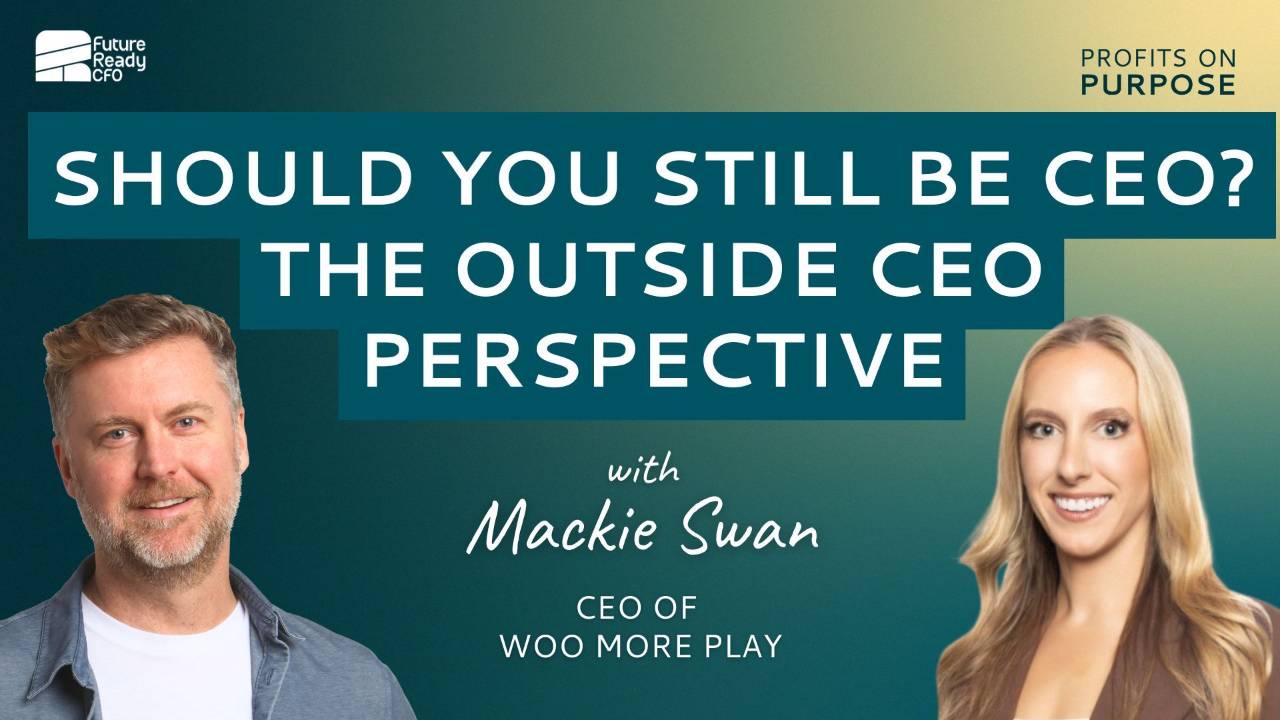
Episode Description
This episode tackles a topic most founders avoid until it's too late: whether you should still be the CEO of your own company. Mackie Swan was brought in by the three original founders of Woo More Play to scale a sexual wellness brand they realized they shouldn't be running day-to-day. Three years later, she's taken the business to profitability while navigating the complex world of "vice categories."
This isn't a conversation about sexual wellness products—it's about a decision many founders will eventually face: Am I the right person to be running the company I founded?
Key Takeaways
-
Capacity vs. Desire framework for CEO succession
-
Stakeholder segmentation for CEO onboarding
-
Working backwards from end goals for decision-making
-
Procrastination as a signal you're not the right person for a role
See More from Mackie and Woo More Play
Listen to the full episode to discover how Mackie's experiences can inspire and guide you on your entrepreneurial journey. Don't forget to subscribe for more insightful conversations!
I hope you enjoy this episode!
Give it a like, share, and subscribe to not miss the content coming your way weekly.
– Nate and the Profits on Purpose podcast team




Transcript
-----
00:00 Introduction to Profits on Purpose
02:03 Mackie Swan's Journey to CEO
06:05 The Founders' Perspective on Leadership
09:31 Establishing Trust and Alignment
13:05 Compensation and Incentives for CEOs
17:04 Decision-Making Dynamics in Leadership
21:05 Hiring for Assertiveness and Challenge
24:16 Evaluating Opportunities as a CEO
28:14 Onboarding and Ramp-Up Strategies
30:54 Onboarding Insights and Founders' Impact
31:50 Reflecting on Improvements and Team Dynamics
33:30 The CEO's Role: Specialization vs. Generalization
35:18 Capacity and Desire: The Duality of Leadership
38:07 Managing Distractions: Focus and Time Management
42:32 Financial Decision-Making as a CEO
45:34 Vision for the Future: Empowering Women
46:59 Navigating Vice Categories and Business Challenges
50:18 Key Performance Indicators: Tracking Success
-----
Nate Littlewood (00:00)
Welcome back to Profits on Purpose, the podcast for e-comm and CPG founders who are looking to scale their businesses both profitably and purposefully. I'm your host, Nate Littlewood from Future Ready CFO, which is a go-to CFO solution for e-comm and CPG founders who are looking to help with turning financial chaos and confusion into clarity and confidence.
Anyway, today's guest is Mackie Swan, who is the CEO of Woo More Play, which is a sexual wellness brand sold in Anthropologie, Nordstrom, Revolve, and many more locations. Today, we're going to be talking about a topic that most founders avoid thinking about until it's often too late, which is whether or not you should still be the CEO of your own company.
The backstory here is that in November 2021, while she was finishing off her MBA, Mackie was actually brought in by the original founders of Woo More Play to basically scale a business that they had started, but had come to the realization that they probably shouldn't be the ones running on a day-to-day basis. Anyway, three years later, Mackie has managed the business through to profitability.
has launched multiple successful products and navigated the complex world of what she refers to as vice categories. We'll talk a little bit more about that later. But anyway, this is not a conversation about sexual wellness products, okay? It is a conversation about a decision that many, founders are eventually going to have to face, which is, I the right person to be running the company that I've founded?
Mackie has firsthand perspective on this topic and I think, you know, many, many founders and CEOs are going to benefit from this conversation. So Mackie, welcome to the show. It's great to have you here.
Mackie Swan (02:03)
Thank you so much, Nate. I'm excited to be here and looking forward to our conversation today.
Nate Littlewood (02:08)
Likewise, likewise. Well, why don't we get the conversation started here with just talking a little bit about your backstory. Just quickly, like what is WooMore Play all about and how did you come to be the CEO of this business?
Mackie Swan (02:24)
Great question. So woo, we make clean, non-toxic intimacy products for women and their partners. Our business really exists to help women experience more agency in their own sexuality and feel good in their bodies during sexual experiences. How I came to be CEO is definitely a longer story, but I think to sum it up, I can say that I was really fortunate to get into the sexual wellness industry when it was just starting out, well before the category had
popularity and the market size that it does today. So when the founding team at Woo was looking for a new CEO to come in, I had the benefit of having a few years experience in this world and growing sexual wellness brands and so it was just a really strong fit at the right time.
Nate Littlewood (03:11)
Gotcha. So you obviously had a significant amount of product or industry experience here, which makes complete sense. But I wonder if we could talk for a minute about the situation from the founders perspective. My understanding is that there were three original founders of the business and I presume between the three of them, they have a fair bit of, you know, domain and subject expertise. What was it about being the CEO or running the business themselves that you think intimidated them and you know, how or
Why did they get to the point where they realized that they needed someone like you to come in and help them?
Mackie Swan (03:47)
Yeah, I don't know if I would say intimidation was the real factor here. You're correct that there were three co-founders, one of whom was serving as CEO before they brought me on board. And what I believe was the real issue is that I think that, many founders turned CEOs, they were spending a lot of time working on every other part of the business than the reason that they actually got into this industry in the first place. So Westin, my business partner and who served as CEO
Nate Littlewood (04:14)
Hmm.
Mackie Swan (04:17)
before I came on board. He is very creative. He's a product designer. He's an innovator. He and the other two co-founders really got into this business to create clean, beautiful, effective products for women and their partners. And when you're an early stage CEO, you're managing a P &L, you're dealing with investors, you're running a supply chain. You get pulled in so many different directions. And I think it was at the point where it was just really like taking them away from the things that they did best.
Nate Littlewood (04:31)
Mm-hmm.
Mackie Swan (04:47)
And I think that's true for any position, not just a CEO role, but you wanna make sure that people are in the right seats and that they're being able to do things in their job that speak to their natural talents, that make them happy, that make them excited to show up every day. And so I think it was just at the point of like, hey, this isn't why we got into this business. And if we brought somebody else in who could manage the operations, maybe we can kind of get back to the passion and the thing that brought us to Woo in the first place.
Nate Littlewood (04:58)
Hmm.
Mm-hmm.
Right, right. So they're still involved or Wes is still involved in a creative, in some sort of creative role or?
Mackie Swan (05:23)
Yeah, so all three co-founders are involved in some capacity. Two of them are at a more strategic level but still serve on our board, are still involved with some higher level decisions. Weston is still very much in the day-to-day with me. He and I work very closely together and he has transitioned into our creative director role. So he runs a lot of our marketing, a lot of our branding, a lot of our product development, and he and I work closely day-to-day.
Nate Littlewood (05:40)
Mm-hmm.
Yeah.
Okay, okay, that makes sense. So these guys realized that they were having to do things as the CEO of the business that they didn't necessarily love and weren't that passionate about. And they recognize that they needed to bring someone in to help with that.
Do you know much about the process that followed? mean, I presume that at some point in, you know, not long after this, they cross paths with you, but like what was going on from their perspective? Like how do you even go about looking for someone like you? Because I don't think at that point in time, you actually had CEO on your resume or bio. So how did they find you? And like, what were some of the other people that they may have crossed paths with during that search?
Mackie Swan (06:25)
Mm-hmm.
Absolutely, and of course I don't know everything because I didn't, I didn't
have that experience on their side of this firsthand. But what I do know is that they spoke to many, many people. They did eventually enlist the help of a team to help find the right CEO from outside the business. And I think that they looked like very far and wide within the sexual wellness world, which again, still is not a very big industry. And four or five years ago, it was even smaller than it is today. But I think they had a ton of conversations. And I
Nate Littlewood (07:05)
Mm-hmm.
Mackie Swan (07:08)
think that it...
It's a couple different things because it's finding somebody who has the right experience, has the right resume, like has the domain expertise and knows the world of sexual wellness, knows the world of running a vice category. But what I believe is even more important than all of those things is just finding the right cultural and personality fit. And when you bring somebody on in the early stages like that, our relationship, I would say, is akin to a co-founder relationship where we're really deeply in it together. So finding somebody that is going to
be somebody that you want to work that closely with for years and is going to be the right cultural fit for the founding team, for the employees, for the vendors, and just the business on the whole. I think is a really big piece of it.
Nate Littlewood (07:51)
Right.
like to the extent that you might be privy to what they were going through as they were getting comfortable with the idea of letting go of their baby, but also from your perspective, who, you know, is being brought in to take care of someone else's baby at a fairly young age. Like, tell me a little bit about that dynamic and how you all got comfortable with it.
Mackie Swan (07:56)
Mm-hmm.
I think part of establishing that level of comfort is being really clear on what everybody wants and me coming in and having a really deep understanding, okay, what is your end goal with the business, with the brand, but also with you as a person and how can we kind of work together to get there and also how does that overlap with my goals for my professional life and also just my personal life too. So I think that's a big part of it.
Mackie Swan (08:43)
perspective on it. mean, I certainly feel a deep sense of duty and I have, you know, in every job that I've ever had at every level. So that's not a new experience for me, but it's certainly a new layer of complexity of, okay, I've taken on a really big responsibility for people who have put a lot of blood, sweat and tears into this business and I'm, I'm going to give it my all and I'm going to make sure that I show up every day.
Mackie Swan (09:08)
really with that in mind and really doing what's best for the business in mind. So I think that I think that's a deeper sense of duty than I've experienced in my career in the past. But one that I was comfortable with because it felt so clear to me that there was really untapped opportunity with this brand and that it was something that was really going to align with my skill set. Like when when when we agreed to work together, it was very clear to me that this was going to be a good fit for me. It was going to be a good fit.
Nate Littlewood (09:12)
Hmm.
Mm-hmm.
Mm-hmm.
Mackie Swan (09:38)
for the company and what I would bring to the table would be really well suited for what the business needed.
Nate Littlewood (09:38)
Hmm.
Mm-hmm.
Interesting. said a moment ago that it was really important for there to be alignment or that everyone to be clear on exactly what they wanted. I'm curious whether there was immediate alignment on that. Like when you both put your cards on the table and say, hey, this is what I want or this is what I want. Like, did they match up perfectly or was there some sort of negotiation or compromising that had to happen with respect to the future, the vision, the strategy, anything?
Mackie Swan (09:56)
Mm-hmm.
Nate Littlewood (10:15)
else.
Mackie Swan (10:16)
I think it was mostly a line. think that,
A couple things that come to mind for me, first and foremost, is like I said, they had been well into the process by the time we met and we had the opportunity to really dive in together. And so I think the benefit of that for me was that there was a lot of clarity around what they wanted. They had had the opportunity to explore this with other prospective candidates. And so I think that that had even more deeply sharpened their understanding of what they needed in the role and what they wanted for the future of the business.
And so I feel like the clarity is the piece that people often and miss in these conversations and having that clarity does make it clear upfront is this a fit or not. And so I credit them with like having a lot of that clarity already established by the time that we met that made those conversations go more smoothly than I think is probably typical for founders who are looking for an outside CEO.
Nate Littlewood (10:58)
Mm-hmm.
Right.
Mm-hmm. Mm-hmm.
Yeah, okay. That does sound super, super helpful. I get it. I get it. So when we get to the point where they say to you, hey, Mackie, you've got the job. We'd like to hire you as the CEO. How?
Mackie Swan (11:19)
Yeah, yeah.
Nate Littlewood (11:32)
was the deal structured? You don't need to go into specific terms or details, but can you tell me a little bit about how, as a founder of a business, you would correctly incentivize and motivate a CEO to kind of look after the business with the appropriate level of care? For you to be engaged the way they want you to be engaged, I guess is what I'm asking.
Mackie Swan (11:52)
Mm-hmm.
Yeah, I think there are two things that are important and both of those are what was offered to me and what I think has made this work so well. Number one, with any startup CEO, I think there's always the conversation of like, when do you pay yourself and how much do you pay yourself, et cetera. because I was leaving an established role, was, you have to be comfortable. I was moving out of state. It was like, okay, we're gonna make sure that
you have a salary that you're not gonna have to worry about whether or not you can pay your bills and that was like, okay, then I know I can make this, not the...
Not that it eliminates any risk with changing any role, but that you can focus on the business and be really laser focused on that. And then on top of that, having, think your comp structure include a level of equity that makes you feel like you really have some skin in the game. And so the way that that was structured is a way that, you know, I do think that my mentality is that of a co-founder of like, okay, this is my business, this is my brand, and I'm going to be really focused on doing what's best for the brand.
I think that that mindset comes naturally to me and I think that the Comp package was structured in a way that really led to that mindset as well.
Nate Littlewood (13:06)
Mm-hmm.
Hmm. Okay. So something
I observe with a lot of founders, particularly when they're in the earliest stages, you know, working through six and like early seven figures of revenue is...
They often treat their salary or their pay as an optional line item in the P &L or cash flow statement. And it's kind of a backup expense like, hey, it would be nice if I can pay myself if we can afford it. But you know what? If this risk I'm taking on or this new product or channel, this idea that I want to test out, if it doesn't work,
and we end up, you know, taking a hit on that, then I'm going to wear the brunt of that personally. And I'm willing to sacrifice my own salary in order to pay for that. I guess one of the interesting things about bringing on an external CEO, particularly as a relatively early stage brand, which I understand this was when, you know, when you first got involved, is that you kind of remove that as an option. Like you've rocked up and, you know, you've done so on the basis that you're going to get a
paycheck and like your salary I presume is not negotiable at that point.
Mackie Swan (14:32)
I wouldn't say it's not not negotiable and what I mean by that is that mentality that you described that a founder has of like, okay, I'm gonna, I'm gonna skip this or I'm gonna delay that because it's what's best for the business. Like not that I've ever been without a salary, but there are times where it's like, we've had these plans in mind or.
Mackie Swan (14:53)
we wanted to bring on these resources or we wanted to make this change to comp or whatever, where I've also had to make some of those decisions. And so I think that it does introduce another layer to that dynamic, but I also think that...
Mackie Swan (15:09)
the way that founders often have to make those decisions of like putting the needs of the business in front of their personal needs. I think there are times in my tenure as CEO where I've had to do the same thing and that I don't regret. mean, I think that in any business there are ups and downs and there's times where you have to make tough decisions and you just have to do what the right thing to do is.
Nate Littlewood (15:16)
Gotcha, gotcha. Okay.
I'd love to talk a little bit more tactically about decision-making within the company. I have to assume that over your four or five years with the business now, you have been through some pretty big strategy decisions. I'm sure there must have been hiring and firing decisions and capital allocation decisions along the way.
when you're an ex, you know, a professional CEO, someone that's been brought in, but you're not the founder, and I presume that they probably still own more equity than you do, but how do some of those bigger and more complicated decisions actually work?
Particularly in a scenario where there is perhaps not initial alignment and you know want to do one thing and maybe they want to head in a different direction. Can you give me a sense of how those conversations go and how you guys you know arrive at an agreement or a path forward?
Mackie Swan (16:24)
Mm-hmm.
Totally, so.
To provide more context, I'll say that part of what I think makes our working relationship so productive is that Weston and I are very, very different. What he is very good at are things that I am really weak in. What I am very good at are things that are not his strengths. So I feel like we balance each other out really, really productively. And so there are many times where we maybe disagree on an initial direction or where we are approaching a problem from a different
Nate Littlewood (16:46)
Mm-hmm.
Mm-hmm.
Mm-hmm.
Mackie Swan (17:04)
perspective. And I do this when I'm making decisions independently and I do this when I'm making decisions with my business partner or my team or whomever of like, what is the end goal that we're trying to achieve? Where are we trying to get to? And now let's work backwards and try to try to workshop how this immediate decision is going to impact that end goal. And I think that when you start from the finish line and then you pull back into the present day, that can really help contextualize and often
Nate Littlewood (17:18)
Hmm.
Mm-hmm.
Mackie Swan (17:34)
and will make that decision a little bit more clear or a little bit more defensible. So I think starting there, I think it's fair to say that neither of us bring like a huge ego to most decision-making. I think that we both have that mindset of like what's best for the brand and we're both willing to, I don't know what the right word is, but like we're both willing to.
Nate Littlewood (17:48)
Hmm.
Mackie Swan (18:02)
see things a different way if it becomes clear that that's what's best for the business. I also think that, and I tell this to my team all the time, I think that our decisions are so much stronger when they are challenged up front. So if you have four or five people in a meeting and we're all disagreeing around the direction or we're all disagreeing around like the...
Nate Littlewood (18:06)
Mm-hmm.
Mm-hmm.
Hmm.
Mackie Swan (18:23)
the hypothesis on the table. I actually feel like that leads to the most productive outcomes because it forces everybody, including myself, to really challenge our assumptions, really defend our assumptions, and defend the direction. So I really welcome that disagreement and that pushback because I think it makes us all better, and I think it makes our company a lot better too. So yeah, think that having that loose framework of how we approach
Nate Littlewood (18:26)
Mm-hmm.
Yeah.
Hmm.
Yeah.
Mackie Swan (18:53)
approach
decisions, being clear on where the hell we're trying to go, and then coming back into the present is something that has worked really well for us.
Nate Littlewood (19:02)
I love that as a framework and approach,
especially the part you mentioned about making better decisions when you get challenged. So a quick detour here and something I'm going to ask for your advice on. So when I was a founder, I was also the CEO and I happened to be the major equity holder in my business. I did have a co-founder, but he had a lot less equity and he was also a lot younger and much less work experience than what I had.
and
I would often run into situations where, and I should also add that like, I can be fairly forward and I guess forceful when I've made my mind up about something and I have an opinion on it, right? Like I'm not going to be shy about letting you know. I would often find myself in situations where I just felt that there wasn't enough resistance. like, I don't want you guys to agree to everything I'm saying. I want you to argue with me. I want you to tell me where you think I'm wrong. And you know, if you've got a different
an opinion and it was a constant struggle to, I guess, get my co-founder and often the rest of the team to actually do that. Do you have any tips and advice on how to resolve situations or dynamics like that?
Mackie Swan (20:18)
So my advice is hire for that skill, and that's something that I do very specifically. And there are certain interview tactics and questions you can ask during an interview or hiring process to understand.
somebody's comfort level being that assertive with you. But I like specifically hire for that skill and specifically screen for that skill because I assume similarly to you based on what you just share. Like every time I do one of those personality assessments or anytime I get feedback from my team or anybody, it's like,
Nate Littlewood (20:37)
Mm-hmm.
Mackie Swan (20:52)
assertive, bold, I'm kind of already over here when somebody else is a few steps behind. And so I think when you have that personality type, it's really important to surround yourself by people who are comfortable.
you know, matching that energy and comfortable telling you when you're wrong. And I need people around me who will tell me when I'm wrong and that includes my employees. I give people like a sheet of like, here's the things that I need from you in order for us to work together. Like really like down to the minutia of like communication patterns.
and things that I need to be a CEO from the people on my team. And I like specifically say there very explicitly, you have to tell me when I'm wrong.
And I need you to tell me if I'm giving you a directive that doesn't make sense or if you're concerned about an initiative or whatever it is, like you need to be vocal and you need to stand up for your department and stand up for your function in the business. And you have to call me out because if there's not that level of like trust and candor, then it's like, what are we doing here? What are we doing here? I just waste too much time.
Nate Littlewood (21:34)
Mm-hmm.
Mm-hmm.
Mm-hmm. Mm-hmm.
Yeah.
Tell me more about how you screen for that during interviews. Is there specific questions or examples that you ask for? How do you look for it?
Mackie Swan (22:08)
I think there's a few different ways and one way is that like I know that people have different opinions on screening tools during interviewing but it can be useful to understand like how bold or how dominant somebody's personality can be. I think seeing how people respond to feedback in an interview is really useful and not just when we're talking about employees or direct team members but also
Nate Littlewood (22:24)
Mm-hmm.
Gotcha, gotcha. Okay.
Mackie Swan (22:35)
and
just how comfortable they're going to be. And a lot of that I think is just personality and somebody's kind of natural inclination. that is one of the top things that I require from the people that we work with is you have to be willing to speak up.
Nate Littlewood (22:42)
Yeah.
Gotcha.
Gotcha. Makes a lot of sense. So we spoke a little earlier about this decision to bring you on from the founders perspective.
Mackie Swan (22:56)
Yeah.
Mm-hmm.
Nate Littlewood (23:07)
I'm to put you on a bit on the spot here and I'd love to learn a little bit more about your perspective as the CEO and clearly someone who is very capable of running and scaling a business like this and is willing to do so in an early stage company environment. Was there ever a point in your journey here where you thought to yourself, you know what, I don't want to be the CEO of someone else's company. If I'm going to do this, I'd like to start my own company and you
do so presumably with more equity. Did that thought ever go through your mind? And if so, why didn't you go down that path?
Mackie Swan (23:46)
I think that that's kind of the natural, not just for somebody who comes in as an outside CEO, but for people who get the startup bug, it's kind of like once you're bit by the startup bug and you know that that's where you thrive and that's what you enjoy, I think for a lot of people the natural next step is okay, go and found your own brand or start your own company. I'm not gonna say I never would, but I'm not someone that's...
Mackie Swan (24:13)
at this time feels really called to do that. I really enjoy like coming into the early stages and trying to provide some structure and trying to provide like, you know, light touch of like operational support and governance and all of that stuff and kind of bringing some
Nate Littlewood (24:16)
Mm-hmm.
Mackie Swan (24:34)
like bringing some efficiency and bringing some productivity and some structure to like the beautiful madness that is an early stage startup. That's what I really enjoy. The thought of like starting something from scratch is not something that so far has like really called to me or something that I felt really inspired by. And it would have to be something that I felt like.
Nate Littlewood (24:40)
Yeah.
Mackie Swan (24:57)
you know, like any founder, it's like you have to be so obsessed with it and it has to be something that you think is a really good solution to an existing gap in the marketplace. Like what I'm really obsessed with at this point in my career and have been for many years is like, how can we make really great products that help women enjoy sex? And I get to like work on that passion in my work at Woo. So it's, I think it's hard for me to see how that could be better starting something from scratch.
Nate Littlewood (25:07)
Hmm. Yeah, yeah, okay, interesting. Talk to me about, you know, the category, which you were obviously very interested in at the time, and you clearly had some incredibly relevant prior experience in as well.
What else was the checklist that you were looking for? You like the team, you like the category, was there anything else on your kind of must-haves list as you were evaluating this opportunity?
Mackie Swan (25:56)
there were so many. Let's see if I can recall and articulate them. I think number one is just people. Like, are these people the type of people that I want to spend all day with all the time? And the answer to that was yes. But that's something that I personally am like, I need to sit across the table from you. I need to spend time with you in person and face to face and, you know, get to know you and see how you are in the world and see if you're somebody that I enjoy being around and want to spend time with. So that was a big one.
Mackie Swan (26:26)
I think the quality of the products, like I never would have accepted this role if I did not wholeheartedly believe in the products and feel very proud of them and feel proud attaching my name to this business. And that was an immediate yes as well. Like the quality was there. I think the brand was there. And then on top of that, just opportunity. Like it felt really evident to me that there was a lot of untapped opportunity within the business and within the brand and that it
Mackie Swan (26:56)
was at like
Nate Littlewood (26:56)
Right.
Mackie Swan (26:57)
a very early stage of what could be a huge company. And so to me, I saw like various signals of like, okay, we're kind of, we're sitting on a little bit of a gold mine here. Like we're sitting on untapped opportunity that with the right, you know, gas, could take off in a big way. So that was one. And then I think the other big piece,
Nate Littlewood (27:02)
Right.
Mackie Swan (27:24)
that it's difficult to quantify, this is something that I've looked for.
in any role I've ever considered or taken is like, this going to challenge me? Is this going to make me like better? Basically, am I am I going to be better and more experienced and have more skills on the other side of this experience than I than I would if I stayed where I am? And so that was a big one, too, of like, is this going to kind of push me to be like at a stronger phase of my career? And it like the answer to that was yes as well.
Nate Littlewood (27:38)
Mm-hmm.
Hmm.
Yeah.
Mackie Swan (27:58)
Am I gonna learn something new?
Nate Littlewood (27:58)
Yeah, okay. Yeah, yeah,
they're all really sensible criteria. You obviously thought a lot about it. It makes total sense. So let's rewind the clock. I think it was four or so years now when you first came in.
Mackie Swan (28:04)
Yeah.
Nate Littlewood (28:14)
I'd love to understand a little bit more about what your, I don't know, 30, 60, 90 day onboarding and ramp up plan kind of looks like, right? You're this new person, you've been brought into the company as a CEO, you've just met the team and you are about to become the most senior person in the organization.
What is your onboarding and ramp up plan look like and how do you establish trust, credibility, rapport with all of the suppliers, customers, team members and everyone else?
Mackie Swan (28:45)
Mm-hmm.
I think it is, it can be a bit overwhelming when there's so much to do.
and you want to do it all yesterday. So that's part of it is like sitting down and setting those priorities. And the way that I approached it is I kind of thought of like the different like buckets of stakeholders within the business. So you have like your customers and those stakeholders, you have your internal team and your employees, you have your vendors, you have your suppliers, and then you have your like financial stakeholders and investors. And so I kind of went through those like big areas of the business and
Nate Littlewood (29:08)
Hmm.
Mackie Swan (29:23)
Okay, who is like tier a number one people that are like mission critical to this business that I need to have a very strong and long-term relationship with Those are gonna be people that I'm gonna meet with very early on not just for my own benefit but also to bring them along on the journey of this like transition in our leadership and make sure that they are Comfortable and communicated with around where the business is heading and what our priorities are And then I kind of just like went down
on the list of like what needs to happen immediately, what are things that I can do in the first three months, what are things I can do in the first six, then what needs to happen in the first year. And I think that generally speaking, that was a strong process. The other thing that I dove into really, really deeply, like even within the first 30 days, this was one of the first things that I tackled when I started, is really trying to understand who our customer is. Like as an early stage brand, like you don't have a ton of money to spend on.
Nate Littlewood (30:02)
Right.
Mackie Swan (30:22)
on
fancy shmancy research firms. And so you kind of gather all this data around who your customers are in these various places. And I'm not a statistician. I'm not a data analyst. But I had enough at my fingertips to say, OK, I'm going to do a deep dive. And I want to be able to, in 30 days from now, describe in detail who our customer is, why our products are helping them, and start to formulate some theories around how we could find
Mackie Swan (30:52)
more people like them. So outside of just like stakeholder management and kind of understanding the different areas of the business, I think that that was one of my like first priorities when I started is trying to get my my hands wrapped around that.
Nate Littlewood (30:54)
Okay.
Mackie Swan (31:08)
But I will say that one thing that really stood out to me and that like continues to be really meaningful in hindsight is I think a lot of the like pushback or trepidation that you would anticipate from people
in different parts of the business, I think just was not there because the founders had done such a good job like establishing that trust and credibility before my first day. And so I think I'm really grateful that I came into a team and I came into some of our customer conversations and investor conversations with people already having like a positive perspective and feeling like I already had credibility that had been established before I walked into the room. And I think that was like a really
Mackie Swan (31:52)
important part of the transition and it set us on a really positive path forward.
Nate Littlewood (31:56)
Hmm. Nice. Nice. Is there anything that, I mean, with the benefit of hindsight, is there anything that you would have done differently or you think could have been improved upon?
Mackie Swan (32:09)
I mean, of course there's always things that can be improved upon. I think, I think this is true all the time. Like this is something that I have conversations with about.
all the time with other founders and it's like not something that's unique to me coming in as an outside CEO. But I think when it comes to team, and again I use that more broadly, not just employees but like your key vendors or key partners, whomever it is that you're relying on to run your business, I think that...
Mackie Swan (32:42)
like when something is not the best fit, you always want to act sooner rather than later. And I think that when you're like coming in and you're inheriting a lot of that structure, kind of have to seek, you know, you have to sequence things. You can't make every single change in the whole wide world at the same time. And so I think that just being really thoughtful around like, what are the really high impact areas that need improvement? And then what are the nice to haves and being really clear on those priorities.
Nate Littlewood (32:48)
Mm-hmm.
I'm thinking a little bit more about a comment you made at the beginning of this conversation about Wes, one of the co-founders who loves the creative part of this business, but you mentioned that there was a whole lot of other stuff that he didn't really enjoy doing. And he kind of came to the conclusion or they came to the conclusion that, you know, we don't want to be running this business.
Mackie Swan (33:30)
Mm-hmm.
Nate Littlewood (33:39)
I think...
I think there's an interesting contrast here and to be totally honest, I'm not quite sure where this is going yet as a question. So just bear with me. But the observation I want to make is that I do often come across founders like that. And in fact, I have a couple of them at the moment as fractional CFO clients. Like they're good at, you know, really one part of the business, whether it's product or creative or something, and they enjoy that. And they're kind of reluctantly acting as the CEO. And there's all this, you know, talking to
the finance numbers guy, the operations staff, know, the customer service stuff that they don't really, you know, like doing that much. And, you know, it requires them to almost force themselves into it.
a, from the perspective of a founder who might be struggling with this sort of decision and thinking, hey, you know, do I want to be a CEO across all disciplines or do I want to specialize in one particular domain? Is there anything else that you think should be on a checklist if you're considering
getting some outside help from a CEO like yourself. Is there anything else, any frameworks, questions one should ask yourself that comes to mind for you?
Mackie Swan (34:54)
So Nate, you just described me so accurately, the wanting to have a new problem to solve every day and wanting to tinker and all the things. And that is me. And I feel like that's why I've so enjoyed coming on as a CEO to an early stage brand is I also get such a dopamine hit from like.
what's kind of the challenge of the day? How can we dive in? What new thing can I learn, like uncovering this problem? But not everybody's like that. And some people I think do require like a lot more like narrow focus and a lot more depth in their day to day. And I think, I don't know what the checklist is of being a founder and saying, okay, here's how I know it's time to bring on a CEO. But there's a couple things that do come to mind. One of which is like,
Mackie Swan (35:47)
There's two kind of sides of the coin. One is capacity. Like, do you have the ability to grow as your business grows and to like continue growing as a CEO as the demands of the business change? My belief is that if somebody like has the grit and has the resilience and has the frame of mind to be a good founder and can get a business off the ground, which is no small feat and get it into seven figures, which is no small feat. Like most of those people in my opinion,
Mackie Swan (36:17)
probably have the capacity to continue growing as a CEO. They're probably pretty smart, they're probably pretty talented, they probably have a really strong work ethic.
On the other side of that coin, if capacity is one side, think desire is the other side, where like, do you want that? Like, do you want to continue growing in the role of CEO as the business grows? And I think that a good question for people to ask themselves is like, are the needs of the business outpacing either my capacity or my desire to continue leading that business? And that could probably provide a good framework. I am a big fan of the book, Who Not How, which,
Mackie Swan (36:56)
If anybody hasn't read it, it's all about developing your who's and just making sure that you have the right people in your network and on your team and the right people in the right seats. And one thing that really struck me in reading that book for the first time is the author talks about how if there's a specific thing that you continuously procrastinate on in a way that's out of character, that's a good signal that you're probably not the right person to do that job. If there's something that you keep putting off and you keep putting off and you know that you
Mackie Swan (37:26)
to do it. It's like, okay, I'm not the person for this because the right person would not be procrastinating in this way. And I can't speak on whether or not the founding team had that experience directly. But that's something that like I keep in mind of, am I not the right person for this specific thing? Or like, how do I know when the needs of the business maybe it's like a new vendor or a new
Mackie Swan (37:48)
supplier or a new partnership that we don't have in place. Like that's how I evaluate, hey, we need to start resourcing this area in the business in a new way. Is our existing resources not able to keep up with the demand? And so I think that can be like a good way to kind of analyze that.
Nate Littlewood (37:53)
Hmm.
Interesting. Okay. Yeah, that's a very, very interesting perspective. A follow on...
for this dopamine problem that I think we share and love of shiny objects. I'm curious how you manage that as a CEO and manager. I'm guessing that on any given day, there's probably 10 or 20 times more things and shiny objects begging for your attention than what you actually have time in the day to realistically do. And as someone who does enjoy tinkering in a wide variety of problems,
How do you find the discipline to not do that? And how do you determine what are the 10 % or so of things that you actually need to dedicate yourself to?
Mackie Swan (38:55)
So a few ways, one of which is the whole like...
Urgency versus not urgent and important versus not important matrix. So I think if a problem hits my radar or hits my desk I'm always asking myself is this a today thing? Is this a this month thing? Is this a this year thing? Like what what is the actual business impact in terms of dollars and that helps me Determine do I need to like shift my focus and dive into it right now? Or can I take a step back? I think once my focus is on the thing then I go through the
Mackie Swan (39:34)
the thought process of
What is my level of involvement? Like, is this a problem that I can just get the right person on and delegate and set expectations really clearly and then let them tackle it and I can just advise or catch up with them at the end or, or, you know, be more loosely involved or like, is this high level enough that I personally need to be helping solve this problem? and so that's the other part of it. And I think also just time blocking. Like I have very clear blocks on my calendar and I have very clear days and windows of
Nate Littlewood (40:02)
Mm-hmm.
Mackie Swan (40:07)
times where I do not take meetings. It's like, this is my, this is my problem solving time. This is my time to dive into whatever thing I want to dive into and I'm not scheduling over it. And I will tell my team, my phone is on, do not disturb, call me twice if something's on fire. But otherwise, you know, you're not going to hear from me for the next four hours. and so I think by like having dedicated time to like dive into the interest of the week or the interest of the month or whatever the thing
Nate Littlewood (40:26)
Mm-hmm. Yep.
Mackie Swan (40:37)
is that's really exciting me. Right now it's like back to consumer research. It's the thing that we did four years ago. The thing that I did four years ago in my first few days, I've done more deeply over the past few months of like a really deep dive and I'm really excited and energized right now by having new insights on who our consumers are and who our key customer segments are. So I've had a four hour block on my calendar once a week where I'm just kind of like pouring over that in a way that
Mackie Swan (41:07)
isn't taking away from like time-pressing areas of the business and is productive and makes me feel really excited and like jazzed to dive into it.
Nate Littlewood (41:15)
Hmm. Yeah, yeah. That's a really thoughtful approach. I'm also, I'm smiling because I'm intrigued by how different your, what you just described is to a process that I developed recently. I was putting together a, basically a digital product, like an online course for founders to address that problem. And I came up with this framework.
that basically involved going through the financials, benchmarking different parts of the business to comparable companies and peers. And I have a whole system through which I do this. then identifying where are the financial weak points in your profit and loss or your cash flow statement or whatever. And flowing that into, okay, here's a brainstorming list of possible solutions. if, for example, if our cost of goods sold is too high as a percentage of sales,
Mackie Swan (42:04)
Mm-hmm.
Nate Littlewood (42:16)
this is the possible solutions that we could come up to address that.
Anyway, intriguing to, you know, compare the different approaches. I'm curious though, like how do numbers and financials play a role?
in your decision making as a CEO today? Like how are you leveraging and utilizing your financial statements to be a better CEO?
Mackie Swan (42:41)
I mean, I
think it plays a role in everything that we do. when I say, I decide the importance or impact or urgency of an issue, that is...
quite literally a financial decision. we have an issue with a recent PO or a product problem or a supply problem that is gonna have a direct impact on our immediate revenue, like you can bet that I'm diving into that problem and that I'm like in frequent communication with my ops person or my suppliers or who, you know, tariffs are a great example. Cannot tell you how many hours I spent with my team and with our key suppliers navigating the tariffs issue. Because was like this has a very real and like very
Nate Littlewood (43:13)
Yeah. yeah.
Yeah.
Mackie Swan (43:23)
immediate financial impact on our business and like on our margins and on our supply chain. And then I think when it comes to things that are less immediate and more long term, like what works really well for me is probably similar to the process that you just described. And it's what I do with my finance team of like, okay, here are areas in the business that we feel can be optimized or that we feel are inefficient right now. And then let's figure out how to make those actionable.
Nate Littlewood (43:27)
Sure.
Hmm.
Mackie Swan (43:53)
Like maybe we're not hitting our margin targets on a specific product. Okay, maybe those cogs are too high. What are our actions? We can negotiate with our supplier. We can shop it around. We can order in higher volumes. Okay, if we're gonna order in higher volumes, what is the impact on cashflow? And then you kind of like put all of the options on the table that you could do and then you prioritize. So it's like, okay, if this is everything we could do to improve our cogs.
Mackie Swan (44:19)
this is the priority and then it's like, okay, is that me? No, I don't need to call and talk about volumes on this product. I have a head of ops for that. She can do that. She's better at it than I am anyway. I'm gonna go let her go negotiate that. But I think that we kind of approach things like we don't follow EOS in its entirety, but the way that we do.
Mackie Swan (44:43)
like strategic planning internally is okay if we look at the entire next year and then we we decided each quarter we want to have like one really big area of focus maybe one quarter it's okay it's our paid digital ecosystem maybe one quarter it's our supply chain and fulfillment maybe one quarter it's
Mackie Swan (45:04)
looking at our financing structure or shopping around with lenders, whatever it is, and then diving into that area of the business for three months straight and really pouring into it and really doing that in a way that is going to have a direct impact on the P &L. And that, feel, provides, again, enough structure where you're being really productive and you're being focused and it does translate into real business value, but not
Mackie Swan (45:34)
so much structure that it doesn't work well in a startup environment.
Nate Littlewood (45:37)
Yeah,
yeah, yeah, I love that. I love that. Okay, so we're going to have to wrap things up very shortly, but I have a couple more questions for you. You mentioned at the start of this conversation that when you were first engaging with the founders of the company, you talked about vision and what the goals and priorities were. What does the future look like for WMOR Play? What is the end game for the company?
Mackie Swan (46:06)
Yeah, I mean, I think that the future for us looks like becoming the number one resource for women who want to have better sex. Like that is what drives us from a mission standpoint. That is what drives us when we're making business decisions or product decisions. I think that there is still a real gendered discrepancy in people's relationship to their sexuality in the world and specifically in this country. And I think that we have a lot of opportunity to help women feel more empowered and
Mackie Swan (46:36)
feel more excited and feel more connected to their bodies and to their sexuality. So that is the goal.
Nate Littlewood (46:41)
Mm-hmm.
Okay, got it. And on that topic, we touched very briefly on this earlier, but the definition of vice categories. Tell me what does that mean and how does it impact your day to day?
Mackie Swan (46:53)
Mm-hmm.
it impacts so much. So vice categories to me, some people refer to these as shy buys, but it's products and categories that are kind of on the fringes of what you might find in your grocery store, right? So it might be sexual wellness, cannabis faces similar issues when it comes to like business and policy issues that we do, firearms, tobacco.
you know, certain like fintech, I think that there's a lot of regulatory issues when it comes to like Bitcoin or those types of things in that industry. And it impacts so, so much of what we do. I cannot emphasize it enough. I often will have this conversation when I'm talking to like a new a new potential vendor or a new candidate and people be like, well, you know, it used to or maybe a little bit. And I'm like, no, it does today. And it
Mackie Swan (47:56)
it does in many different ways. So one great example is payment processors. We sell organic lubricant. We sell organic lubricant and adult devices and natural feminine wipes. Like there is nothing nefarious or illegal or anything like that in the business that we do at Woo. In spite of that, we have had many times with many different payment processors where we'll just wake up one day and they'll shut us down.
Mackie Swan (48:26)
It happened with PayPal. It's happened with QuickBooks. We've been working with them for four or five six seven years and then as recently as last month a payment processor will say we we Can't work with you. You've been flagged as violating our terms of service. So we're not gonna be able to support your business anymore. So when you when you literally yes We did not lose our accounting system. We lost our ability to receive payments via QuickBooks, which
Nate Littlewood (48:26)
Wow.
What? So QuickBooks, you lost your accounting system because of the product you sell. but-
QuickBooks payments,
Mackie Swan (48:56)
And they're just like, okay, you...
Nate Littlewood (49:00)
I hate PayPal.
Mackie Swan (49:00)
You can't use PayPal anymore and
you can't get your tens of thousands of dollars that are sitting here in this account. So stuff like that happens all the time. It comes up in conversations with investors. It comes up in conversations with lenders. The challenge is that a lot of different industries and lot of different types of businesses have their terms of service that helps them make sure that they're partnering with ethical companies. And a lot of them will refer to adult services or escort services.
Nate Littlewood (49:07)
Yeah.
Mackie Swan (49:30)
or things of that nature in very vague terms. And so it's difficult for them to delineate like, okay, organic lube's okay, but, you know, online sex work is not okay. They don't really have a way to distinguish the difference between those two things. And so we often get like caught up in the muck of that. Advertising, it's a huge issue. Like, yeah.
Nate Littlewood (49:45)
Hmm. Mm-hmm.
Ouch.
Matter, Google, can you advertise?
Mackie Swan (49:57)
yeah,
we do advertise and we are able to advertise profitably, but it is like very complex, very challenging. I can't even tell you how many times we've had our meta ad account deactivated and then we just have to start from scratch because they decided it violates their policy. So it's really, it's challenging and it means we have a lot more work left to do. Like that is the problem, right? To me, like that's strong evidence of the problem that we're trying to solve.
Nate Littlewood (50:03)
Yeah. Yeah.
Mackie Swan (50:26)
It's incredibly frustrating, but it's also motivating.
Nate Littlewood (50:28)
Spot on. Yeah. Well, you've hit the nail on the head right there. That is exactly the problem. Yeah, I hear you.
Mackie Swan (50:35)
Yeah
Mm-hmm.
Nate Littlewood (50:42)
I want things up here. I wanted to ask you a question that I now ask all of my guests on this show, given me being the numbers nerd I am. I'd love to know what is your favorite business KPI or metric? How often do you track it and why?
Mackie Swan (50:59)
I...
love tracking EBITDA. I love looking at our bottom line. I do have a dashboard that tracks it on a daily basis that is relatively accurate. mean, of course, it's not going to be accurate down to the dollar, but if you have a pretty good understanding of your monthly fixed expenses and then you can automate your daily media buy across all your channels and your daily revenue across all your channels, it does give you like a pretty good
Mackie Swan (51:30)
view of how you're tracking towards bottom line for the month. So that's something that I look at every day. And then, of course, obviously look at it at least monthly when we close our books and look at performance. And the reason I love that, obviously gross margin is super important and making sure you have strong margins is really important for setting up a sustainable, profitable business. But when you are in the world of manufacturing products, those changes can take a little bit longer to realize.
Mackie Swan (52:00)
maybe you are working on improving your cogs, but it's gonna like take a couple or a few months before that actually hits your P &L. The reason I love like looking at EBITDA more deeply and more frequently is a lot of those like expenses are things that we can toggle up, toggle down, turn off like much more quickly. And so I think looking at that and then looking at areas of the business where you can do some scenario planning and say like, okay, if we hit our base revenue goal, this is how much
Nate Littlewood (52:19)
Mm-hmm. Right.
Mackie Swan (52:30)
we're gonna spend in these areas, but if we're ahead, we're gonna over allocate. If we're behind, we're gonna under allocate, and you can have some real immediate impact by tracking that more regularly. So that is where I spend a lot of my time.
Nate Littlewood (52:38)
Mm-hmm.
EBITDA. I love it. You're talking my language there. I think you're also the first person to actually give me that answer. So I appreciate it. Cool. Yeah. I get CACs and LTVs. I get revenues a lot. I get new customers, daily new customers. But no one's ever said EBITDA before. So
Mackie Swan (52:47)
Yeah. Really? my gosh. All right. That surprises me.
Nate Littlewood (53:04)
Yeah, yeah, totally. Well, Mackie, we're to have to wrap things up here, but this has been a fascinating conversation. I've really enjoyed your perspective on these topics and I appreciate you entertaining on my questions. I know, I think you mentioned that you spend most of, do most of your interviews talking about branding and brand building. So I hope this has been a pleasant change for you. Where should folks go if they would like to learn more about you and what you're up to?
Mackie Swan (53:34)
Great, well this was such a fun conversation, Nate. Thank you so much. And if people want to learn more about the brand, they can visit our website. It's woomoreplay.com. We're also on Instagram @woomoreplay. Personally, people can chat with me on LinkedIn. That's the best place to find me. And yeah, thanks so much for a fun conversation.
Nate Littlewood (53:50)
Mm-hmm.
Of course, absolute pleasure having you and good luck for the next chapter. Take care.
Mackie Swan (53:58)
Awesome, thank you.
Want more like this?
Join our newsletter list and every Thursday morning you can look forward to actionable insights and free tools for scaling your brand.
We hate SPAM. We will never sell your information, for any reason.
